
The Joys of Cruising
There's nothing like a cruise to get away from it all.
(Article originally published in Jan/Feb 2026 edition.)
As most of you savvy MarEx readers know, I love to cruise. The food, the accommodations, the service, the amenities. The ships themselves are marvels of human engineering, full of wondrous sights and sounds and hidden alcoves and sudden discoveries.
And the destinations? Limited only by your imagination. You can go anywhere you want and be pampered every step of the way.
It's a great way to escape, and you can see the world while you're at it.
Yet surprisingly few people have ever gone on a cruise – less than five percent in the U.S., for example. That's about one out of every 20 Americans. Australia has the highest percentage of cruisers at six or seven percent, and countries like Canada, the U.K. and Germany are also well represented, but still less than five percent.
Compared to the land-based hospitality business (hotels and resorts), cruising is still a drop in the bucket. So there's plenty of room for growth, as every cruise line executive knows.
Getting the first-time cruiser
The challenge is getting the first-time cruiser. People are either afraid of the ocean, or get seasick and don't want to catch norovirus, or are claustrophobic and don't like crowded spaces, or simply think every cruise is a "booze cruise" and one big drunken party. And they're all valid reasons.
When I tell people I like to cruise, most either look at me blankly or dismiss the thought outright. It's just not in their realm of reality.
But once you do cruise, you're pretty much hooked. The vast majority of passengers on any given cruise are repeat cruisers, like me, and the industry is growing. Not by leaps and bounds, but steadily, limited only by capacity constraints (there just aren't enough ships and not enough yards that can build cruise ships).
Demand exceeds supply, and that gives cruise companies a lot of pricing power. And they're spreading the word about the joys of cruising.
You see more and more TV ads featuring cruise lines – from family-friendly brands like Disney, Carnival and Royal Caribbean to mid-scale brands like Holland America, Princess and Celebrity to upscale brands like Oceania and Regent Seven Seas (featured in this edition).
For those who don't like the ocean, there's river cruising – a whole different world aimed at educated, sophisticated adults. While mainstream brands focus on network TV with mass audiences, upscale brands like Viking, Tauck and American Cruise Lines prefer sponsoring shows like Masterpiece Theater and "Downton Abbey," which appeal to affluent audiences, their target demographic.
Going first class
So there's something for everyone, and this time we decided to cruise the British Isles – England, Scotland and Ireland. We hadn't been abroad in a while, and we weren't getting any younger, so we decided to do it in style. We chose Oceania, one of two high-end offerings from Norwegian (see this edition's cover story), noted for its cuisine and destinations and a definite step up from what we had done before. We were not disappointed.
Part of the joy of cruising is the planning involved, deciding on the ship, the destinations, the shore excursions, the specialty restaurants, when to go and how to get there. Oceania gave us plenty of help.
We flew overnight from Miami to Heathrow, nine long hours, made tolerable and even comfortable by Delta One accommodations – layflat bed, gourmet dinner, great movies. We arrived relatively fresh, breezed through customs and were greeted by a private driver, who delivered us to our hotel in Kensington, where we met some of our fellow passengers.
Some of you fellow Baby Boomers out there will recall seeing pictures of your father or uncle in uniform during World War II. My Dad still had one of his buried in a closet. He served in the Eighth Air Force as a navigator on a B-24 Liberator and flew 30 missions in 1944 and was awarded the Distinguished Flying Cross for his service.
So the day after we arrived in London we hired a car and driver, collected our niece and nephew, who live and work there, and headed northeast to Shipdham, the small town in Norfolk where he was based as part of the 44th Bomb Group ("Flying Eight Balls"), Second Air Division, Eighth Air Force.
It was a pilgrimage of sorts, and we were able to stand on the runway where he took off and landed, which is in the middle of a corn field, and visit some of the still-standing offices and buildings. It's now part of a major industrial company, Falcon Cranes, which has promised to maintain its historical significance.
A great way to begin a cruise.
Sights & discoveries
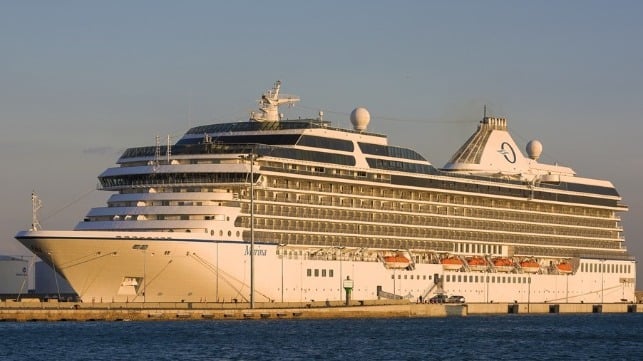
The next day we boarded a bus (er, "motor coach"), for the 90-minute ride to Southampton, the port on the English Channel that is England's main cruise port. Our vessel was the MS Marina, a 2011-build from Fincantieri with 1,200 passengers and almost as many crew, assuring impeccable service in a small-ship setting.
The passengers were mature, friendly and – surprisingly enough for a tour originating in England – mainly American. Most were affiliated with university alumni organizations or an outfit called Educational Opportunities (EO). We saw lots of people sporting EO lanyards as well as colorful mascots pasted on cabin doors featuring the Kansas State Wildcats, Minnesota Gophers, Oregon Ducks, Michigan State Spartans and Notre Dame Fighting Irish, among others.
Since we were traveling Concierge Class, our cabin was high up, on Deck 10, and we were greeted with a bottle of Prosecco and assorted delicacies, not to mention our ever-attentive butler, Dominic. We toured the ship, consumed the Prosecco, had an excellent dinner in the Grand Dining Room and retired for the night.
The itinerary took us east into the North Sea and then up the coast of England and Scotland to Edinburgh ("Ed-in-burra"), the first stop. Then farther north to the Orkney Islands (59° north latitude, the northernmost point of the cruise, not quite the Arctic Circle, which is 66.5°, but close enough). Then around the top of Scotland to the Hebrides (home of Harris Tweed and some fine single malts) and Glasgow (a last minute change from Dublin).
From Glasgow to Belfast in Northern Ireland, then across the Irish Sea to Liverpool, where we day-tripped to nearby Wales. From Liverpool to Cork (Cobh, pronounced "Cove"), from which many of my Irish forebears emigrated, then on to Torbay, a delightful seaside town on the English Riviera, and finally back to Southampton.
Ten days, eight ports, more than 2,500 miles and a lifetime of memories.
There was one glorious day on the North Sea when the sun was shining and it was in the mid-60s and people were sunbathing and swimming in the salt water pool on Deck 12 as if it were the middle of summer. And it was the middle of summer, except you don't often get days like that in the North Sea or anywhere in the British isles. Most of the time it was overcast and rainy.
But we didn't come for the weather (we live in Florida, where it's always sunny and warm). We came for the sights and sounds and experiences. And to get away.
We saw a lot of offshore wind farms, mainly in the North Sea but the Irish Sea as well. In fact, we saw more wind farms than we did oil platforms. A lot more. Maybe the oil platforms are farther out to sea, and cruise ships – especially small ones like ours – like to hug the coast.
In any event, wind farms are an impressive sight. Huge. Stately. Almost monumental. We got up close to one, and its size amazed me. Not just the size of the turbines and the blades, but the number of turbines. This particular wind farm had nearly 100, covering a vast area, and I was surprised we could sail so close to it. It's a sight I'll never forget.
Even more stately but less monumental were the monoliths at Kirkwall in the Orkney Islands. I had always thought there was only one Stonehenge, and there is only one Stonehenge, but there are many other "henges" (prehistoric monuments consisting of stone monoliths) scattered around the British Isles, and the ones in Orkney are famous.
The one we visited was the Ring of Brodgar. A UNESCO World Heritage site, it consists of 26 monoliths dating back to the Stone Age, standing in eerie silence on a windswept plain between two lochs. No one knows for sure, but it apparently was some sort of ceremonial meeting place, bordered by four large burial mounds. Nearby was another famous henge, the Stones of Stenness.
The joys of cruising
No account of a cruise on Oceania, which bills itself as having "The Finest Cuisine at Sea®," would be complete without mentioning the food. It is, without a doubt, exceptional, whether you're enjoying a simple hamburger or a gourmet dinner.
Perhaps the highlight was sea bass baked in pastry for two – loupe en croûte – which we shared in the French-themed specialty restaurant, Jacques. But there was also osso buco in Toscana, the Italian restaurant, and grilled lamb chops in the Terrace Café. In fact, being Irish, the grilled lamb chops became my "go to" favorite.
So it was 10 glorious days of discovery, making new friends and exploring new things, and enjoying the fine food and accommodations – all served on a silver platter without your having to do anything but show up.
Try it some time. You won't be disappointed.

that matters most
Get the latest maritime news delivered to your inbox daily.
Jack O'Connell is the magazine's senior editor.
Top image: Oceania's Marina (Christian Ferrer / CC BY 4.0)
,_S%C3%A8te_01.jpg)
The opinions expressed herein are the author's and not necessarily those of The Maritime Executive.