


Suez Canal Will Raise Surcharge Fees as It Still Looks to Increase Transits
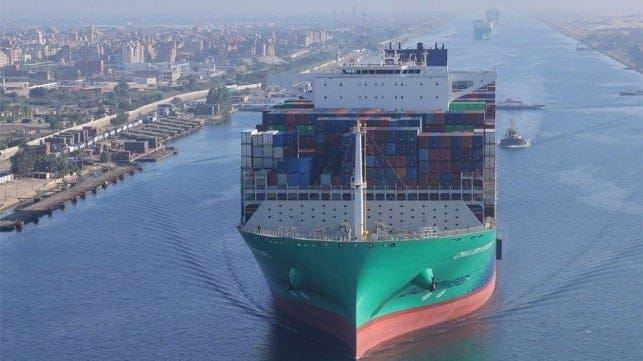
The Suez Canal Authority has posted its first wide-ranging rate increases in the form of revised surcharges for transits in three years. It comes, however, as the canal continues to pursue efforts to increase transits and new risks are emerging for shipping.
The circulars show that the surcharges applied on top of the base rates will be increased starting on July 15. The authority calls these surcharges temporary, but they will represent significant price increases for nearly all categories of ships. The only ships that are exempt from the new surcharges are passenger ships, which are one of the smallest categories using the canal.
The specific surcharge rate varies by the type of vessel, with the largest increase coming for crude oil and product tankers. Their surcharge will be increased from 25 percent of the base fees or 37 percent when they are laden and 27 percent when they travel only in ballast. LPG carriers will face a 32 percent surcharge, while dry bulk will be 22 percent, and containerships will incur a 12 percent surcharge.
The canal had implemented special provisions in the recent past, attempting to attract vessels to make the transit, specifically for all containerships, either carrying cargo or empty.
The Chairman of the Suez Canal Authority, Osama Rabie, commented during ceremonies for CMA CGM’s newest ship transiting the canal, that the canal had succeeded in recent times in elevating the level of maritime services provided as it sought to attract more vessels. He acknowledged that the geopolitical challenges in the region had imposed new realities on the maritime transport market and supply chains. However, they continue to emphasize the benefits of the shorter voyage and cost savings versus taking the Cape of Good Hope route.
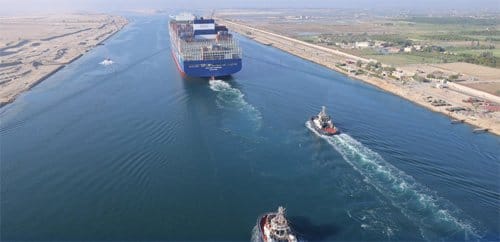
CMA CGM Vendome made its first transit and the first southbound transit for the company's 3 FAL route since January 2026 (SCA)
To emphasize the return of large containerships, the authority highlighted the first transit of the new CMA CGM ultra-large vessels, CMA CGM Vendome (220,553 dwt) vessel, completed in 2025 and registered in Singapore. The ship, which is 399 meters (1,309 feet) in length with a capacity for more than 24,000 TEU, made the transit on June 9. It was in the north convoy coming from France, bound for Asia.
The Suez Canal Authority reported it was the first southbound transit on CMA CGM’s 3 FAL route since January 2026. The French carrier has sent some of its large vessels through the Suez Canal, coming from Asia.
In total, CMA CGM made 104 transits of the Suez Canal in the first five months of 2026. The ships were carrying 12.5 million tons of cargo. CMA CGM is at the forefront, with major carriers avoiding the Suez Canal and Red Sea since the start of hostilities in the Persian Gulf.

that matters most
Get the latest maritime news delivered to your inbox daily.
Renewed concerns were raised on Monday, June 8, when the Houthis’ spokesperson threatened to widen the hostilities, saying that all Israeli ships are barred from transiting the Red Sea. In addition, the Houthis claimed to have launched a new salvo of missiles at Israel after Israel and Iran also launched missiles at each other.
The Red Sea has become a critical alternative for tankers seeking to load at Saudi Arabia’s western terminal as an alternative to the Persian Gulf. At the same time, some carriers are using the Suez Canal and running vessels to the Saudi ports as part of a land bridge to move cargo overland into the Gulf States.
