


Study: North American Ports are Getting Fewer Direct Connections
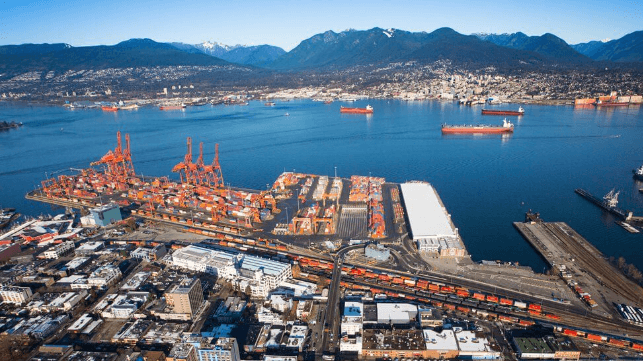
Ongoing shifts in global shipping network could be reducing Canadian ports’ connectivity, according to a recent analysis by the Bank of Canada. Based on datasets for ship movements between 2016 and 2023, it is apparent that Canadian ports have become less directly connected to global shipping networks, compared to ports in other countries. This has increased the chances that foreign supply disruptions- especially at distant hubs- impact Canada’s domestic markets and prices.
To map the decline, the central bank analysis calculated the degree centrality, which is an indicator of the number of unique destinations directly connected to a port. Low degree centrality means a port has few dedicated routes. The study found that the degree centrality of Canada’s top five ports declined considerably between 2016 and 2023. For instance, the weighted centrality for Port of Vancouver back in 2016 was 0.75 percent, but this fell to 0.16 percent in 2023. A similar trend is visible for Halifax, Montreal, New Westminster and St. John’s. For context, the degree centrality for Zhoushan in China, the world’s most connected port, was calculated at 2.9 percent in 2023.
The Bank of Canada explained that the decline in relative connectivity is not solely a Canadian issue but a North American phenomenon. In the U.S. as well, major ports saw their degree centrality decline during the period under review. In 2016, three ports in the US were among the top 10 most-connected ports in the world, but none remained in the top 10 by 2023. Meanwhile, eight of the 10 most-connected ports in 2023 were located in East Asia, up from 6 in 2016. These shifts are likely a reflection of growing trade between developing economies.
Further, the study examined changes in total deadweight tonnage, which could act as an indicator of the overall capacity of ships moving through Canadian ports. The deadweight tonnage of all vessels that departed or arrived at Canadian ports fell from 167 million tonnes in 2016 to 119 million tonnes in 2023 - a decline of 28 percent of maritime trade capacity. Just like the decline in relative connectivity, the drop in capacity is also a broader North American issue.
Taking these factors together, the study concluded that there is a substantive shift in the concentration of shipping services and capacity - away from North America and towards Asia and other growing maritime hubs.

that matters most
Get the latest maritime news delivered to your inbox daily.
Prime Minister Mark Carney also noted falling productivity at Canadian ports at an event in Vancouver last week. “We have fallen way behind in terms of the productivity of our ports and our trade corridors as a whole,” said Carney. “The time it takes from a good showing up just off the coast to landing in central Canada or the U.S is measured in weeks, not days.”
Carney pledged to address these challenges in a comprehensive way as his government rolls out massive investments to the port sector. Early this year, the Canadian government announced $3.6 billion in financing for port authorities to expand trade corridors. In addition, the government is also supporting Port of Montreal with $1.7 billion for expansion, which is expected to increase container handling capacity by 60 percent.
