


South Korea Formulates Plans for Trial Arctic Voyage with Containership
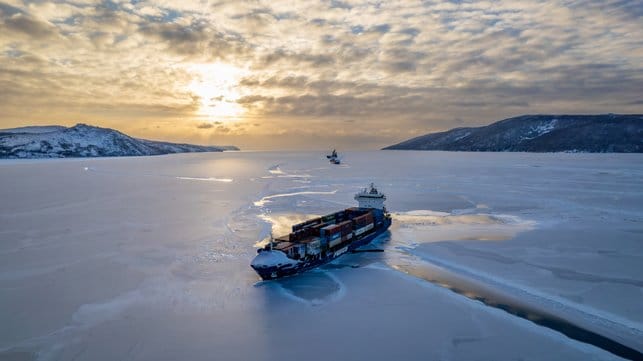
South Korea is pushing forward with its plans to become the first Western-aligned country to launch regular trans-Arctic shipping. The government has set a priority on developing operations to take advantage of Russia’s Northern Sea Route as it looks to increase South Korea’s global trade.
The president of South Korea, Lee Jae-myung, has described the importance of building the country’s economic ties and looks to the Northern Sea Route as a critical advantage. South Korea looks to rival China, which has already launched seasonal service along the route and looks to expand operations in the coming year.
After President Lee announced the government’s support for developing Arctic shipping, the Ministry of Oceans and Fisheries was tasked with developing the plan. The acting Minister, Kim Sung-bum, outlined the plans during a press briefing in Busan on January 5. He detailed how the government looks to take the concept into a development program with the support of the ministry.
He announced that South Korea is targeting a trial voyage for around September. He said the timing was critical to crossing the Arctic during the height of the summer season, when it is most likely to be ice-free or have minimal ice conditions.
The government plans to launch a tender for a 5,000 YEU-class vessel to make the trial voyage this year. Selecting the vessel is the first step, as it will require discussions about financial incentives, a detailed exploration of the costs, and reaching agreements with Russia, which controls permitting for the passages on the NSR.
This will be South Korea’s first containership voyage crossing the Arctic. The plan calls for the vessel to make the trip from Busan to Rotterdam. The government notes it will reduce the mileage required by approximately 35 percent (13,000 km vs 20,000 km) and reduce the transit time by a third from 30 to 20 days. In the past, South Korea has made a partial Arctic transit, having sent five bulkers between Busan and Russia’s Yamal Peninsula on the Kara Sea. This will also be the first complete transit by a South Korean vessel along the NSR.
Acting Minister Kim acknowledged a number of challenges in developing the plan for the trial voyage. He hopes to begin talks with the Russians as soon as a vessel is selected. He, however, acknowledges that South Korea’s participation in the Western sanctions against Russia could be a hurdle to the plan.
The government also plans incentives for shippers and the operators of the vessel. Kim said they recognize that the vessel will encounter higher insurance costs, which the Ministry estimates at as much as $435,000. It plans to discuss financial incentives while saying profitability for the service would be achieved once they have established economies of scale.

that matters most
Get the latest maritime news delivered to your inbox daily.
The Centre for High North Logistics (CHNL) in December released an analysis of traffic on the NSR in 2025 based on data from Rosatom. It concluded that between June and November, there were 103 transits by 88 vessels with the total cargo volume reaching 3.2 million tons. It said the number of voyages was up more than six percent over 2024. Bulk carriers, it said, were a key contributor to growth on the route, although containerships also showed notable growth, said CHNL, with four additional voyages to a total of 15 this season.
China views the route as a key advantage. In 2025, Sea Legend Shipping made what it called a record voyage in just over 20 days using a non-polar containership. Sea Legend is reportedly planning to operate regular summer voyages along the route by 2026.
