


Russia's Shadowy Oil Export Network Shows Signs of Central Coordination
It is well understood that Russia uses a complex network of oil traders and "shadow fleet" shipping companies to evade restrictions and maintain exports of oil and gas. This network has disappeared further underground since sanctions were imposed on Rosneft and Lukoil, the two biggest Russian producers, in October last year. It has been an assumption that while coordinated by the Russian state, which owns most of the oil being exported, the constantly changing cast of companies involves a large number of independent entrepreneurs. An in-depth investigation by the Financial Times has discovered that far from being independent, the network of oil traders and shadow fleet shipping companies furthering the trade use a common architecture, with the bulk of the supposedly independent firms in fact utilizing the same IT infrastructure.
By way of background, in July 2025 Moscow’s Higher School of Economics began offering a Masters academic course in sanctions evasion, equipping students with the skills to "identify and assess the risks of sanctions and other measures imposed by supervisory authorities on companies", with 18 of the 20 student places reserved for Russians. This suggests that the Russians have an organizational concept for sanctions evasion.
The Financial Times investigators estimated that more than 80 percent of Russian crude produced for export by Rosneft was being exported through a single coordinated network of commodity brokers, a surprisingly high dependency on what could easily become a single point of failure.
The investigation based its conclusions on an analysis of names and addresses of known middlemen broker companies, some of them sanctioned, which found that these entities used a single private server “mx.phoenixtrading.ltd” for their email, showing that they had a common IT infrastructure and by implication shared back-office functions. When all 448 domains using the private server were identified, 48 were clearly identified as Russian-associated oil traders, and that these alone accounted for 80 percent of Russian crude produced for export by Rosneft. The investigation did not confirm but found strong indications that many of the remaining domains are associated with the other side of the business, namely the ownership and management of Russia-facing shadow fleet tankers. This deduction is based on the middlemen's propensity to charter tankers formerly associated with Russian state oil major Rosneft – a fleet now transferred to anonymous ownership vehicles in order to evade sanctions.
Within the network, there are constant changes in the names of companies involved. The time lag between a company’s date of registration and the time the detail appears on public company registers is exploited – so that by the time involvement in sanctions-breaking is identified, the broking company may once again have moved on and changed its name. Names are often chosen which can easily be confused with those of legitimate companies. Having a common infrastructure and administrative set-up of course makes it easy for companies to be created, dissolved and renamed at speed to keep ahead of sanctions investigators.
The investigation identified that the single largest exporter of Russian crude in the network is Redwood Global Supply FZ LLC, a company registered in Ras al Khaimah and sanctioned by the UK in December 2025. The rise in Redwood activities matches the decline of Lukoil and Rosneft exports, coincident with the imposition of sanctions. Oil is brought into the system by Redwood, then distributed amongst one set of purchasing brokers, and then sold on to another set of brokers for delivery. As oil is bought, transferred and sold within the network, specific oil source descriptors are replaced with generic descriptors, hiding the origin.
The Financial Times investigation had no conclusive evidence as to who controlled this middleman network with common traits, which it tentatively identified with the descriptor Coral Energy. It does however identify two linked Azeri businessmen as having central roles in the wider Coral Energy enterprise: Tahir Garayev, who is sanctioned by the UK, and EU-sanctioned Etibar Eyyub, a close associate of Igor Sechin, CEO of Rosneft. An Azeri mafia of racketeers is very active in Russian business dealings - a frequent source of conflict between the Russian and Azerbaijani governments.
How the Coral Energy organizational structure is linked back to Russian state control is not absolutely clear, but the Coral Energy network is clearly earning huge brokerage fees through this sanctions-avoidance scheme, and no doubt feeding funds to members of the Russian oligarchy. A continued flow of such corrupt payments is a powerful incentive for President Vladimir Putin’s associates to prolong the war in Ukraine.
Given that many of the entities identified by the Financial Times are already sanctioned, authorities are clearly aware of some - but not all - components of the network and how it works. But sanctions listings and EU sanctions packages take time to promulgate. Even then, the enforcement mechanisms lags far behind the designation procedures.
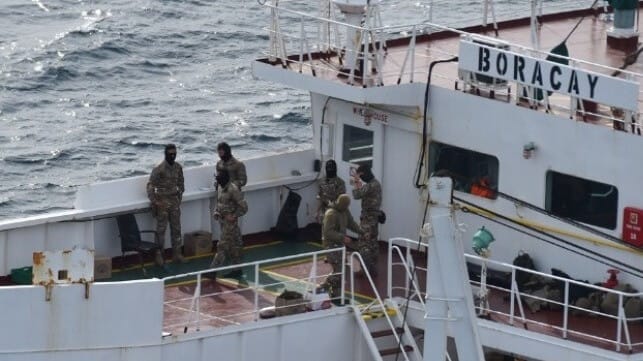
In any case, it is reasonable to attribute some of the dramatic fall recorded in Russian oil export volumes in recent months not just to additional sanctions listings, but to the U.S. political warnings to importing countries such as India. Ukrainian overt and covert attacks on Russian dark fleet operations and infrastructure and the physical interception of dark fleet tankers at sea have played a part. Some nations have stepped up interceptions, based on registration issues or safety and labor concerns. Others however are content to allow the dark fleet unimpeded access through their territorial waters, and overlook transshipments at sea.
Still, while Kpler estimates that Russian oil exports have fallen from 3.8 million bpd in December and are now running this month at 2.8 million bpd, more could clearly be done by leading allies of Ukraine – and more action could have a decisive effect on Russia’s ability to keep on fighting.
One issue is raised in particular by the Financial Times investigation. It identifies Redwood - based in Ras al Khaimah, formerly known as the Pirate Coast - as the export clearing house. Corroborated by collateral record searches, it also identifies a large number of UAE oil traders and brokers who then take the import-export process forward.
Alongside these brokers are also a substantial number of ship managers and owners based in the UAE, organizing ship-to-ship transfers and sending cargos to their ultimate destinations, primarily in China and up until recently in India. The UAE appears therefore to be acting as an open market place, and the co-location of so many of the components of the trade probably means that many of the arrangements can be made face-to-face without leaving an electronic paper trail.

that matters most
Get the latest maritime news delivered to your inbox daily.
Some of the network of brokers and dealers in the UAE make little attempt to hide their activities. For example, Atlantic Jiu Yu FZE, commercially registered in the Ajman Free Zone, openly advertises that it is a supplier of Russian oil to India.
Nonetheless, Western authorities - and individuals living in the UAE worried about maintaining their residency - have been reluctant to criticize the UAE for acting a safe haven for Russian sanctions evasion, for fear of upsetting the UAE authorities and their sovereign investment funds. But given the profits being made, this activity is spreading and unlikely to be ignored forever, risking the UAE’s return to the Financial Action Task Force (FATF) Grey List, from which it was only released in February 2024. Were this to happen, significant additional due diligence procedures and financial restrictions would be reimposed on the UAE’s substantial and growing maritime community, and not necessarily restricted to the tanker sector. This is not a theoretical risk: Kuwait was added to the Grey List only last month after the FATF determined that it lacked adequate controls to combat money laundering and terrorist financing.
