


Report: U.S. Navy is Feeling Out Ship Construction Options in Turkey
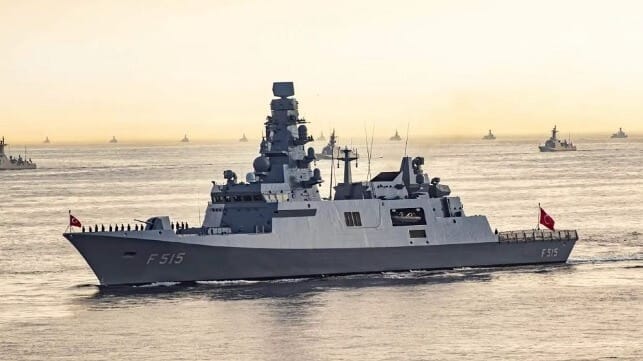
Momentum appears to be building within some corners of the Trump administration to offshore U.S. Navy warship production to yards in U.S. allied nations, where well-developed shipbuilding industries with available capacity can be found. It would require changing U.S. law and longstanding practice, but this has not deterred proponents: South Korea's "Big Three" have openly sought the administration's support for building American warships in Korea, and U.S. officials have recently met with Turkish counterparts to discuss component and frigate construction in Turkey, insiders told Mideast Eye.
"The US shipbuilding industry is in a real crisis, and the Trump administration has talked with Turkey about meeting its needs [for shipbuilding]," an American official told Mideast Eye.
All observers acknowledge that the problem is serious: every U.S. Navy shipbuilding program is behind schedule (as of 2025), according to the Secretary of the Navy, and the Constellation-class frigate was recently scaled back to two hulls over delays and cost overruns. The president himself has acknowledged that "we might have to" begin ordering warships from allied nations in order to make up a domestic capability gap.
In Turkey, the U.S. Navy would have a strong technical partner. Turkish yards are skilled in distributed shipbuilding, series production and short delivery timetables, and they have built export hulls for customers around the world (as well as Turkey's own navy). These experienced builders could ship out blocks and subassemblies for incorporation into American yards' workflows; deliver partially-complete floating hulls; or accept contracts for fully completed vessels.
"The US lacks sufficient manpower, shipyards and dry docks," Turkish defense commentator Kubilay Yildirim told Mideast Eye. "Turkey can help in terms of production volume, timelines, risk sharing and workload distribution."

that matters most
Get the latest maritime news delivered to your inbox daily.
There are limitations, however. Turkey has cordial relations and certain limited defense contracting ties with Russia. Ankara is still under U.S. sanctions for the purchase of Russian S-400 antiaircraft systems, and it was removed from the F-35 fighter program for this reason during the first Trump administration. Efforts to unwind those sanctions are currently under way.
The second potential speed bump - whether for construction in Turkey or in South Korea - would be the Byrnes-Tollefson Amendment, 10 USC Section 8679, which prohibits construction of U.S. naval vessels and major components in foreign shipyards. The law could be changed, but it would require congressional action to legalize the contract and appropriate funds for a foreign purchase.
