


Report: Germany Refused Baltic Passage to Sanctioned “Zombie" Tanker
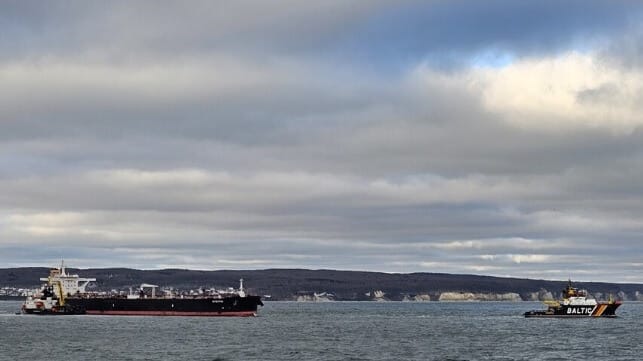
The German Federal Police are reported to be increasing their enforcement efforts on shipping attempting to enter the country’s territorial waters in the Baltic. In an investigation reported by the German media outlets NDR, WDR, and Süddeutsche Zeitung, they highlight that German forces last weekend turned away a “zombie” tanker that presented false papers, and it was preceded by a similar enforcement effort in December.
According to the investigation, the situation began early on January 10 when a suspect tanker displaying the name Tavian and a false IMO number entered German waters near the northernmost state of Schleswig-Holstein, near the base of the peninsula with Denmark. The ship appears to have been on the western side, still in the North Sea, when the first contact was made.
Tracking shows a Federal Police helicopter approached the tanker, and the report says the Germans demanded the vessel’s documents and proof of insurance.
As the tanker rounded Denmark and was moving toward the Baltic, the German forces reportedly again confronted the tanker. It was near the border town of Flensburg. According to the media reports, the German Federal Police told the tanker it was denied entry into German waters. The tanker reportedly held position as the media speculates the captain feared the ship would be impounded. Sunday evening, the tanker turned away from the Baltic.
The media report states that the Federal Police had confirmed the ship was presenting a false identity and IMO identification number. The tanker is listed in the Equasis database as the Arcusat (IMO: 9147447). It had previously, in 2024, identified as Tavian, claiming a flag in Guyana, which is listed as false, as well as using the name Tia. It has had 11 names since 2013 and seven flags, including Tanzania, Russia, Panama, Liberia, and the Marshall Islands. The vessel’s AIS appears to turned off for an extended period of time. It was sanctioned by the United States in 2021 for its operations with Venezuelan oil while it was using the name Sierra.
The same investigation says the Federal Police and the German Navy responded to another suspicious product tanker in December. On December 5, they report the tanker Chariot Tide (52,648 dwt) notified the authorities that it was experiencing mechanical problems and dropping anchor in the Baltic.
They report that the frigate Baden-Wurttemberg and the Federal Police vessel Potsdam quickly responded because the tanker was within a few miles of critical undersea cables. The police boarded and inspected the vessel, and according to the stories, the authorities believed the ship was also presenting a false registry. It initially claimed a flag in Guyana, but the following days changed and said it was registered in Mozambique.
NDR, WDR, and Süddeutsche Zeitung report that the Federal Police confirmed the incident with the Chariot Tide. Asked about the Tavian incident last weekend, the police responded that it was an “ongoing operational procedure.”

that matters most
Get the latest maritime news delivered to your inbox daily.
The media reports said the Federal Police remain on increased alert to protect critical subsea infrastructure. They write that in recent months, Germany has also prohibited the Russian research vessel Akademik Boris Petrov from entering German territorial waters. The vessel has been in service since 1984, and last fall the Russian Academy of Sciences reported the ship departing from the Port of Murmansk for a research expedition in the Barents Sea and the North Atlantic.
Germany’s Foreign Minister, Dr. Johann Wadephul, had announced that as of July 1, 2025, its forces would begin immediately inspection passing tankers regarding their insurance coverage to protect against oil pollution. Germany’s Transport Minister had declared, “We must increase our vigilance in the Baltic Sea regarding the shadow fleet.” Germany, in January 2025, Germany detained a shadow fleet tanker, Eventin, and that resulted in a legal battle in the courts for control of the ship.
