


Are Naval Forces Ready to Keep the Bab el Mandeb Open?
The Houthis' leaders have made their position clear. They stand alongside Iran and the Palestinians, and have demonstrated the Houthi ideological position by launching two drone and four missile attacks against Israel up until April 4, all successfully intercepted without causing any damage. The Houthis appear set on continuing these nuisance attacks designed to express solidarity, which in all likelihood will continue until the war against Iran comes to a conclusion. Alternatively, when the inevitable Israeli retaliation hits the Houthis, they may be tempted to try and increase the scale of their attacks.
In the meantime, the Houthis have advertised they are ready to resume attacks on shipping in the Red Sea and Gulf of Aden, at a time of the Houthi leadership’s own choosing, factoring in (but not determined by) appeals from Iran for support or by the clamor of popular sentiment.
If the Houthi leadership does decide to resume the attacks, then the impact on global energy supplies will be potentially even greater than the impact of the closure of the Strait of Hormuz – because the estimated five million barrels per day-plus of Saudi crude being shipped south from Yanbu through the Bab el Mandeb would cut into the bare minimum needed to keep critical services in Asia functioning.
So how would the world react to a resumption of Houthi attacks against shipping?
Unlike in the Strait of Hormuz, it has already been demonstrated that with a sufficiently strong naval presence, merchant shipping can get through the danger area, albeit admittedly with some casualties.
The threat, if it emerged, would no longer be one that Saudi Arabia could ignore, as it would compromise the Kingdom’s last open shipping route. This certainty would be one reason why the Houthis might not resume their attacks, because it would not only bring the Saudi Western Fleet into action, it would threaten the general ceasefire between the Houthis and Saudis which has been in place since March 2022. Since then, the Saudi Western Fleet has also been considerably strengthened with the addition of five Avante Class corvettes ordered by Royal Saudi Navy in 2018. These modern corvettes are each equipped with 64 Evolved Sea Sparrow Missile (ESSM) medium-range, surface-to-air missiles for engaging anti-ship cruise missiles and drones. Any Saudi involvement would also likely bring with it as well the Egyptian Navy, with whom the Saudis have had a very active bilateral naval support agreement since September 2025.
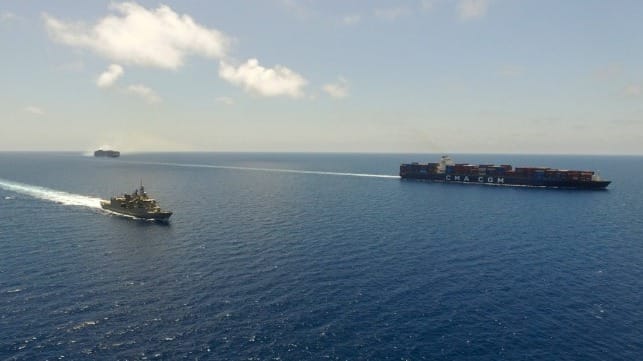
Already in place, patrolling the danger area from a base in Djibouti, are ships of the European Union’s Operation Aspides. Operation Aspides already has a mandate until February 2027 to intervene should there be a threat to civilian shipping, removing the lack-of-political-cover issue which often delays EU deployments. Currently the force is commanded by Rear Admiral Vasileios Gryparis from Greece, with tactical command afloat exercised by Italian Rear Admiral Milos Argenton from the Carlo Bergamini Class frigate Luigi Rizzo (F595).
As well as the Greek MECO 2000 Class frigate HS Hydra (F542), there are also probably two French vessels in the force, their identities as is normal not disclosed by the French, and the force is likely to also be able to call upon the Spanish Air Force CN-235 maritime patrol aircraft normally based in Djibouti. This experienced force could probably be quickly reinforced by the large numbers of European naval vessels defending the Republic of Cyprus, as only the British Sovereign Base Area in Cyprus has been threatened by Iran, rather than the Republic itself.
Asian navies might also be keen to join in, as a closure of the Bab el Mandeb would have direct and significant economic impact on Asian countries heavily dependent on Middle Eastern crude.

that matters most
Get the latest maritime news delivered to your inbox daily.
Although the United States Central Command would wish to assist in an operation to keep the Bab el Mandeb open, the mission to do so is formally allocated to Destroyer Squadron 50; DESRON 50 is heavily engaged elsewhere and might not have the resources to join in. Without DESRON 50 in the force, there would be a deficit both of tactical and overhead intelligence resources, but also of command and control capability.
Unlike for any potential operation in the Strait of Hormuz, there is a large enough potential naval force available to help keep the Red Sea and Gulf of Aden open to the merchant marine. The principal problem is that from a force command perspective, the Americans are unlikely to have the bandwidth to provide some key functionality. This deficit can probably be overcome, but only if someone is currently stepping up and working out how the leadership and coordination role is to be filled – because the requirement to act, in what would be a very complex air defense environment, could come soon and at very short notice.
