
Positive Steps
(Article originally published in Sept/Oct 2025 edition.)
Container cargo exporters and importers need to have their heads on a swivel when looking back at what happened in the first six months of 2025 and looking forward to the rest of the year. Uncertainty over cargo volumes in upcoming months is widespread as the issues of trade, tariffs and a return to normalcy in trade lanes like the Red Sea keep industry analysts vigilant. But despite some unpredictability in the future direction of global trade, container ports continue to move forward with positive steps.
STEADY GROWTH
The Port of Prince Rupert, British Columbia, for example – Canada's third largest port – saw container volumes grow 13 percent year-to-date with notable double-digit gains made at DP World's Fairview Terminal. "In anticipation of tariffs," explains Katherine Bamford, the port's Vice President for Business Development, "many shippers in North America have been trying to mitigate the additional cost burden by expediting shipments of goods from Asia, which has contributed to these increases." The port has three major expansion projects underway.
The CANXPORT project, a large-scale transloading and logistics facility, will offer annual throughput of 400,000 TEUs (twenty-foot equivalent units) for a variety of agricultural, forestry and resin products. The facility will be operated by Ray-Mont Logistics and is scheduled for completion late next year.
Work is also underway on the South Kaien Logistics Park, a joint venture between the Prince Rupert Port Authority (PRPA) and Metlakatla Development Corporation. The anchor tenant will be LinX, a cutting-edge import transload and logistics facility operated by IntermodeX that will connect Asian markets with key North American distribution hubs. The project will provide 150,000 TEUs of annual capacity.
To support future increases in container and bulk-liquid volumes for the new Ridley Island Energy Export Facility, the Canadian National Railway is investing in the Zanardi Rapids Bridge expansion project, designed to expand capacity along a critical port rail link.
With its focus on improving the environment, the PRPA is leading numerous initiatives in reducing the environmental impact of port activities with the goal of becoming carbon neutral by 2050.
In 2024, it launched a renewable diesel initiative to transition port partners away from petroleum diesel to a low-emissions alternative. In the first year, 13 partners took part including DP World's Fairview Terminal, consuming 1.2 million liters of the renewable, drop-in fuel in products ranging from on-dock equipment to locomotives, tugs and trucks.
Prince Rupert is also serving as a testing ground for zero and low-emissions heavy-duty trucks.
MINIMAL TARIFF IMPACT
The Port of Baltimore has not seen any large cargo impacts due to tariffs, says Richard Scher, Director of Communications at the Maryland Port Administration (MPA). Scher says Baltimore is "currently up, year-over-year, for all of the key commodities we handle at the public terminals, including being up 95 percent for containers where we had a record month in April and near-record month in May. Some of our cargoes, like containers and cars, are even up over our 2023 record year."
Meanwhile, Baltimore is moving closer to completion of the CSX Howard Street Tunnel project, which Scher says "is a game-changer for the port as it will increase our business by 160,000 containers annually and create more than 13,000 jobs." To be completed in the spring of 2026, the project will make improvements to allow for double-stacked containers. The port has been using a temporary route for double-stacking.
Work also continues on the planning and rebuild of the Francis Scott Key Bridge, which collapsed in March 2024. The multibillion project is expected to be completed in October of 2028.
On the "green" side of Baltimore, Ports America Chesapeake is using electric ship-to-shore and rubber-tire gantry cranes at its Seagirt Terminal. In addition, the MPA and six partnering companies have applied for $147 million in funding from the EPA to support the procurement of 213 zero-emission vehicles and equipment to improve air quality at the port and surrounding communities.
CONTINUED OPTIMISM
Florida's Port Everglades remains optimistic about the rest of the year. "Our cargo customers' container business continues to show strong growth through July 2025," says CEO and Port Director Joseph Morris. "Based on our fiscal year-to-date results (October 2024 to July 2025), we are up nine percent compared to the same time last year. Barring unforeseen circumstances, we anticipate sustaining this growth for the remainder of the year."
The majority of the port's cargo trade is connected to Latin America and the Caribbean. "Our trade with China accounts for less than two percent of overall volume," Morris adds, "which offers some insulation from the immediate effects of China-specific tariffs."
In keeping with its growth, Everglades can now accommodate more and larger container ships with the expansion of berth capacity at the Southport Turning Notch to five. As part of its $471 million-plus expansion project, the port added six super post-Panamax gantry cranes and is currently upgrading seven others.
Perishable cargo demand at the port has remained steady. Volumes in fiscal year 2024 (Oct. 1, 2023 to Sept. 30, 2024) exceeded 130,000 TEUs, placing Port Everglades as Florida's #1 port for perishables and #8 in the nation.
MINIMAL CHINA BUSINESS
The Port of San Diego, with its diverse maritime business at the Tenth Avenue Marine Terminal (TAMT) and National City Marine Terminal (NCMT), has less than five percent of its business tied to China. "We receive minimal container cargo at our terminals," notes Chief Operations Officer Mike LaFleur. "At this juncture of the various tariffs that have been placed on goods coming from several countries, the Port of San Diego is not experiencing a decrease in business."
In coming years, he adds, "We're looking to increase our container business across more international markets. With the increased lifting capacity of our new electric mobile harbor cranes, we're working to recruit a monthly or twice-monthly container service to focus on Japan and Southeast Asia."
The port's container cargo continues to be mainly refrigerated products including bananas, seasonal fruits, perishables and seafood through its imports and exports with Latin America and its regular refrigerated container service with Dole Fresh Fruit.
In recent times, San Diego has received a number of grants to support infrastructure projects.
At NCMT, it's working with the Oregon Shipping Group, the Port of Bellingham and Caltrans to open a new coastal shipping corridor known as the West Coast M-5 Coastal Connector, which will allow barge transportation for building materials, containers and general cargo on the north-south route.
At TAMT, it's moving forward with zero-emissions initiatives including work on both cargo terminals as well as a proposed zero-emissions truck stop and electrical system upgrades, which involve enhancements to the supporting substation infrastructure. The funding is also supporting the purchase and deployment of additional battery-electric, zero-emissions equipment, vehicles and charging infrastructure.
ONGOING IMPROVEMENTS
Container volume throughput from January through June 2025 at Port Tampa Bay was comparable to the same period in 2024 although July and August throughput was considerably up compared to the same period a year ago, says Greg Lovelace, Senior Vice President for Marketing and Business Development. However, he notes, "It's too early and difficult to predict the remainder of the year given the uncertainty in the market."
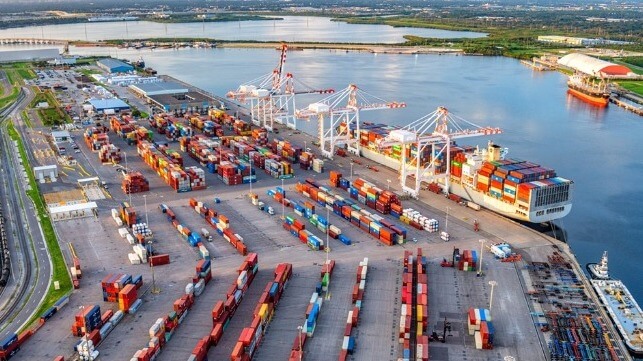
Tampa Bay continues to invest in its container infrastructure. In collaboration with terminal operator Ports America, recent enhancements include a new expanded gate complex, five post-Panamax gantry cranes and the recent purchase of two additional cranes, 100 acres of container storage and a berth extension from 3,200 to 4,500 linear feet.
"The state of Florida strongly supports its ports and Tampa Bay offers the best, long-term growth potential due to its available land and strategic location," Lovelace points out. "A major milestone was the approval of our deep-draft channel project, which will deepen our port from 43 to 47 feet."
Like several Florida ports, refrigerated cargo is an important part of the business. Port Logistics Refrigerated Services operates a 135,000-square foot, on-dock cold storage facility at Port Tampa Bay.
"Over the past year," Lovelace adds, "refrigerated container cargo shipments handled at this specialized facility have increased by 30 percent. This can be attributed to weekly connections from Guatemala and Honduras by Dole and weekly connections from Costa Rica by Seacat Line."
The opinions expressed herein are the author's and not necessarily those of The Maritime Executive.