


Pioneering Cruise Ship Retires as Japan Looks to Grow Market
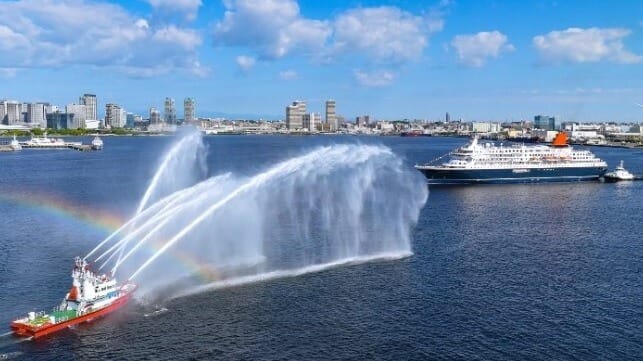
Japan’s domestic cruise market is poised for strong growth, in part thanks to the path pioneered by Mitsui O.S.K. Line’s (MOL) Nippon Maru as one of the country’s first modern dedicated cruise ships. After 35 years of service, Nippon Maru completed her final cruise on May 10, but she and several other early Japanese cruise ships established a path for the future of the industry.
The Nippon Maru started construction in October 1989 at Mitsubishi Heavy Industries’ Kobe–Osaka shipyard and was launched in March 1990 as one of the three modern cruise ships, along with the slightly older Fuji Maru (entered service in April 1989), also for MOL, and NYK’s Asuka (entered service in December 1991). Together, they were the first modern, newly built cruise ships for the domestic Japanese cruise market.
At 22,472 gross tons, Nippon Maru was a small cruise ship (547 feet / 167 meters in length) with accommodations for just 422 passengers. She entered service on September 27, 1990, sailing from Kobe, Japan, to Keelung, Taiwan, and Hong Kong, and over the years developed a reputation for Japanese hospitality and fine food and service that endeared her to the market.
MOL highlights that she played a defining role in shaping Japan’s modern leisure cruise industry, including becoming the first to transit the Panama Canal and offering the first Japanese cruise to the Baltic in 2001, and the first modern around-the-world cruise for a Japanese cruise ship. She would ultimately make nine world cruises in her career. She also operated a 62-day cruise that included the Caribbean, Hawaii, and Alaska, and more recently, a 48-day cruise from Japan to Mauritius.
The Nippon Maru outlived her peers. The Fuji Maru was retired in 2013, while the Asuka was sold in 2006 and replaced with a larger ship. She would get extensive overhauls, including increasing her passenger capacity, at the 20- and 30-year marks. By the time MOL Cruises announced in 2025 her planned retirement, it was reported that she had sailed over 2,000 cruises, taking her nearly three million nautical miles with more than 600,000 passengers and visiting over 400 ports. She docked for the last time on May 10 at Yokohama, and the company held a commemorative retirement ceremony.
“Nippon Maru has been much more than a cruise ship — it has been a symbol of connection, discovery, and heartfelt hospitality for generations of guests,” said Tsunemichi Mukai, president of Mitsui Ocean Cruises, during the retirement ceremony. “We are deeply grateful to the guests, crew members, port communities, and partners who supported Nippon Maru throughout this extraordinary 35-year journey.”
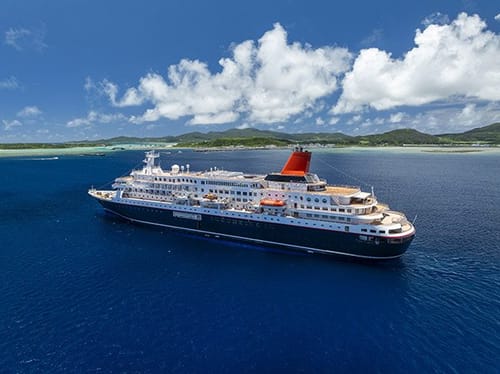
Nippon Maru pioneered with long cruises as well as trips around Japan (MOL)
MOL’s New Cruise Venture
Indeed, the success of Nippon Maru inspired the board of MOL, a company much better known for its bulkers and containerships, to decide in 2022 to pursue expansion of the cruise business as part of a diversification strategy. It initially planned to invest more than $700 million to build two 35,000 gross ton cruise ships, but instead, in March 2023, it acquired the 32,000 gross ton Seaboun Odyssey (built in 2009) from Carnival Corporation’s Seabourn Cruise Line.
Launched in December 2024 as Mitsui Ocean Fuji, she started the company’s expansion in cruising. Her initial success, MOL said, encouraged them to return to Carnival Corporation and, in March 2025, made a strong cash offer to buy the sister ship Seabourn Sojourn (built in 2010). The second cruise ship is being delivered to MOL this month and will enter service in September as Mitsui Ocean Sakura.
“Japan has not enjoyed the huge growth of the international market,” noted Anthony Kaufman, Head of Commercial Strategies at Mitsui Ocean Cruises, during a panel discussion on Asia at Seatrade Cruise Global. While admitting there are barriers to entry and old stereotypes in the Japanese cruise market, he also highlights that the demographic is a “huge opportunity” and that Japan has many benefits with its destinations.
MOL’s new cruise operation, Mitsui Ocean Cruises, is raising the bar with a new level of luxury while offering mostly shorter cruises in and around Japan. NYK has also expanded its cruise operations, launching in 2025 its newly built Asuka III (52,265 gross tons) while keeping the 1990-built Asuka II (50,000 gross tons) also in the market.
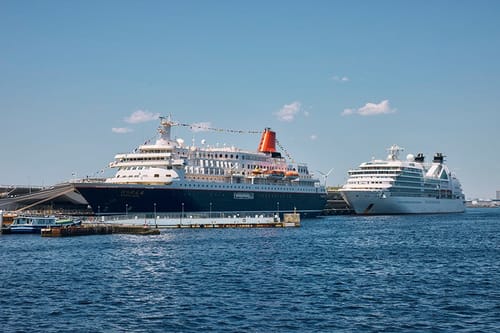
Passing of the generations as Mitsui Ocean Cruises replaces Nippon Maru with two ships acquired from Seabourn Cruise Line (Mitsui Ocean Cruises)
Growth Outlook for Japan
The lines are expanding as they see the opportunity to develop Japan’s still nascent domestic cruise market. While Japan is a popular tourist destination, setting a record in the first half of 2025 with 21.5 million visitors (up from 17.8 million in 2024), according to the Japan National Tourist Organization, cruising remains only a small part of the country’s current tourist industry.
For all of 2025, Japan had just 1.8 million cruise visitors, and they were mostly international tourists during port calls on cruises. The domestic market was just 76,000 passengers, with another 167,000 Japanese passengers sailing on international cruises. Japan ranks twelfth as an international source market for cruising, according to data from the industry trade group CLIA (Cruise Lines International Association), yet the industry notes that domestic passengers were up 25 percent year-on-year in 2025.
The Ministry of Land, Infrastructure, Transport and Tourism of Japan announced in 2025 an ambitious goal to grow the domestic Japanese cruise market to one million passengers by 2030. While the domestic industry’s record was 356,000 passengers in 2019, the year before the pandemic, the Ministry notes that Japanese cruise travelers account for 0.03 percent of total Japanese tourists. It wants to work with the industry to grow the business.
“Many people in Japan have never experienced cruising, and its appeal is not yet fully known. We want to make this wonderful experience more accessible and familiar as a way to enjoy leisure in Japan,” says Ryotaro Shiiba, who is heading the newly launched Oriental Land Cruises, which in turn has a licensing agreement and will start Disney Cruise Line Japan.
Oriental Land, which has operated what is today the Tokyo Disney Resort for more than 40 years, looks to expand Japan’s cruise market for family vacations and entertainment to the broader market. It has ordered an adapted design of Disney Cruise Line’s Wish class cruise ship (about 140,000 gross tons) with accommodations for about 4,000 passengers. It plans to launch year-round cruises from Tokyo in its FY 28 (ends March 2029), and the company is already planning additional cruise ships.

that matters most
Get the latest maritime news delivered to your inbox daily.
Mitsui Ocean Cruises is developing the luxury cruise segment with its two ships, which are all-suite with accommodations for 458 passengers, while saying “newbuilds remain a distinct possibility” as it considers more options to grow. At the same time, Japan’s Ryobi Holdings, a diversified business with operations in tourism and transport, is building the first ultra-luxury 120-passenger yacht cruise ship for the Japanese market. It plans to introduce the ship called Sefu in the summer of 2027.
Having started with a few small cruise ships and lagging behind the global market, the Nippon Maru, however, led the way for the domestic market. Her legacy is a market that is expected to grow significantly over the next few years.
