


Pentagon: China Plans to Build Nine Aircraft Carriers
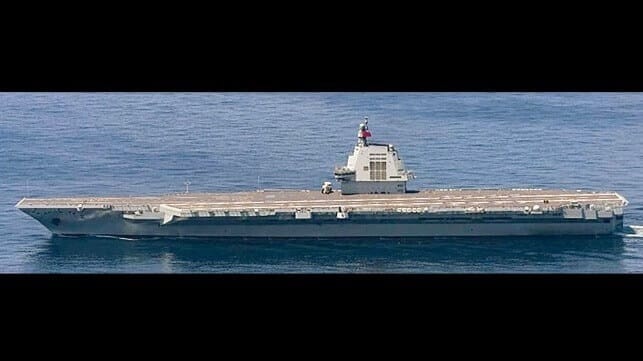
China's naval aspirations are more ambitious than previously understood, according to the Pentagon's annual assessment of the People's Liberation Army. The Chinese PLA Navy is already the largest naval force in the world by vessel count, and modernizing at breakneck speed - but this is not enough, according to the report. China plans to expand its carrier force to a total of nine vessels by 2035, enough to compete for sea control in the Western Pacific.
China's carrier technology has evolved rapidly since it finished and relaunched an ex-Soviet hull - the Liaoning - in 2012. It built its own adapted copy, the Shandong, in 2019. The third-generation design, Fujian, skipped over steam-catapult technology and jumped to high-tech electromagnetic launch and recovery. Though its powerplant is diesel-fueled rather than nuclear, Fujian is in all respects a modern CATOBAR carrier. Future Chinese carriers could incorporate nuclear power, potentially as early as the next hull, which is currently under construction at Dalian Shipyard.
Each additional carrier that the PLA Navy operates will have an outsize effect on the balance of power in the Western Pacific. Excepting the naval shipyard at Yokosuka and the harbor at Guam, U.S. Navy carrier strike groups in the Pacific have to operate thousands of miles from resupply and repair facilities, the nearest full-size base being Pearl Harbor. Fuel and dry stores have to travel a long way to reach Navy task forces in the region, and each combatant vessel rotating through the area has a long transit to and from the U.S. mainland, consuming time on station.
In addition, combatant commands in Europe and the Mideast have their own needs for presence and naval aviation. At any time, the U.S. Navy's deployed carrier strike groups have to respond to a global demand signal. But China's limited geographic interests allow it to focus all its assets on the Indo-Pacific. Its short lines of communication afford faster rotations in and out of port, along with shorter voyages for the naval auxiliaries providing replenishment. A fleet of nine Chinese carriers could potentially generate more deployed hulls in theater - under way, in the Indo-Pacific, at the same time - than the U.S. Navy's 11-carrier fleet.

that matters most
Get the latest maritime news delivered to your inbox daily.
In addition, China's future carriers are expected to exceed the U.S. Navy's Ford-class in size and aircraft count - though analysts note that quantity is no guarantee of capability. The Pentagon's nine-carrier count also omits China's Type 076 big-deck amphib, effectively an escort carrier in size and capability. The Type 076 is catapult-equipped, and is designed to carry and launch drone fighters, which could further augment China's carrier force.
China's growing force of combatant vessels would be only one component of its resources for a much-anticipated conflict in the Western Pacific. The PLA Rocket Force fields multiple classes of antiship ballistic missiles, in quantity, designed to strike American carriers as far away as Guam. China's PLA Air Force has begun testing a long-range "sixth-generation" stealth fighter, according to the Pentagon - likely a reference to the tailless, three-engine jet spotted in December 2024. And a new model of PLA early-warning aircraft will give Chinese forces a technological edge for detecting and targeting American fighters, the Pentagon warned.
