


Oman Clarifies its Stance on Hormuz as Talks with Iran Widen
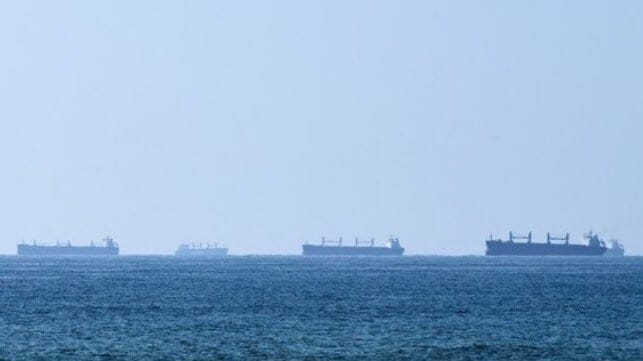
An uneasy calm appears to be prevailing in the Strait of Hormuz after the exchanges of fire between the United States and Iran, which followed the Iranian attack on the Singapore-flagged container ship Ever Lovely (IMO 9629110) on June 25. Both sides agreed on June 29 to stand down from these recent exchanges, to observe the ceasefire in a tighter manner, and also to resume technical discussions in Doha. In the background, and separate from the US-Iranian negotiations in Bürgenstock, bilateral discussions involving Iran and GCC states are taking place, with the GCC countries concerned that the talks in Switzerland will not deliver a lasting solution acceptable to all parties.
While a relative calm prevails, shipping is using both the Omani/IMO channel to the south, and a loosely-defined channel through Iranian waters to the north, with inbound and outbound shipping using the same channel, at a rate of about 60 transits a day. The volume of traffic is difficult to judge accurately, given that some ships are still traveling without switching on their AIS systems.
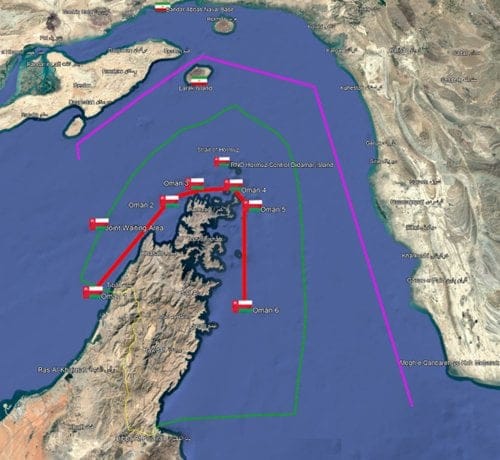
The Omani/IMO channel for exiting the Gulf (red), the inward and outward Iranian PGRA route (purple), and the extent of Omani territorial waters (green) (Google Earth, ©CJRC)
In the meantime, however, there had been some confusion about the Omani position regarding the Strait, attributable to poorly-sourced reporting and uncritical acceptance by the media of Iranian interpretations of the Omani position. Clarity was restored, however, when the Omani Foreign Minister, accompanying Sultan Haitham on a visit to France, gave an interview to Monte Carlo Doualiya, the French radio station broadcasting in Arabic. Sayyid Badr al Busaidi reiterated Oman’s position on Hormuz transits:
• Any bilateral understanding between Iran and Oman must fall within international law and UNCLOS.
• Oman is "not in favor of imposing transit fees. That is prohibited under international law, and we are committed to those rules."
• Oman is considering with Iran how environmental protection, navigational services, and emergency response can be improved in the Strait, drawing on the models in operation covering the Strait of Malacca and Singapore. Proposed future arrangements would be discussed and agreed upon with the international maritime community.
• Responsibility for mine clearance in the Strait rests with Iran, who should approach others for support if it was unable to fulfill its commitment to clearance of the Strait under the 14 Point MoU signed with the United States.
The statement makes it clear that while the scope and fee scale for services provided and charged for as Navigation Dues is under consideration in the discussions between Iran and Oman, charging tolls for passage, in effect creating a reconstruction fund, is not.
The statement also makes it clear that Oman will not unilaterally give permission for the European naval stabilization force to operate in the Strait. If the force is to be involved in mine clearance, then the permission of Iran needs to be sought.
Oman and Iran have already held a series of meetings to discuss management of the Strait, and a further such meeting occurred in Muscat on June 29. The meeting was chaired jointly by Oman's Sheikh Abdulaziz bin Abdullah Al Hinai and Iran's Deputy Foreign Minister Kazem Gharibabadi, who also led Iran’s delegation at the last similar such meeting in Muscat on May 24.

The Omani-Iranian Joint Committee meeting to discuss Strait of Hormuz navigation services, held in Muscat on June 29 (Omani MoFA)
Oman is keeping other GCC states closely informed on the progress of its talks with Iran over the Strait, in an effort to avoid misunderstandings, but also in an effort to build a new consensus. The Qatari Prime Minister Sheikh Mohammed bin Abdulrahman Al Thani visited Muscat to coordinate with the Omani Foreign Minister on June 23. The Omani Chief of Staff visited his opposite number in Bahrain also as part of this continuing dialogue on June 28.

The Omani Foreign Minister greets the Qatari Prime Minister in Muscat for a coordination meeting, June 23 (Omani MOFA)

that matters most
Get the latest maritime news delivered to your inbox daily.
At the same time, other GCC states are also conducting bilateral conversations with the Iranians. The Qataris are doing so as a consequence of holding a seat at the US-Iranian negotiations in Bürgenstock. The Saudi Foreign Minister Prince Faisal bin Farhan and his Iranian opposite number Abbas Araghchi held telephone discussions on June 24. The Times of Israel is reporting that these bilateral discussions with Iran outside the confines of the Bürgenstock talks will culminate in a regional conference involving Iran, to be held in Saudi Arabia, where the nations of the region will aim to establish a new political climate for living alongside each other.
Both Iran and the GCC have much to gain from a new security concord. If Pax Americana is not going to deliver peace in the region, then the nations of the region must establish a new modus vivendi among themselves, a development that would be equally welcome in the Gulf as in America, which would rather focus on problems elsewhere. The maritime community will breathe a sigh of relief if peace and stability can be established, at least some dividends to a highly disruptive war.
