


Old Shipping Containers Find New Life as Russian Tank Protectors
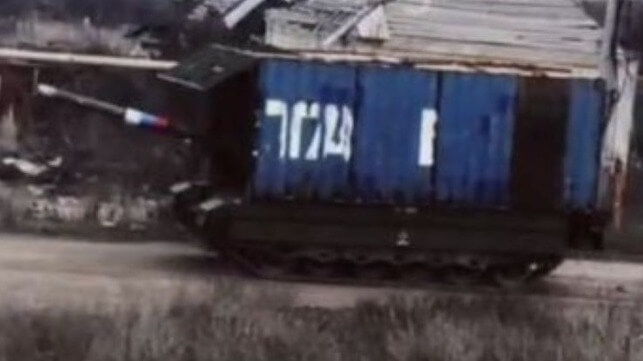
After their life in oceangoing service, shipping containers get repurposed for all sorts of inventive uses - storage sheds, shop spaces, mobile offices, housing, even indoor aquaculture ponds. This month, bystanders in a Russian-occupied area of Ukraine spotted a new and even more creative application: two Russian tank crews (and possibly more) have installed cut-up shipping containers atop their vehicles to create improvised anti-drone cages.
Ever since drones came to dominate the battlefield in eastern Ukraine, Russian forces have been looking for ways to improve the survivability of their armored vehicles. As tanks make conspicuous targets, they tend to get hit quickly by Ukrainian drone operators.
To maintain armored vehicles in the fight, Russian tank crews have tried installing all kinds of top-mounted "cope cage" structures to keep Ukraine's explosives-laden quadcopters off the turret and the hull. Common early examples used steel fencing wire or netting to catch the drone before it could make contact. Other recent protective structures are made of steel panels and look like shells or upturned boat hulls - hence their informal name, "turtle tanks."
Another video of a Russian turtle tank with a mine trawl attached to it is flying around international channels pic.twitter.com/b1sP7HXtmC
— Sprinter Press (@SprinterPress) May 8, 2024
The latest style is also the simplest. Drawing on the adaptable, ready-made dimensions of a shipping container, two Russian tank crews cut out the box's floor, trimmed off the front, and placed it atop the hulls of their armored vehicles. A cutout panel on the back lefthand side appears designed to let out exhaust fumes - but also provides an ample entryway for drones.
??????????Russians are sheathing/covering tanks with containers pic.twitter.com/1v8XggjV8Y
— ????MilitaryNewsUA???????? (@front_ukrainian) December 20, 2025

that matters most
Get the latest maritime news delivered to your inbox daily.
The expediency of the material is a clear advantage: very little fabrication is required when starting with a premade box, and the end result adds just a few thousand pounds in weight. On the other hand, the steel is 1/16th of an inch thick, and affords relatively limited protection.
"Turtle tank" measures have had varying degrees of success. The cannon barrel still has to have a large opening in front, and the structure must be ventilated to allow exhaust to escape, so there are often chinks where a careful drone pilot can penetrate the protection. And once a drone pilot spots a tank, there will usually be more drones coming.
