


Ørsted and Equinor Sue Challenging Stop-Work Orders for Offshore Wind Farms
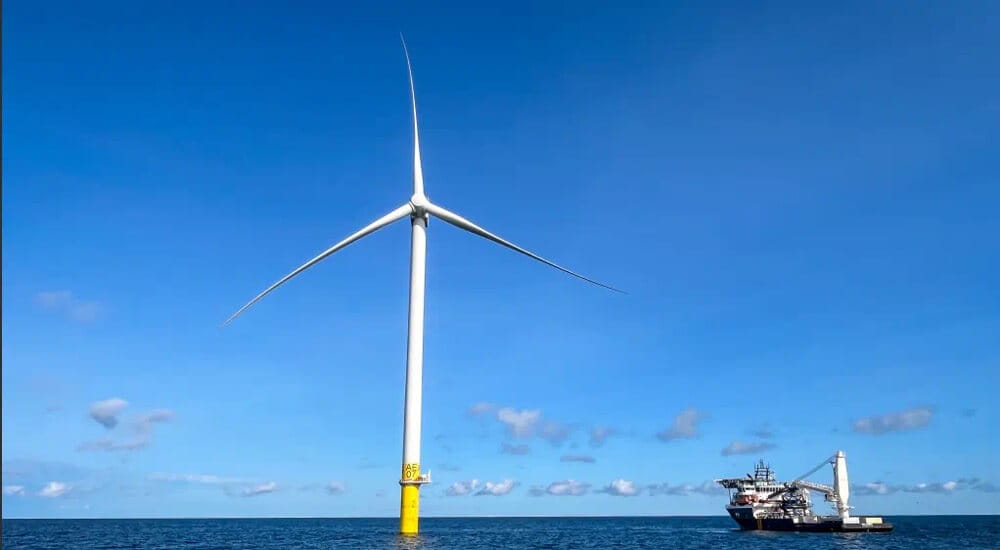
Two more offshore wind farms filed suits against the Trump administration after they were ordered in late December to stop work due to “national security” concerns. Danish offshore wind energy developer Ørsted amended its existing complaint in U.S. District Court to challenge the Trump administration’s stop-work order on the nearly completed Revolution Wind project, while Norwegian company Equinor filed a civil suit on January 2 for the Empire Wind project. Both companies said they would file motions for a preliminary injunction against the Department of the Interior’s Bureau of Ocean Energy Management (BOEM), which issued the stop-work order on December 22.
Both companies assert that the suspension order “violates applicable laws,” and say it is causing “substantial harm” to their projects and companies. They are following Dominion Energy, which filed suit last week to challenge the stop-work order for its Coastal Virginia Offshore Wind. BOEM, at the direction of the Secretary of the Interior, Doug Burgum, issued the stop-work order for these projects, as well as Avangrid’s Vineyard Wind 1, and Sunrise Wind, which is also being developed by Ørsted.
The Trump administration asserted that new data showed the potential for radar interference and clutter from the turbine blades and towers. At the beginning of the week, the court hearing the Dominion Energy case ordered the Department of the Interior to provide the confidential study, which it says is the basis for the order, but refused to issue a temporary restraining order for Dominion Energy. The court converted the case to a motion for a preliminary injunction, which will be heard in January.
Each of the companies contends in their legal action that the projects spent years in permitting and engaged in years-long consultation with the U.S. Department of Defense [War] Military Aviation and Installation Assurance Clearinghouse to address potential impacts to national security and defense capabilities. The companies have indicated that they were willing to work constructively with the administration for a durable resolution of any concerns.
Revolution Wind told the court that it is in advanced stages of construction, now approximately 87 percent complete. The project they report has spent and committed billions of dollars, noting that it was expected to start generating power as early as January and would be completed in 2026. Similarly, Dominion Energy says Coastal Virginia was nearing its first power while Equinor reports Empire Wind is more than 60 percent complete. Equinor says it has invested over $4 billion, of which $2.7 billion has been drawn under the project financing. Empire Wind is also investing in the redevelopment of the South Brooklyn Marine Terminal.
For Ørsted, this is the second time in months that Revolution Wind is being forced to seek court interventions owing to the administration’s efforts to stop the project that is located approximately 15 miles south of Rhode Island and 32 miles southeast of Connecticut, with power contracts with both states. In August last year, BOEM ordered the developer to halt ongoing activities to allow time for it to address what it said were concerns that had arisen about the permitted process. The company, however, got a reprieve a month later after a federal court in D.C. ruled in its favor, allowing construction to resume.

that matters most
Get the latest maritime news delivered to your inbox daily.
In its amended complaint, Revolution Wind highlights that it is in the final stages of construction with all offshore foundations, its export cabling, two offshore substations, and 58 of 65 wind turbines already installed. The wind farm, which has a capacity to generate 704 MW, is contracted to deliver electricity to Rhode Island (400 MW) and Connecticut (304 MW).
While Ørsted has opted to sue BOEM over the order on Revolution Wind, the developer is evaluating options on Sunrise Wind, a separate project that it wholly owns. When it received approvals in June 2024, Sunrise Wind was touted as the largest offshore wind project in New York with a capacity of 924 MW, enough to power nearly 600,000 homes. Located about 30 miles east of Montauk and featuring 84 large turbines, the project was expected to be operational in 2027.?Ørsted highlighted that among the options being evaluated are engagement with relevant agencies and stakeholders and legal proceedings.
