

Nuclear Aircraft Carrier ex-USS Enterprise Departs for Dismantling
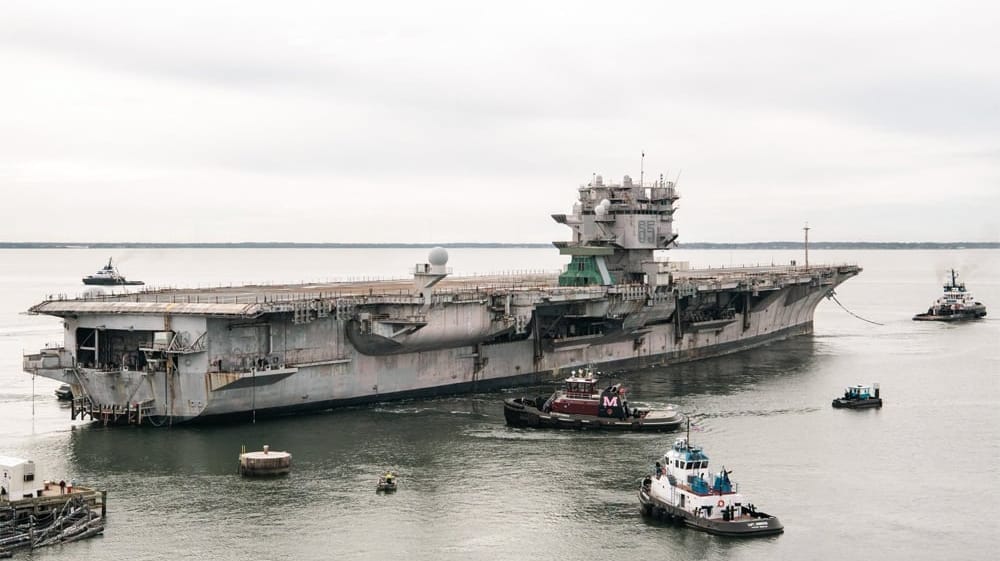
The U.S. Navy confirmed that the former aircraft carrier USS Enterprise has begun its final voyage bound for dismantling in Mobile, Alabama. The world’s first nuclear aircraft carrier, she was decommissioned a decade ago after a career that spanned 55 years.
Commissioned in 1961, Enterprise was known by her sailors as “Big E” and is considered a technological milestone in naval history, laying the groundwork for the modern U.S. Navy. She played a central role in U.S. naval operations during the Cold War, Vietnam War, and post-9/11 conflicts in the Middle East but also demonstrated the use of nuclear power and taught the Navy operations for a large nuclear carrier.
“Enterprise will always be remembered for her proud legacy of service, a legacy made possible by the sailors and support personnel whose dedication kept her mission-ready,” said Kevin Cormier, Deputy Portfolio Acquisition Executive Maritime for Aircraft Carriers. “All who served aboard and sustained this historic ship should take pride in the vital role they played in supporting the fleet. Their dedication ensured that Enterprise remained a lasting example of naval excellence. Fair winds and following seas.”
12:15 hrs Eastern the USS Enterprise CVN-65 the first nuclear aircraft carrier has been decommisioned in the Newport News Shipyard and is outbound for sea heading to Mobile, Alabama. My dad fueled her and my oldest brother defueled her. #cvn65 #ussenterprise #BigE #NewportNewsShipyard #HuntingtonIngalls
— ???????????????????????????????? ???????????? ???????????????????? ???????????????????????? (@AirAssets) November 2, 2026
She departed Newport News, Virginia, on November 2, being towed to Mobile 17 months after the dismantling contract was awarded for $536 million in a fixed-price contract to NorthStar Maritime Dismantlement Services. It is a partnership between NorthStar Group Services and Modern American Recycling and Radiological Services, announced in November 2024 as one of the bidders for the contract. The other competitors for the contract were in Newport News, Virginia, and Brownsville, Texas.
She will be arriving in Mobile around the same time as the former ocean liner S.S. United States is being towed out to begin her final voyage. The hull of the liner is currently expected to depart the MARS yard on November 9 before it is sunk to become a manmade reef. The carrier is expected to take a similar spot in Mobile and likely will become a new tourist attraction for the city.
The eighth naval vessel to bear the name Enterprise, the ship was built by Newport News Shipbuilding and commissioned in 1961. According to the Navy, she steamed more than one million nautical miles under nuclear power during her operational career.
Enterprise was the world's first nuclear-powered aircraft carrier (USN)
Following Enterprise’s inactivation in December 2012, the Navy completed defueling of the ship’s reactor plants and decommissioning in 2017. They spent years studying the best process for disposal of the vessel before announcing in 2023 that it had decided to dismantle the carrier at a commercial shipyard. They said this approach would not tie up vital capacity at the public shipyards needed for the active Navy vessels.
The government has already removed some elements from the ship and will take control of the radioactive parts, while the partnership will be responsible for the remainder of the vessel. The Department of Defense said last year it expected the dismantling to be completed by November 2029. The Navy considers the established process as a model for the upcoming decommissioning of the first of the Nimtz class carriers. USS Nimitz is now scheduled to end service in the first part of 2027.

that matters most
Get the latest maritime news delivered to your inbox daily.
While outclassed by the more modern Nimitz class and now the supercarriers of the Ford class, Enterprise remains the longest naval vessel ever constructed, although she has a smaller displacement than the newer carriers. She has a length of 1,123 feet (342 meters) at the flight deck and has a displacement of approximately 94,000 tons. Enterprise had an acknowledged top speed of over 30 knots, although it was rumored she could operate at much faster speeds.
Enterprise’s legacy will continue with the future Ford-class aircraft carrier, Enterprise (CVN 80), the ninth U.S. Navy ship to carry the name.