


Libya Resumes Monitoring Arctic Metagaz as Report Details Ukrainian Attack
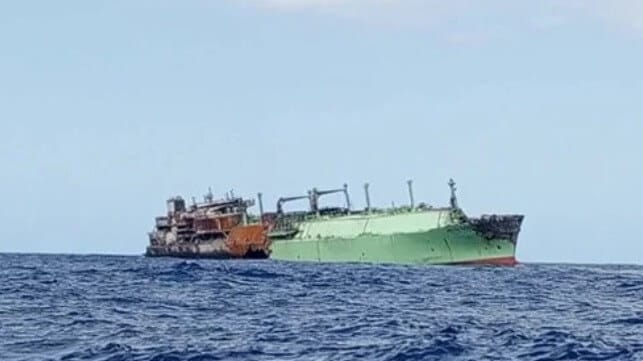
Libyan officials are again monitoring the hulk of the Russian-flagged LNG carrier Arctic Metagaz while they continue to discuss how to handle the wreck. At the same time, reports surfaced first in France and now on Associated Press, confirming that the Ukrainians struck the vessel from a base in Libya and that it was, in fact, the second such incident.
The independent French outlet RFI broke the report, saying that Ukraine was behind the attacks on Russian vessels in the Mediterranean. It revealed an October 2025 agreement, which Associated Press now confirmed as a “covert deal” between Ukraine and the UN-recognized government, which controls Tripoli and western Libya. According to RFI, Ukraine has as many as 200 operatives in Libya, mostly drone experts, working from three bases.
The report says that Ukraine began outfitting a runway and antenna for drone controls last October. It works from a Libyan air base, a second coastal location north of Tripoli, and a Libyan military base near Tripoli. The reports said the United States, Turkey, Italy, and the UK also have a presence near Misrata, which supports the Russian claims that Ukraine used British intelligence and was permitted by Libya to stage the attack on the Arctic Metagaz in March.
RFI reports the first attack was in December on the tanker Qendil, which was sailing between Greece and Libya. The Security Service of Ukraine (SBU) had released a video and highlighted the attack both for its distance from Ukraine and as its first in the Mediterranean without providing details on how it was staged. The 115,338 dwt tanker was damaged and changed course, while there were unconfirmed reports that two senior Russian military officials were on the vessel.
The reports citing two Libyan officials speaking off the record assert that the Ukrainian operatives launched an autonomous surface drone from Mellitah, north of Tripoli, in March against the Arctic Metagaz. It struck the engine room, and two of the LNG tanks exploded, ripping large holes in both sides of the ship.
Under the terms of the agreement, Ukraine is aiding the government of embattled Prime Minister Abdul-Hamid Dbeibah with training, experience with drones, and promises of future arms sales and Ukrainian investment in Libya’s oil sector. In turn, Ukraine was permitted to establish the bases. Dbeibah is battling multiple factions, primarily a powerful military faction based in eastern Libya and supported by the Russians. Libya has been factionalized since the end of its longtime dictator Moammar Gadhafi in 2011.
???? #ArcticMetagaz ???????? Odyssey
— Sergio Scandura (@scandura) April 7, 2026
????Update???? Impressive new images released by the eastern Libyan Navy show the drifting wreck of the Russian tanker Arctic Metagaz in unprecedented detail.
The Libyan Navy patrol vessel TBZ15 - a Tariq Bin Zeyad militia asset, untrackable w/out AIS… https://t.co/8drVHFKsIQ pic.twitter.com/NCEIcbg3tC
(Video showing the latest effort by the Libyan Navy to monitor and survey the wreck drifting in the Mediterranean)
Reports today are that the western military faction in Libya is leading the latest efforts to manage the dangers from the drifting Arctic Metagaz. Last weekend, the towline on the ship parted during a storm, and Libyan officials said the efforts had failed. Once the storm abated, the military reportedly sent a new boat to monitor the wreck, including divers to survey the ship.

that matters most
Get the latest maritime news delivered to your inbox daily.
The latest reports put the wreck 70 nautical miles northwest of Benghazi. The Chief of Staff of the Navy is reported to be leading a committee to discuss the wreck and determine the course of action.
Reports have said Libya lacks the port facilities and that the salvage operation has been hampered by the sanctions on the Russian energy industry. It is unclear how much LNG remains aboard the vessel, but it is believed to have as much as 900 tons of fuel. Despite being heavily damaged, it remains afloat, drifting toward Malta or Italy at times, while the winds and current generally are driving it toward Libya.
