


Japan and South Korea Advance Autonomous Navigation
As efforts continue to develop autonomous navigation systems for large commercial ships, both Japan and South Korea are reporting projects that reached key milestones. They are working to continue to develop the parameters for safe autonomous operations and to advance commercialization of the technologies.
Japan’s The Nippon Foundation has been sponsoring a series of demonstration projects over the past few years designed to develop key elements of the technology. ClassNK officials point out that the efforts are aimed at improving safety by preventing human error and at improving the working conditions for seafarers by reducing the workload. Japan faces the challenge of an aging workforce and declining numbers of seafarers, while it needs shipping to maintain supply chains to its many islands.
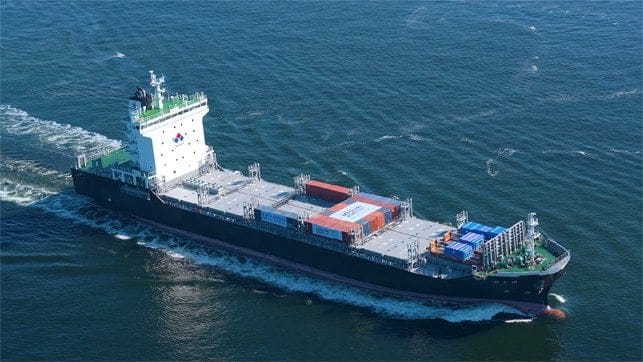
The MEGURI2040 Full Autonomous Ship Program sponsored by The Nippon Foundation recently reached another milestone. ClassNK granted a full autonomous notation to the domestic containership Genbu (5,374 dwt), which was the only newly constructed ship in the autonomous shipping project.
ClassNK highlights that it is the first case of an autonomous navigation notation for a vessel operating on medium- to long-range coastal routes. The vessel was constructed by Kyokuyo Shipyard and had completed its demonstrations and certification. The ship, which is 134 meters (440 feet) in length, has a capacity for 696 TEU.

Bridge of Genbu with the autonomous navigation system (The Nippon Foundation)
The companies developing the technology point out that international standards for autonomous navigation have not yet been fully established. ClassNK reports it developed guidelines for autonomous operations based on the demonstration, as well as elements for the operation and maintenance of the systems. Granting of the notation to the containership followed similar efforts, which also certified a ferry that participated in the demonstration project.

that matters most
Get the latest maritime news delivered to your inbox daily.
South Korea’s Avikus, the autonomous navigation subsidiary of HD Hyundai, highlights that it spent the past three years working with Norway’s DNV to define the safety requirements for its autonomous navigation support system and to establish the verification framework. Avikus reports it is stepping up its efforts to commercialize its vessel autonomy technologies.
DNV recently issued Type Approval for the Avikus Autonomous Navigation Support System, HiNAS Control. It points out that this is the first time a mass-produced autonomous navigation system that was designed for multiple vessel types has gained recognition. Previously, Avikus says the systems were specific to the ship or the individual project. By gaining the Type Approval, HiNas Control can be installed without additional verification, which Avikus says will improve deployment efficiency. It also hopes it will enhance confidence among global shipowners.
