


IMO Consensus-Building Process Underway at MPEC Meeting
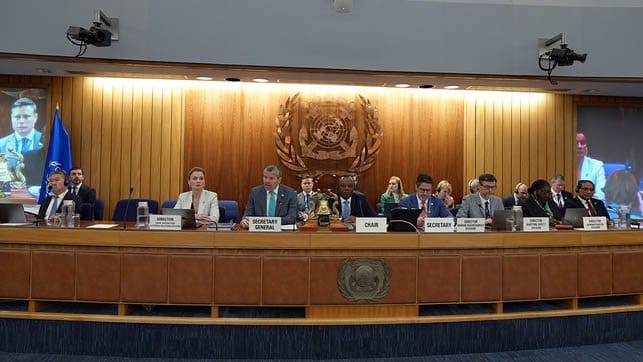
Delegates to the International Maritime Organisation’s Marine Environmental Protection Committee’s 84th Session appear to have taken the IMO Secretary General’s opening remarks to heart.
IMO Secretary-General Arsenio Dominguez called for delegates to approach discussions on the way forward for the Net Zero Framework proposal, which was rejected last October, in a constructive and pragmatic manner. He encouraged avoiding the rancorous manner in which discussions had taken place before last October’s vote.
The “listening to each other” process seemed very much underway at an off-site workshop and dinner hosted by the Saudi IMO Permanent Representative, Eng. Kamal al Junaidi on Tuesday evening. The tone was set at the event by the representative from Liberia, which voted against the Framework last October. She presented a broad-based critique of the old proposal, noted the high compliance costs of the measures proposed, the administrative burden, and governance difficulties associated with the proposed IMO Fund, and the disproportionate cost/benefit impact on developing states. She was also concerned about the treatment of some transitional fuels and considered overall that the policy should aim to encourage compliance rather than attempt to penalize slow adopters.
Liberia has kept its criticisms of the old proposal constructive by submitting what it describes as a new, pragmatic approach to reducing greenhouse gas emissions from ships.
The Liberian approach moves away from a focus on penalties towards creating encouragements and incentives to speed adoption of improved, less polluting bunker fuels. The approach would align targets to the availability of new fuels and take-up, and also aims to incentivize new methods of reducing emissions – not restricted to fuel types, but embracing well-to-wake emission reductions regardless of the energy source, and also emission-reducing technologies such as onboard carbon capture systems and wind?assisted propulsion. Targets would be set on a five-year cycle to reflect the availability of emission reduction fuels and technologies, but also to enable shipowners to plan changes to their fleet configurations in a cost-effective manner.
The Liberian approach will get a formal hearing, now being on the MEPC agenda, and is co-sponsored by Argentina and Panama. Panama, like Liberia, also opposed the October proposal, and both countries have a big influence within the MEPC because of the large size of their ship registries. If the proposal achieves majority consensus, then the next step would be to adopt the Liberian pragmatic approach in a new fleshed-out proposal, probably for consideration later this year at the next MEPC.

that matters most
Get the latest maritime news delivered to your inbox daily.
Unclear as yet to many delegates spoken to at the MEPC, but likely to emerge before the end of the week, is the United States’ response to the Liberian proposal, which is likely to peel away a number of diehard opponents to any form of Net Zero Framework proposal. Back in February, before the Liberian approach was tabled as an agenda item, Marco Sylvester, the U.S. Deputy Assistant Secretary for Transportation Affairs, called for the “Net Zombie Framework” to be finally put aside.
