


Historic Liverpool Waterfront Vessels Undergo Vital Preservation Repairs
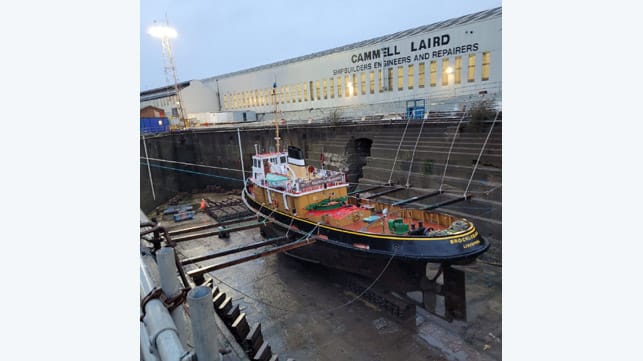
Efforts are underway in Liverpool to preserve two historic vessels that are a familiar sight in the city’s waterfront, a move that is aimed at ensuring they continue attracting visitors for years to come.
The National Museums Liverpool is undertaking a £200,000 ($267,000) conservation project to preserve the future of tugboat Brocklebank and pilot boat Edmund Gardner, both of which have come under threat due to years of decay.
A national heritage, Brocklebank is a tug that was launched in 1964 and was mainly used for ship handling in the city, but had occasional duties at Heysham, Larne, and Barrow. Historical accounts indicate that she was one of five motor tugs built by W. J. Yarwood & Sons between 1962 and 1965 for Alexandra Towing Company.
During her service years, the tug is famed for escorting the Royal yacht Britannia when Queen Elizabeth II visited Liverpool to review the tall ships in 1982. Following retirement in 1989, the tug was purchased by the Merseyside Maritime Museum and chartered to the Brocklebank Preservation Society, which has been maintaining and operating the vessel.
Normally berthed in the Albert Dock next to the museum, a recent inspection revealed serious corrosion across the steel hull of the vessel, prompting the need for restoration. The repair work comprises a high-pressure clean and the application of a repair coating to fill all the pitting affecting the ship. When completed, the vessel is expected to continue attracting visitors at the waterfront for another decade.
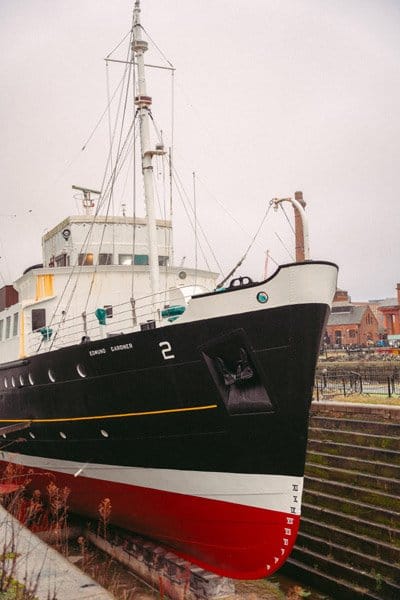
Edmund Gardner looking smart with its new paint (KieranIrvine photo, courtesy of National Museums Liverpool)
Also undergoing preservation works is the Edmund Gardner, which resides in Canning’s north dry dock and is the largest object in the museum’s collections. The boat was built in 1953 by Philip and Sons for Mersey Docks and Harbor Board and was the second of a new generation of large diesel-electric powered cutters to replace the pre-war steam cutters.
Together with her two sister ships, Edmund Gardner performed the task of guiding the steady stream of ships entering and leaving the Mersey docks during the 1950s-1980s. Historical accounts show that during her career in the pilotage service, she carried out her duties without major incidents and was considered a particularly good ship in heavy weather. Apart from pilotage, she also provided assistance for injured seamen on incoming ships and for yachtsmen on several occasions.
Apart from being a workhorse in the Mersey docks, Edmund Gardner is also remembered for the 1963 collision with the ore carrier Iron Horse. A steering gear failure caused the carrier to hit the Edmund Gardner on the starboard side, rolling the ship over heavily and damaging the bridge deck and hull plating.
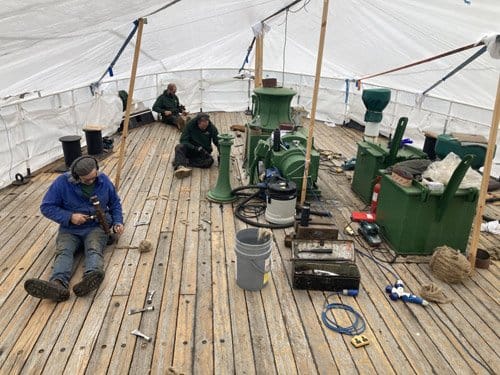
Edmund Gardner decking recaulked - National Museums Liverpool
The boat was purchased by the Maritime Museum in 1982 and is today one of only two large pilot boats preserved worldwide, with the other being in Australia. The boat contains many of the original features, including the control and navigation equipment on the bridge and is part of the National Historic Fleet.

that matters most
Get the latest maritime news delivered to your inbox daily.
To ensure the boat continues to be an attraction at the Mersey waterfront, it recently underwent specialist treatment of its wooden deck and caulking to prevent it against water ingress into the vessel’s interior, something that is key to its long-term preservation.
The UK’s Public Bodies Infrastructure Fund, a government capital investment program for the essential maintenance of museum estates, is funding the conservation project of the two ships.
