


Gaps in Awareness, Poor Communication Caused Tug, Barge, Workboat Collision
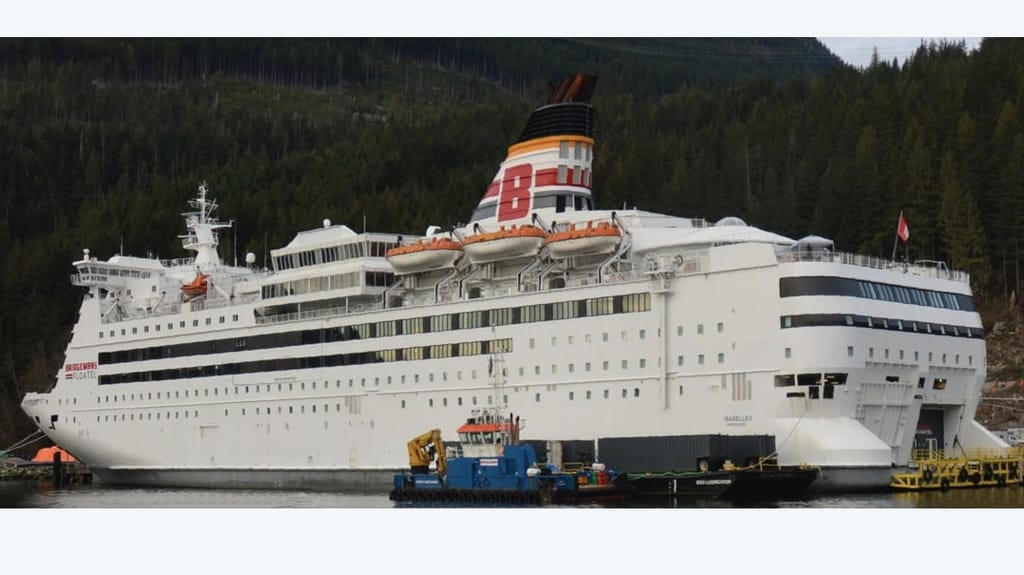
Marine investigators in Canada released a report outlining how gaps in situational awareness and a breakdown in communication caused a collision involving a tug, a barge, and a workboat in Squamish Harbor, British Columbia, in December 2024. The incident involved the tug Haisla Northwind, the barge BSG Lubricator, and the workboat Triton 1. It occurred in the marine safety zone of the Woodfibre LNG Project site.
The incident on December 18, 2024, occurred while the tug was pushing the barge on a scheduled run carrying provisions to the Isabelle X, a former ferry that was being used as a floating accommodation (floatel) for project workers, which was moored at the site. The barge collided with Triton 1, which was idling on standby, causing the workboat to capsize and sink.
The workboat’s operator, who was the only person on board, entered the water before being rescued by the workboat Roe 5 that was nearby and was treated for hypothermia. Only minor pollution was observed following the collision, with spill containment booms being deployed as a precaution. While no damage to the tug or barge was reported, the Triton 1 was not salvaged.
The Transportation Safety Board of Canada (TSB) has released its report on the incident, indicating that gaps in situational awareness and breakdown in communication were the main cause of the collision. The report shows that as Haisla Northwind pushed BSG Lubricator forward, visibility from the wheelhouse was obstructed by structures on board the tug and the barge, which reduced the tug master’s ability to visually detect the Triton 1 as it idled on the water.
Due to the obstructed visibility from the wheelhouse, the master of Haisla Northwind was not aware of the workboat directly on his path. The investigators also established that bright lights from the construction site and nearby vessels also reflected off the water, creating glare that made the Triton 1’s navigation light difficult to distinguish from other lights in the area.
It was also established that Triton 1’s operator heard no arrival message on the VHF radio, did not expect any vessel to be approaching, and his attention was distracted by a cellphone call. Also, the operator is said to have expected the workboat’s navigation lights to make it visible to other vessels.
Built in 2018, the 110 gross tonnage Haisla Northwind was a multipurpose tug that supported various marine operations at the Woodfibre LNG project site, including anchor handling, crane operations, line handling, towing, and cargo stowage. She also transported wastewater, provisions, and equipment for workers. On the day of the incident, she had three crewmembers onboard. The 1964-built barge BSG Lubricator was mainly used to transport wastewater from, and provisions to, the Isabelle X. Built in 2021, the 7.6-meter Triton 1 did not have any fixed role at the site and was used as needed in various activities.
The investigation established that on the day of the incident at 1533, tug Haisla Northwind departed from Tymac Launch Station in Vancouver Harbor on a scheduled run to the floatel. She was pushing the barge BSG Lubricator, which was secured using a winch system on the tug’s bow. At around 1932, the two arrived at the project’s marine safety zone, approximately 600 meters south of the floatel. At this point, the tug’s speed was about 6.2 knots, with the master gradually reducing speed as she approached the ramp located at the floatel’s stern. The master relied primarily on visual navigation.
At about 1940, when the tug and barge were approximately 370 meters from the floatel, and while the deckhands were preparing to take their lookout positions, the master felt a sudden impact. The BSG Lubricator had struck the workboat Triton 1 that had been idling on standby. While initially the tug’s crew thought the barge had hit a submerged log, it soon became apparent that it was a workboat.
Investigators were able to establish that in the incident, gaps in situational awareness were a major factor in the collision. This is because the master of the tug was not aware that the workboat was in the path of the tug and the barge. Likewise, the operator of the workboat was unaware that the workboat was positioned in the direct path of the oncoming tug and barge. Another critical factor was visibility, as the view from the tug’s wheelhouse was obstructed by the crane located on the tug’s forward deck. Further, it was obstructed when pushing the barge with the four wastewater containers and one refrigerated container on the barge deck.

that matters most
Get the latest maritime news delivered to your inbox daily.
The investigation also found that operations at night posed further challenges to the tug master’s visibility. When approaching the floatel, bright lights from shore-based structures and nearby vessels caused significant light pollution, reflecting off the water and creating glare. This made it difficult for the tug master to distinguish the navigation lights of other vessels that may have been in the tug and barge’s path.
TSB said that following the collision, organizations involved have since taken safety actions, including strengthening lookout and communication procedures, installing additional vessel-tracking and visibility equipment, and introducing new marine safety plans. Other measures include restricting all barge movements to daylight hours and improving coordination among vessels operating within the marine safety zone.
