

Falklands: Argentina's New Legal Dispute Over the Sea Lion Oil Project
[By Donald R. Rothwell]
The longstanding Argentina-United Kingdom Falkland Islands dispute is back in the global headlines. The UK endorsement of the offshore “Sea Lion” project in waters to the north of the islands has seen Argentina respond by commencing a legal challenge.
The Sea Lion hydrocarbon exploitation licences have been granted to Navitas Petroleum operating in conjunction with Rockhopper Exploration in an area located approximately 107 nautical miles to the north of the islands, covering 541km2.
Argentina’s legal challenge is under the 1982 United Nations Convention on the Law of the Sea (UNCLOS) and is two pronged via an initial request for provisional measures before the Hamburg-based International Tribunal for the Law of the Sea (ITLOS), with a final determination by an Arbitral Tribunal to follow. ITLOS hearings are scheduled for 10–11 November 2026 and a decision on that phase of the case can be expected soon after.
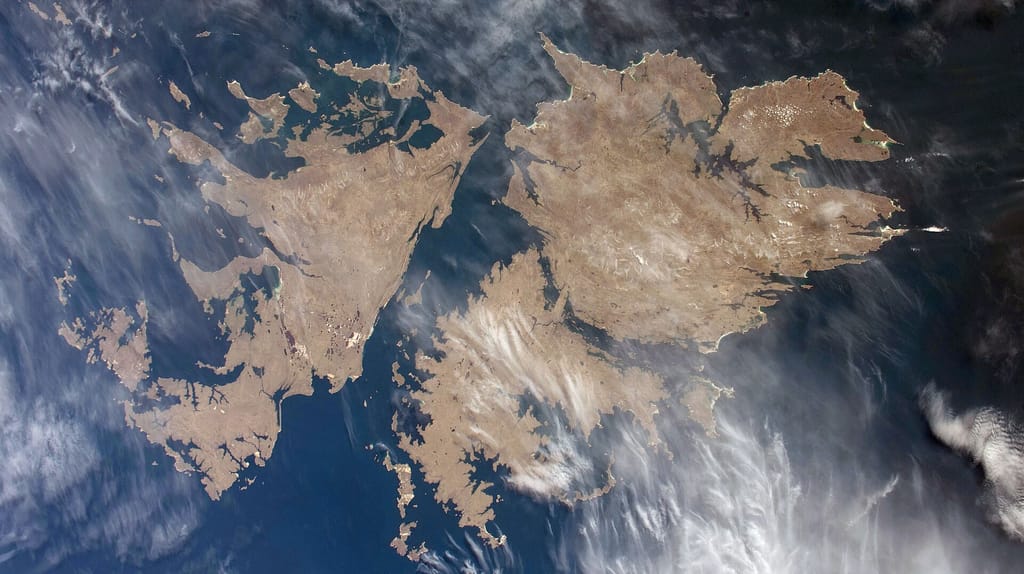
While Argentina has framed its claim around UNCLOS, the core of the case is the territorial dispute over the islands, referred to as Malvinas by Argentina. This longstanding dispute has its roots in European settlement throughout parts of South America, a British outpost being established and then abandoned in the 18th century, followed by a more permanent British presence on East Falkland and West Falkland from the 19th century until today. The islands have an approximate population of 3,500 and formally are a “British Overseas Territory” (BOT) along with other such territories including Bermuda and Gibraltar.
Argentina’s claim to the Malvinas is founded in “Papal Bulls”, which were effectively pontifical decrees dividing parts of the Roman Catholic world, in this case Spanish interests in South America. Argentina argues these were given legal substance by the 1494 Treaty of Tordesillas and were reflected in the early contests between Britain and Spain over the islands.
However, there has never been a permanent Argentine settlement on the islands other than temporary military occupation during the 1982 Falklands War following Argentina’s invasion.
Since the war’s conclusion an uneasy peace settled over the islands. Argentina has never relinquished its claim, while the UK sought to conclusively demonstrate the islanders wished to remain British, with a 2013 referendum voting by a 99.8% majority to remain as a BOT. The Sea Lion project has inevitably provoked Argentina to now explore its legal options in pursuit of its claim over the islands.
Argentina’s UNCLOS legal case is that the UK is illegally exploiting the continental shelf seabed to the north of the islands, that Sea Lion will result in environmental impact and damage, and that the UK’s conduct in issuing the Sea Lion exploration licences is an aggravation of the dispute over the maritime areas adjacent to the islands. Absent the underlying territorial dispute, these would all be legitimate issues for ITLOS determination.
However, as both Argentina and the UK are UNCLOS parties, the Tribunal will first need to ask whether it has jurisdiction to determine the dispute and this is where Argentina will face some challenges.
ITLOS, as a tribunal established under UNCLOS, has under Article 286 jurisdiction to determine disputes “concerning the interpretation or application” of the convention. As such, it does not have the jurisdictional capacity to determine territorial disputes under general international law. In practice, these are matters traditionally within the remit of the International Court of Justice.
There are examples of UNCLOS law of the sea cases in which territorial disputes have also been central. The most prominent was the 2016 South China Sea Arbitration where the Philippines challenged China’s conduct in the region. While the South China Sea is riddled with territorial disputes, especially over multiple islands, rocks and reefs in the Spratley Island group, the Philippines neatly sidestepped this issue and instead focused on China’s maritime claims, island reclamation activity, and artificial island building within areas of the Philippines Exclusive Economic Zone. Accordingly, there was never a need for a determination to be made as to who had territorial sovereignty over what feature.
This will not be the case with respect to the Falklands/Malvinas. If the UK has sovereignty over the islands, then Sea Lion is a legitimate act of exploration and exploitation of the continental shelf. If the Argentine claim over the islands is valid, then the UK’s conduct is in breach of UNCLOS.
Argentina’s claim could therefore fall at the first hurdle, and Buenos Aires is no doubt aware of this challenge. ITLOS, however, has generally been reluctant to take a narrow view of its jurisdiction and to deny hearing a case brought before it. In this context, another ITLOS case regarding the Chagos Archipelago – which had been the subject of an International Court of Justice Advisory Opinion over its status as a BOT – and where Mauritius was seeking to settle a maritime boundary with the Maldives, did proceed to a full determination despite the sovereignty dispute between Mauritius and the UK not being fully resolved at that time.
All the indications are that Argentina will explore all legal and associated diplomatic and political avenues to block the Sea Lion project. Argentine President Javier Milei may also be seeking to provoke nationalist pride in advance 2027 Presidential elections in which he is expected to run once more. US President Donald Trump may also intervene due to his unhappiness that the UK did not provide him with more support in Iran. He already indicated in September that the US may shift its position on the Falklands away from supporting the UK claim.
London will inevitably robustly defend its position on all fronts. If the UNCLOS case proceeds it will be historic and the first occasion any aspect of the Falklands/Malvinas dispute has gone before an international court.

that matters most
Get the latest maritime news delivered to your inbox daily.
Donald R Rothwell is Distinguished Professor of International Law at the ANU School of Law, College of Law, Governance and Regulation, ANU and one of Australia’s leading experts in international law with specific focus on the law of the sea, law of the polar regions, use of force and implementation of international law within Australia.
This article appears courtesy of The Lowy Interpreter and may be found in its original form here.
The opinions expressed herein are the author's and not necessarily those of The Maritime Executive.