


Exmar’s Pioneering Ammonia Dual-Fuel Gas Carriers Named at Hyundai Shipyard

Two innovative vessels, which are being billed as the world’s first mid-size gas carriers with ammonia dual-fuel engines, were named as they are nearing completion. The vessels, which were ordered in 2023 and 2024 by Exmar, a specialist in gas shipping, are being built at the Ulsan, South Korea, shipyard of HD Hyundai Heavy Industries and are viewed as the cutting edge for a new era in shipping.
The ships, which are each 46,000 cubic meter gas carriers, were named Antwerpen and Arlon in honor of two Belgian cities. Each measures 190 meters (623 feet) in length and is specifically designed for the transport of liquefied gas cargoes, including ammonia and LPG. Exmar highlights that the vessels were deliberately lengthened 10 meters (approximately 33 feet) in the design stage, along with a slight increase in beam to achieve a meaningfully higher cargo intake compared to the standard design. Hyundai developed the proprietary technology and the three tanks, which provide 45,000 cbm storage below deck, and two 500 cbm deck tanks.
HD Hyundai highlights that ammonia (NH3) can be stored in pressurized tanks at around 8 bar or in refrigerated tanks at -33°C without the need for cryogenic technology. In liquid form, it has about 1.7 times higher storage density than liquefied hydrogen (-253°C) at the same volume, making it suitable for large-scale, long-distance transport and storage of hydrogen.
One of the key features of the design is the ability to use cargo as fuel. Exmar says this creates significant operational flexibility and environmental advantages. It reports that the ammonia dual-fuel technology enables CO2 emission reductions of up to 90 percent during navigation.
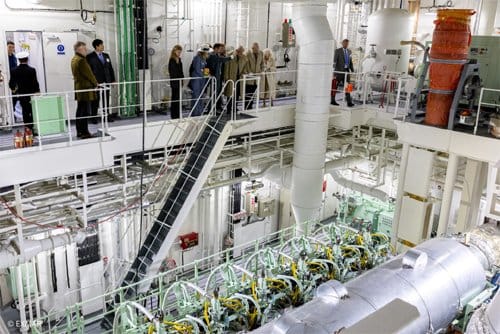
The mid-sized gas carriers are the first to be outfitted with the ammonia dual-fuel engines (Exmar)
The ships also feature shaft generators and a selective catalytic reduction (SCR) system to reduce nitrogen oxide emissions.
The safety concerns about ammonia were addressed by equipping the vessels with advanced detection and mitigation systems. They have an ammonia gas detector for real-time leak monitoring and an ammonia purge recovery unit. These ships are the first of four being built for Exmar. They are currently completing outfitting and are scheduled for delivery in May and late June.
For HD Hyundai, the vessels represent a significant achievement in its strategy to pursue high-value vessels and new technologies. It highlights the ammonia gas carriers as the next step following its 2016 delivery of the world’s first methanol-powered petrochemical product carrier and the 2023 delivery of the first methanol-powered containership. Designs for the ammonia gas carriers were developed through a partnership involving HD Hyundai, HHI-EMD, Wartsila Gas Solutions, WinGD, Lloyd's Register, and Exmar

that matters most
Get the latest maritime news delivered to your inbox daily.
While the expectations remain high for ammonia as an alternative maritime fuel, DNV highlights that there are only three ships in the world currently operating with ammonia, two tugs and one offshore supply vessel. However, it calculates that there are currently 46 vessels on order, with as many as 18 scheduled for delivery in 2026 and reaching 46 vessels by 2030.
HD Hyundai highlights the forecast by the International Energy Agency that projects ammonia will account for eight percent of marine fuel demand by 2030. It is projected to rise to 46 percent by 2050. Ammonia is also seen as a likely carrier, as it can be used to transport hydrogen when combined with a cracking process at the destination.
