


European Nations Warn Shadow Fleet Shipowners to Play By the Rules
The coastal states of the North Sea and the Baltic have released a joint letter to remind shadow fleet shipowners and flag states of their legal obligations. Notably absent from the signatory list is Russia, the easternmost Baltic coastal state and the alleged root cause of the safety questions at issue in the letter.
The missive begins with a warning about the ever-growing problem of GNSS interference in the Eastern Baltic, well-documented for years by ship trackers and researchers. Strong technical evidence points to a cluster of powerful GNSS jamming and spoofing stations located in the Russian exclave of Kaliningrad, including some which appear to run on dated analog equipment. All of the locations appear to turn on and off in unison, indicative of unified command and control, according to GPSPatron and Gdynia Maritime University.
"These disturbances, originating from the Russian Federation, degrade the safety of international shipping. All vessels are at risk," the 14 coastal states warned in the new letter.
The states called on the international maritime community as a whole to ensure that crewmembers are ready and capable to fall back on traditional navigational skills when GNSS service drops out. The letter also calls for international collaboration on an alternative terrestrial radionavigation system (like eLORAN). The petition acknowledges the decade-long warning from the cybersecurity community that GNSS is too easily defeated to be used without backup, and that safety at sea requires resilient positioning, navigation and timing.
The states also put shadow fleet shipowners on notice that they need to follow IMO conventions. The Russia-serving shadow fleet is known for eschewing the cost of maintenance; hiring customer-oriented, low-enforcement flag registries; and hopping from one flag to another with frequency. More than 300 shadow fleet vessels now fly a fake flag or no flag at all, according to the latest numbers from Windward.
The states reminded owners that ships can only fly one flag, and that sailing under the flags of two or more nations is the same thing as operating as a stateless vessel, per UNCLOS Article 92. Stateless vessels are subject to flag state verification boardings on the high seas. Upon boarding, coastal state officials have the opportunity to inquire about the rest of the vessel's compliance status, like insurance, SMS, STCW, MARPOL or sanctions compliance, potentially resulting in detention.
The letter also includes a variety of basic reminders targeted at specific quality issues in the shadow fleet, and the list is extensive. The 14 coastal states saw it necessary to remind shadow fleet shipowners that their vessels need to keep a lookout; need to have an SMS and a MARPOL response plan; have to follow IMO mandatory routing systems; and must talk with VTS operators.
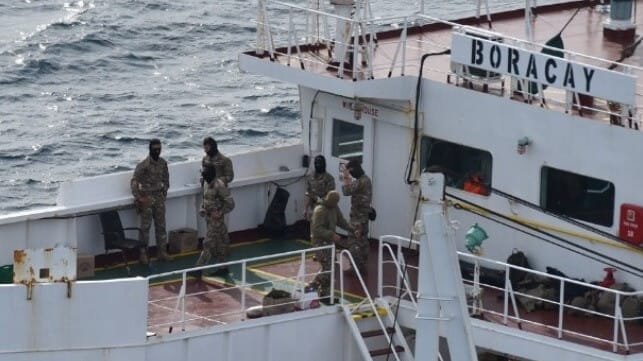
The warning appears in the context of a nascent, newly-muscular approach to maritime law enforcement in Western Europe, and could serve as a policy guide for joint interdiction operations. Last week, French commandos boarded and seized a sanctioned Russia-serving shadow fleet tanker in the Mediterranean, with assistance from the UK. The vessel's master was detained on suspicion of flying a false flag.

that matters most
Get the latest maritime news delivered to your inbox daily.
Signatories to the letter include Belgium, Denmark, Estonia, Finland, France, Germany, Iceland, Latvia, Lithuania, The Netherlands, Norway, Poland, Sweden and the United Kingdom.
Separately, in a parallel show of resolve, the European Union voted Monday to phase out all imports of Russian natural gas by the end of 2027, and all Russian LNG by the end of this year. Slovakia and Hungary voted against the proposal, and Hungary has vowed to sue to reverse it. The decision will have a significant impact on Russian energy shipping within the span of a year: about 15 percent of all EU LNG imports come from Russia, and Europe accounts for about 75 percent of the sales volume of Russia's Yamal LNG export terminal in northern Siberia. Europe will have to substitute another source of LNG - likely the U.S. Gulf Coast terminals, creating a new strategic dependency - and Russia will have to find a new buyer for its LNG exports.
