


European Governments Adopt Ambitious Plan for 100 GW of Offshore Wind Power
Meeting for the third North Sea Summit, the governments of nine Northern European countries adopted a new plan calling for coordination, power sharing, and working in unison to develop 100 GW of offshore wind power. They estimated it represents an investment of over $1 trillion.
Known as the Hamburg Declaration, the agreement was signed by the governments of Germany, France, Belgium, Denmark, Ireland, the Netherlands, Norway, Northern Ireland, and Luxembourg, to achieve what they are calling energy sovereignty. The countries are promising to work in unison, saying they are “doubling down” on clean power.
Europe currently has approximately 37 GW of offshore wind energy installed in 13 countries. The UK has emerged far and away as the leader and last week completed a record new allocation round. Other countries, such as Denmark, which pioneered offshore wind energy, Germany, and the Netherlands, have struggled with recent rounds designed to launch the next phase of their offshore energy projects.
Three years ago, the countries set a goal of reaching 300 GW by 2050. They spoke of ways they could improve the tendering process and the benefits of coordinating. Today’s landmark agreement outlines specific steps while addressing the recent challenges that emerged in the market.
The declaration outlines steps for “getting offshore wind back on track.” They are calling for a stable tender pipeline with a predictable schedule for the developers, taking steps to de-risk investments, designing a sound investment framework, and simplifying and speeding up permitting. It endorses Contracts for Difference as the standard auction methodology, although many of the governments have been slow to adopt this structure, which has worked for the UK.
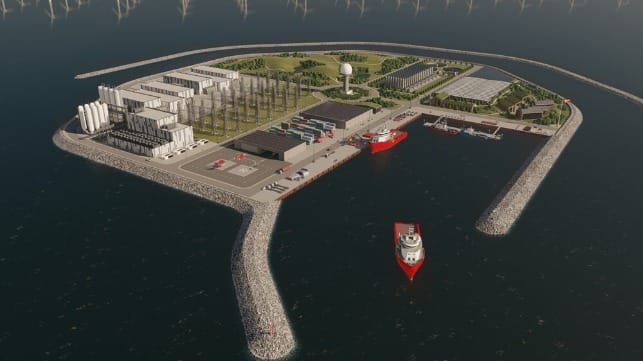
They are also outlining steps, including interconnecting the offshore grids to develop cross-border projects and the sharing of power generation capacity among countries. They are also proposing hybrid offshore assets, including subsea energy infrastructure that combines offshore wind connections with electricity interconnects. Separately, Denmark and Germany said they would proceed with the Bornholm Energy Island, one of the first concepts for an energy hub approximately 10 miles offshore.
“This ambitious announcement to build a vast number of new offshore wind farms jointly with our European partners will increase the energy security of the UK and the whole of the North Sea region,” said Jane Cooper, Deputy Chief Executive of RenewableUK. “This historic declaration puts offshore wind right at the heart of Europe’s power system.”
The Europeans agreed to push forward with offshore wind as part of a broader clean energy strategy. This came despite pressure from Donald Trump, who continues to make moves to block the U.S. industry and said at the World Economic Forum last week that “windmills” are “losers.” He continues to be critical of European countries focusing on wind and clean energy.

that matters most
Get the latest maritime news delivered to your inbox daily.
More than 100 companies also endorsed the Hamburg Declaration and committed to their part in the development. They are pledging to reduce the cost of offshore wind energy by 30 percent by 2040 by taking steps to drive scale, lower financing costs, and industrialization.
European energy ministers said they believed it would be possible to build a steady pipeline for installing 15 GW per year across the North Sea and Baltic.
