


Drone Attack Kills Master, Injures Three Crewmembers in Black Sea
IMO calls on member states to push back on the practice of attacking civilian shipping
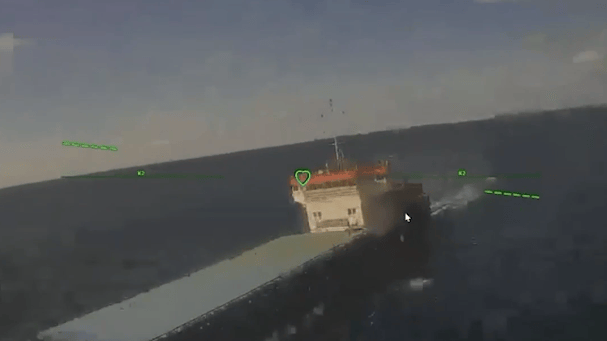
Overnight Wednesday, Russian and Ukrainian forces traded drone strikes against each others' shipping in the Black Sea. On one Ukraine-bound vessel, the master was killed and at least three crewmembers were injured when a Russian drone damaged the deck and superstrucure. It is the latest in a long series of Russian strikes on shipping near Odesa.
Drone operators on both sides of the conflict preferentially target the superstructure and the bridge: wheelhouse windows are vulnerable to blast damage or penetration, it is easy to hit, and a successful strike is likely to disable the vessel. As a manned space, a strike on the bridge is also likely to cause casualties. Video footage released by Ukrainian President Volodymyr Zelensky on Thursday showed that Ukraine's Unmanned Systems Force continues to aim for the bridge deck when targeting Russia-linked vessels; the imagery shows three examples of this practice from Wednesday's operations.
"There have . . . been good results in the Black Sea. Every day, we respond to aggression. Russia must choose peace," Zelensky said, congratulating Ukraine's intelligence services and drone forces.
I thank our warriors, who make Russia feel the war every day. Last night, in a joint operation by the Security Service of Ukraine, the Unmanned Systems Forces, the Defense Intelligence of Ukraine, and the Foreign Intelligence Service, the Yaroslavl oil refinery was hit. The… pic.twitter.com/lQM7MrpBA3
— Volodymyr Zelenskyy / ????????? ?????????? (@ZelenskyyUa) September 17, 2026
International pushback
The IMO is growing concerned at a widening pattern of attacks on shipping, not just in the Black Sea, but also in the Red Sea, Gulf of Oman and the Arabian Gulf. At various times and locations in the past year, at least five militaries or organized groups have used kinetic antiship strikes at scale as a means to advance their broader strategic objectives.
In a recent address at IMO, Secretary-General Arsenio Dominguez called on member states to apply pressure where possible to push back against attacks on civilian shipping.

that matters most
Get the latest maritime news delivered to your inbox daily.
“I call on you to share these impacts with the relevant bodies in your countries so that this can be dealt with within the United Nations, as appropriate.… It falls to you and your capitals, and relevant bodies of the United Nations, to address the root causes and find solutions,” Dominguez said. “We are reaching a point where these conflicts are being used as a pretext to attack merchant vessels and innocent seafarers. Do not use these conflicts to attack innocent seafarers.”?
The practice of attacking an opponent's merchant shipping has always come with serious moral considerations, but in recent decades, a difference has emerged: in most previous conflicts, the most-affected seafarers were citizens contributing to their own nation's war effort by transporting materiel, soldiers or economic goods, accepting the risks in the name of duty and rewarded with recognition for their patriotism. Today, international shipping now depends heavily upon foreign professionals - neutral, uninvolved mariners from overseas, who now find themselves exposed to the effects of wars that are not their own, absorbing high risk without national recognition. Though provided with hazard pay and right of refusal under the MLC, anecdotal reports indicate that as a matter of practice, some seafarers are underinformed about those risks or pressured to accept them, thereby exposing them to hazards to which they do not fully consent. As an example of the scale of the problem and the reaction of seafarer-supplying nations, the government of India has called for agencies and operators to cease dispatching any Indian seafarers into the Strait of Hormuz in particular, given the dangers of attacks on uninvolved foreign nationals.
