


Carnival Cruise Line Adds Bow Crest as Ships Reinforce Brand Marketing

Once, cruise ships came in only one color, white, while passenger liners maintained basic black for their livery. It is only more recently that the cruise corporations began looking at their ships as part of the marketing, and last week Carnival Cruise Line announced it would be reinforcing it with a new “bow crest” added to its livery.
A leader in the contemporary segment (i.e., broad market) of the industry, Carnival Cruise Line operates 29 cruise ships, with five additional large ships on order. It is a North American-driven brand, although it recently added an Australian subsidiary. Started in 1972, the brand grew with its positioning of “Fun Ships,” which still remains at its core, while it has also sought to increase its positioning as “America’s Cruise Line.”
In the earlier days of passenger shipping, nationality was a strong element of the companies. There was French Line, North German Lloyd, Italian Line, Swedish American Line, Norwegian America Line, and United States Line, for example. Liners, however, were almost always painted black, in part to hide some of the ravages of weather on their hulls or, in the early days, to blend with the coal dust as they were bunkered before ships converted to oil.in the 1920s
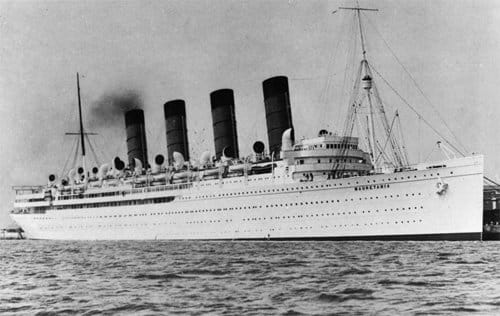
Once the fastest liner in the world, Mauretania was painted white for cruising in the 1930s
A few of the companies, such as HAPAG, painted liners white to distinguish them as cruise ships. Cunard made news in 1933 when it painted the liner Mauretania, once the fastest liner on the Atlantic, for her new cruise service. Her hull was white, boot topping green, deckheads pale green, and the funnels were the traditional red. They said it worked so well, and kept the ship 7 to 9 degrees cooler than the black livery, that the liner Franconia was also painted white before her 1934 world cruise. After World War II, Cunard painted its luxury dual-purpose liner/cruise ship Caronia four shades of “Eau de Nil” (green), giving her the famed nickname the Green Goddess.
While white hulls mostly became the standard for cruise ships in the 1960s, it would take years for more branding beyond the unique funnel markings to take root. Carnival Cruise Line, for a time in the earlier years, would hang banners on their ships in port with their marketing slogan “Ain't We Got Fun” tied to its TV advertising with Kathie Lee Gifford, but it was Norwegian Cruise Line that stunned the industry in 2002 when Norwegian Dawn introduced “hull art.” The tradition continues to this day with the line hiring artists to create unique designs for its ships.
Other lines began adding their names and logos to the hulls of their ships. A start-up line trying to be unique painted its ships bright red, earning it the marketing moniker of the “Big Red Boat.” More recently, Royal Caribbean International started painting its cruise ship hulls powder blue. Lines also started adding the brand name to their ships’ name including Norwegian, Carnival, Celebrity, and, more recently, Oceania.
Carnival Cruise Line is a relative newcomer to livery marketing. As it neared its fiftieth anniversary and the introduction of its first LNG dual-fuel cruise ship, it harkened back to its roots, naming the ship Mardi Gras and revealing a special red, white, and blue livery for the hull. Carnival said the scheme is “Paying homage to maritime tradition and patriotic colors,” and that “the eye-catching hull design is highlighted by a stately navy blue hull inspired by officers’ uniforms, along with vibrant red and white accents.”
“When we first saw the hull design for Mardi Gras, we knew it was something special,” said Christine Duffy, president of Carnival Cruise Line. In 2021, she reported that they decided to expand the livery to all the ships to become a trademark feature celebrating the line’s positioning as “America’s Cruise Line.”
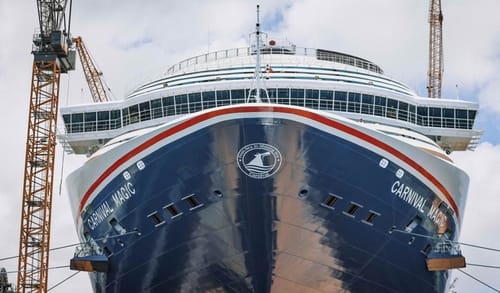
New bow crest being added to emphasize Carnival's brand positioning (CCL)
The rollout of the hulls was completed in 2024. Last week, Carnival Cruise Line unveiled its new “From Sea to Shining Sea” bow crest. The idea of bow crests is not new in the industry, but they were often the company flag, the ship’s symbol, or the identity of the company’s owner. NYK displayed its flag on the bow of the early Crystal Cruises’ ships, and Bergen Line displayed its identity on the bow of the Royal Viking Star.
“Inspired by 'America the Beautiful,’ the new bow crest celebrates the landscapes and oceans Carnival shares with guests nationwide,” the company writes. It is making its first appearance as the Carnival Legend emerges from a 16-day dry dock at Grand Bahama Shipyard in Freeport. Next will be Carnival Magic, and the plan is to roll it out on the fleet except for the Carnival Jubilee and soon-to-be Carnival Tropicale, which display a Texas star as their bow crest tied to their year-round homeporting in Galveston, Texas, and the strong Texas-themed marketing.

that matters most
Get the latest maritime news delivered to your inbox daily.
Today, cruise ships come in a range of colors, and they have emerged as branded symbols to emphasize the marketing of the lines.
