


Carnival Corp. Emphasizes Strategy of Fleet Optimization Over Newbuilds
Carnival Corporation’s recent decision to move cruise ships between brands and reposition ships from certain markets is a demonstration of a strategy focused on optimizing its operations. Post the COVID-19 pandemic, Carnival Corporation is eschewing the strategy of competitors such as Norwegian Cruise Line Holdings and MSC Cruises, which are emphasizing shipbuilding and fleet modernization, while Carnival is instead following a strategy of measured capacity growth and maximizing its existing assets.
For Carnival Corporation, this is playing out in several different steps. It was the only one among the major cruise brands not to introduce a new ship in 2026 across any of its eight brands. Its total fleet numbers 92 cruise ships with approximately 270,000 berths, but it also delivered two ships, Costa Fortuna (2,700 passengers) and Seabourn Sojourn (458 passengers), to new owners.
Newbuilds
The shipbuilding orderbook for the corporation shows a similar skewing to match the corporate strategy. Overall, it has the second highest number of berths on order (nearly 52,000), but it is deceptive as it is the lowest percentage (19 percent of current capacity) among the major lines. The orderbook is also concentrated on Carnival Cruise Line, which has five ships due by 2033, representing a more than 30 percent increase in capacity. AIDA also has two ships on order, while Princess Cruises placed long-term orders for delivery between 2035 and 2039. So far, there have been no post-pandemic orders for the other five brands.
While Carnival Corporation is taking a measured approach, MSC Group has a nearly 60 percent capacity increase ordered between MSC Cruises and Explora Journeys, without the announced but not yet finalized New Frontier class planned for Germany’s Meyer Werft. Similarly, Norwegian Cruise Line Holdings, between its three brands, has a 62 percent capacity increase on order, while Royal Caribbean Group has a just over 20 percent capacity increase on order, but it is almost all concentrated at its namesake brand and due for delivery by 2032.
“We are focused on adding capacity across the company where it aligns with demand and our position in the marketplace. This measured capacity growth strategy will result in our adding one to two ships per year,” Josh Weinstein, Chief Executive Officer of Carnival Corporation, has explained to investors. He calls it a disciplined growth strategy as they focus on yielding higher returns on invested capital.
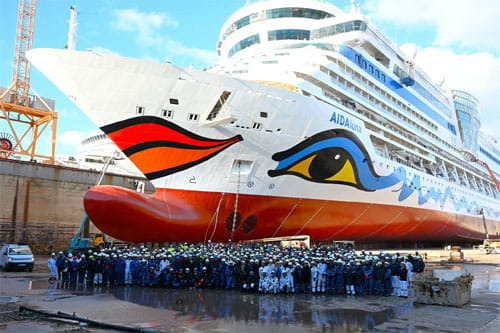
AIDA is leading the revitalizations across the corporation, having updated three ships so far (AIDA)
Revitalizations
A second leg of the strategy has focused on revitalizing existing ships. Renovations have seen new cabins added, along with new amenities on ships across the fleet. AIDA is moving into the second stage of a renovation strategy, having updated three ships (AIDAdiva, AIDAbella, and AIDAluna) and recently adding AIDAprima and AIDAperla to the renovation schedule along with the other four sisters in the Sphinx class. At the same time, Holland America Line will start its evolution program in 2027 with its four Vista class ships and two Signature class ships ultimately scheduled to be renovated. Weinstein highlights that while AIDA’s ships have higher density, limiting the opportunity for adding capacity, Holland America’s ships will increase their capacity by adding approximately 42 berths per ship during the modernizations, along with adding amenities. Similarly, Cunard’s Queen Mary 2 will begin a month-long overhaul in April 2027, which includes adding 31 new staterooms, including 16 Princess Grill category suites.
“While it is safe to assume that more vessels will be ordered for delivery in the 2030s, we have no plans to deviate from our one to two ships per year cadence,” explains Weinstein. “What we do plan to do is lean heavily into investing in return-generating modernization programs across our existing fleet.” He has also told investors, “You can expect to hear more in the coming months about significant enhancement programs for more of our brands.”
Redeploying Ships
Another leg of the strategy recently emerged as it plans to shift ships between P&O, Holland America, and Cunard. Holland America will get a fifth Vista class ship as P&O’s Arcadia will move to its fleet in 2029, expanding Holland America to 12 ships and adding 2,000 berths to its current capacity of approximately 23,000 berths. It is a logical move as Arcadia is built on a platform developed for Holland America, and the hull was actually the fourth in a five-ship order placed in 1999 and 2000. Before construction, the hull had been reallocated to Cunard, but before delivery, it was moved to P&O, which has operated the ship since 2000.
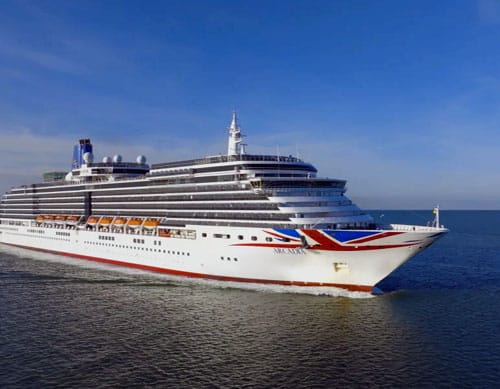
Arcadia shifts to Holland America
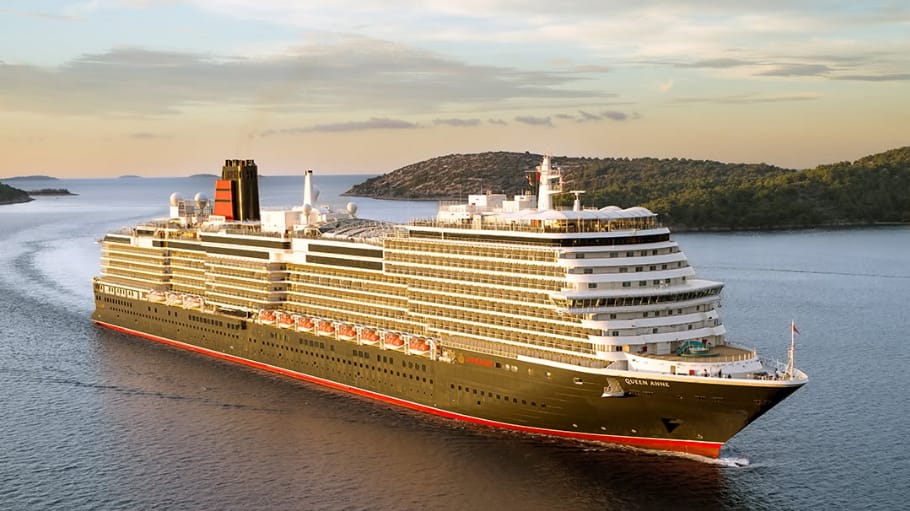
P&O will trade ships, and while losing the Arcadia, it will take over the Queen Anne from Cunard. As it is a larger, 3,000-berth ship, P&O will net out an increase of 1,000 berths also in 2029. Cunard is reduced back to its pre-2024 three-ship fleet.
Explaining the shuffling of ships between brands, a Carnival Corporation spokesperson explains, “Guest expectations keep changing, and we change with them. Sometimes that means moving ships to other cruise lines in the Carnival Corporation family where each one can shine brightest. By matching each ship to the guests and experience she suits best, we further enrich the guest experience and position the company for even stronger performance in the future.”
Deployment Strategy
Carnival Corporation is also showing shifts in its deployment strategy. It was recently announced that Carnival Cruise Line will redeploy two ships permanently away from Australia, removing nearly 5,000 berths from the market. Previously, it had said the two ships, Carnival Adventure and Carnival Luminosa, would be deployed seasonally in Australia during the Southern Hemisphere's summer.
At the same time, Costa recently moved its last ship from Asia. It had been in the Asian market for 20 years. It was a pioneer among the international brands entering the Chinese market, but now will focus mostly on the Mediterranean along with Brazil and the Caribbean in the winter months.

that matters most
Get the latest maritime news delivered to your inbox daily.
“We are actively shifting our deployment mix toward the opportunities we find most active,” Weinstein told investors. He notes that this is how they are achieving growth within a strategy of relatively flat overall capacity growth.
While Carnival Corporation is following a different strategy, at least near-term it is paying off. The corporation reported all-time high net income and revenues in its most recent quarter, with even management saying it had driven results ahead of expectations. Further, it noted that customer deposits were up nearly seven percent in the quarter to record levels. Entering 2027, Carnival Corporation reports its booked capacity and pricing are at record levels, as it also sees accelerating demand for its cruises.
