


Billionaire "Dark Fleet" Oil Traders Weigh In on Iran's Succession Battle
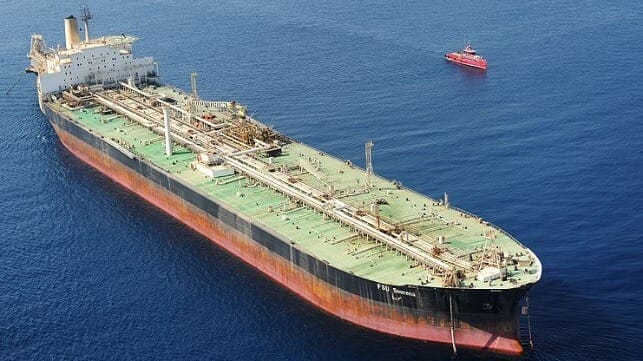
Iran's Supreme Leader Ali Khamenei is aging and his health is now openly discussed within Iran, raising the prospect of a succession battle over the future of religious rule - with implications for wealthy Iranian oil traders who provide the workarounds needed to circumvent Western sanctions.
Iran's religious rulers derive support from corruption and criminal networks, which both prop up the regime but which also make enormous profits for those connected to the inner circle. Two particular characters have weighed into the debate over who should succeed Ali Khamenei, both of whom have made enormous wealth from dark fleet activities shipping Iran's oil exports, and who have been sanctioned for doing so.
The record of their activities may not be wholly in the public domain, thanks to their skill in managing to hide their brokering activities within semi-legitimate businesses. But the information known to governments has been sufficient to see them sanctioned, even though they are both able to operate in some jurisdictions where the profit motive is regarded as more important than observation of Western-led sanctions.

Regime diehard Ali Shamkani at his daughter Fatemeh's wedding in Tehran. His son Hossein, resident in Dubai, has become rich by trading in sanctioned oil on behalf of the Iranian government (Instagram).
Mohammed Hossein Shamkani is the son of former Iranian National Security Advisor Ali Shamkani, still a close and hardline advisor to the Supreme Leader Ali Khamenei. Shamkani's companies Admiral, and Milavous based in Dubai, are alleged since 2011 to have blended Iranian and Russian oil and falsified origins, purportedly managing for many years to sell such cargoes to reputable Western oil majors. Shamkani was sanctioned by the EU in 2011, and was described in a recent EU sanctions update as being a "key player in Russia's shadow fleet operations". Notwithstanding EU sanctions, Shamkani has denied being associated with Milavous or being involved in the shipments of Iranian-manufactured drones to Russia. He was sanctioned by the US Treasury on July 30, 2025, a listing which linked him to Marvise SMC DMCC, Armada Global Shipping DMCC, Koban Shipping LLC, Crios Shipping LLC, and Fractal Marine DMCC, all based in the UAE. The US Treasury listing described Shamkani's empire as covering 'more than 50 vessels'.
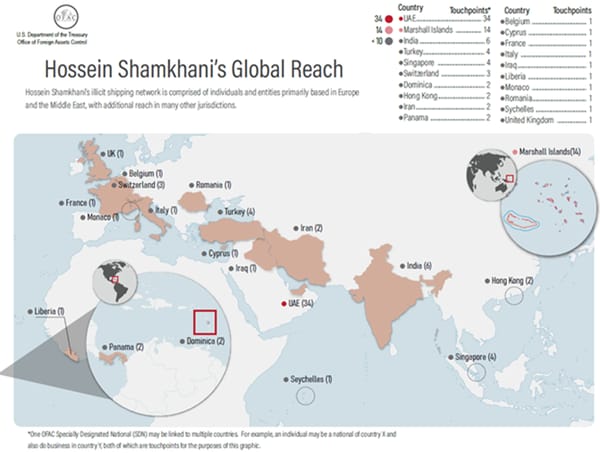
US Treasury graphic of the Shamkani business empire (US Treasury)
Babak Zanjani is similarly well-connected. Arrested for corruption in 2013, but not often found thereafter in jail, Zanjani was sentenced to death in 2021, accused of spreading corruption on earth, but more particularly for purloining $2.7 billion owed to the Ministry of Petroleum for oil exports conducted through his business empire. By order of the Supreme Leader, his sentence was commuted in 2024 to 20 years in prison, but he was soon out and back to work.
Zanjani's Sorinet Group is based in the UAE, and trades in cosmetics, finance and banking, hospitality, commercial aviation, infrastructure, building material, information technology and international real estate development. The company operates in Turkey, Tajikistan, Malaysia, and China, and in 2013 Zanjani estimated his net worth as $13.5 billion. By 2013, his business activities had earned him sanctions listings from the EU ("a key facilitator for Iranian oil deals and transferring oil-related money") and the US ("helping Iran evade sanctions by moving billions of dollars and channeling funds to IRGC-linked entities"). In particular, Zanjani was linked to ship-to-ship oil transfer activity off Malaysia's east coast.
Zanjani's post-penal business empire is flourishing, now known as the Avan Group, which has multiple dealings with IRGC and government entities. On December 2, he launched a blistering attack on X (to which only regime insiders have access), attacking the leading moderate in the Supreme Leader succession battle, ex-President Rouhani.

that matters most
Get the latest maritime news delivered to your inbox daily.
Both Shamkani and Zanjani still seem able to travel freely, but appear to have chosen to spend more time in Iran recently, presumably because of fears for their personal safety.
While those convicted of corruption on earth thrive for the time being, at least 5,000 Iranian oilfield workers have begun a series of well-supported strikes in the South Pars gas complex area, the largest for years, and despite intimidation from the authorities. The worker solidarity seen so far suggests that the strikes will continue, which will inevitably affect export shipments on which the regime depends for revenue. A constant irritant of many such as the striking oil workers is that while they are struggling to survive, corrupt and supposedly religious regime insiders get rich.
