


Bering Sea Trawler Boarded and Investigated in Pollock-Counting Dispute
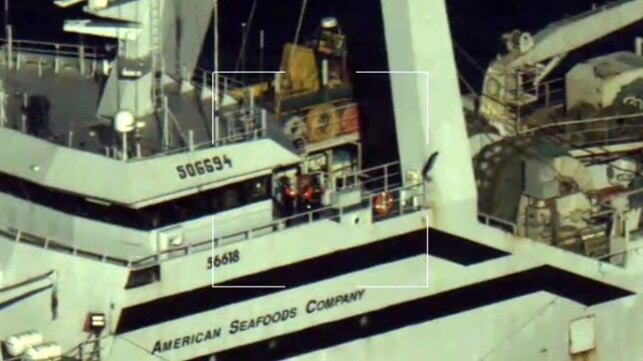
The U.S. Coast Guard and the Seattle-based American Seafoods Company (ASC) have launched a public dispute over how to count the pollock aboard a factory trawler in the Bering Sea. The Coast Guard claims that it found "significant violations" of fishing regulations aboard the vessel Northern Eagle, based on an allegedly substantial difference between the ship's pollock production records and its official electronic logbook. No charges have yet been filed, and ASC disputes any allegations of wrongdoing; in a statement Tuesday, the company said that it did not "under-report, conceal or hide" any catch or product on Northern Eagle.
The dispute stared during an earlier onshore audit, when NOAA Fisheries' Office of Law Enforcement discovered what it believed to be "major discrepancies between the vessel's production reports and electronic logbook." Suspecting a significant violation, NOAA Fisheries coordinated with the Coast Guard to conduct a boarding and inspection.
On March 26, the cutter USCGC Waesche met up with Northern Eagle at a position about 15 nautical miles from Dutch Harbor. The Waesche's crew boarded the vessel and pulled its logbooks for investigation. After review, NOAA Fisheries calculated that the ship's production weight exceeded its reported catch weight by 1,223 tonnes. Further investigation of logs from a previous voyage suggested that Northern Eagle underreported its take of pollock roe by about 12.4 tonnes, an amount worth about $150,000, NOAA said.
Waesche's boarding team stayed on the ship for a transit into nearby Dutch Harbor. At the pier, the crew unloaded the catch while officials counted out the boxes of pollock roe that came off the ship, finding an extra 241 boxes ($65,000) that were unrecorded in the logbook. Coast Guard Arctic District Commander Rear Adm. Bob Little ordered the extra roe seized and stored securely at a nearby cold storage site.
"The integrity of fisheries data is paramount for the sustainability of our nation's living marine resources," said Capt. Tyson Scofield, commanding officer of the Waesche. "This seizure highlights the Coast Guard's commitment to enforcing federal law with our partner agencies to ensure a level playing field for all fishermen who follow the rules."
In a statement Tuesday, ASC said that the discrepancy of 241 cases out of more than 72,000 cases on board was simply a routine difference between "daily production estimates and final production reports," and that the discovery has been "mischaracterized as a regulatory violation." The company says that the matter boils down to an accounting problem: by ASC's account, NOAA Fisheries' officers used an inaccurate and outdated method to calculate the raw weight from the finished production weight, resulting in misleading numbers - instead of going by the onboard flow scale weights, which are NOAA-regulated and used to calculate taxes and manage catch levels.
"We strongly reject any narrative that portrays a discrepancy in daily estimated production as an intentional breach of conservation measures that protect our fishery," said Inge Andreassen, President of American Seafoods. "There is no economic motive to report anything other than exactly what we produce."

that matters most
Get the latest maritime news delivered to your inbox daily.
It is the second time in recent years that ASC has become entangled in a regulatory dispute, following its disagreement with Customs and Border Protection over its former "Bayside Canadian Railroad" Jones Act compliance scheme. In 2024, ASC affiliates paid a near-record fine to settle charges of Jones Act violations centering on the alleged misuse of an exception that allows shippers to employ foreign-flag vessels in coastwise trade, but only if the transportation is conducted "in part over Canadian rail lines."
According to CBP, two ASC affiliates built a miniature railway on a dock in New Brunswick, Canada, scaled to accommodate one tractor-trailer truck on a 100-foot-long rail journey. For more than a decade, this Canadian rail treatment enabled the affiliates to move ASC's pollock from Alaska to New Brunswick using a foreign-flag ship, then onwards into U.S. consumer markets by truck - without U.S. vessels or mariners. A federal judge ultimately ruled that the Bayside Canadian Railroad did not meet the statute's standard for "transportation," and the two ASC affiliates paid a $9.5 million fine to CBP to settle the litigation - the second-highest Jones Act penalty in U.S. history.
