


Arctic Shipping: What Does it Mean for Trade, Environment, and Geopolitics
[By: Charlotte Edmond, Senior Writer, Forum Stories, World Economic Forum]
Earlier this month, China established the first scheduled cargo service between Asia and Europe via the Arctic Ocean, marking a major development in opening the Arctic to trade.
Passing north of Russia through the Arctic Circle halves the time it takes some ships to reach Europe compared to traditional routes south of Asia, but the route also holds significant environmental and geopolitical risks.
From China to Europe in 20 days
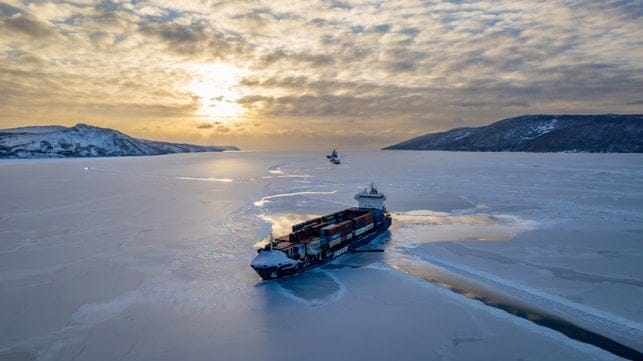
On 15 August, a Chinese-owned ship set off from the eastern Chinese port of Ningbo and is expected to complete its voyage to the UK via the 5,600km Northern Sea Route (NSR) in about 20 days. The ship, carrying high-value cargo including batteries and photovoltaic equipment, is the first of eight scheduled this season by the carrier Sea Legend.
Countries including India, South Korea and Japan have all shown interest in Arctic shipping routes, although China has been the most active in seeking passage, framing it as the so-called Polar Silk Road.
The pursuit of Arctic trade routes has intensified as the war in the Middle East and rising geopolitical tensions have highlighted the risks posed by strategic trade bottlenecks such as the Strait of Hormuz, Malacca Strait and Suez Canal.
Currently, the bulk of cargo using Arctic shipping routes is Russian oil and gas, passing between Russian and Chinese ports rather than across the full route into Europe. The volume has been growing in recent years, but is dwarfed by routes such as those through the Suez Canal.
Sea ice and weather conditions mean that the NSR is only accessible to many ships during the warmer months. However, with warming climates causing polar ice to retreat, the route is likely to become accessible for extended periods.
Sea Legend is using digital navigation and monitoring to adjust routing in real time according to conditions. From November to July, when only ships with reinforced hulls can pass through the route, the carrier company has bought or leased a number of smaller vessels. These are costly, in short supply and may still need to be accompanied by icebreakers.
All of this starts to erode the price and speed advantage of the NSR.
China has already been joined by others on the Arctic passage, with South Korean company PanStar also sending its first container ship from Busan New Port to Europe this month.
Travelling via the Arctic will cut the journey by around 7,000km and 10 days, with South Korea's Vice-Oceans Minister Nam Jae-hon saying the route was "bound to become an alternative" to Middle Eastern shipping routes.
Some experts have cautioned that South Korea's use of the NSR could expose operators to potentially violating Western-imposed sanctions if they use Russian-provided services such as icebreakers or emergency support. Moreover, observers note that China's partnership with Russia to transit the NSR poses a risk should it be used in the future for military purposes.
Threatening a fragile environment
Shorter journeys via the NSR burn less fuel, cutting both oil expenses and carbon emissions. So, in that respect, the route may offer some environmental benefit.
However, as the environmental group Bellona cautioned in its 2025 report, there are many other reasons why the route has environmental costs.
The Arctic ecosystem is fragile and already under pressure from warming temperatures and melting ice. The treacherous conditions the NSR presents – shifting ice floes, narrow passages, poor weather conditions – also create an increased likelihood of accidents and emergencies.
Furthermore, there is little capability in the region to deal with oil spills, for example, and ships stuck in ice may have to wait weeks for assistance.
In addition, noise pollution from ships may disrupt marine wildlife like whales and seals who depend on sound for navigation and communication. The habitat is also an important breeding and feeding ground for fish, migratory birds and marine mammals.
However, as receding ice makes the NSR passable for longer and conflict adds risk and tensions to alternative routes, the incentives to use the NSR may continue to grow for some countries.
This article is part of: Centre for Regions, Trade and Geopolitics at the World Economic Forum. It can be found in its original form online.

that matters most
Get the latest maritime news delivered to your inbox daily.
World Economic Forum articles are republished in accordance with the Creative Commons Attribution-Non Commercial-No Derivatives 4.0 International Public License.
The views expressed in this article are those of the author alone and not the World Economic Forum.
The opinions expressed herein are the author's and not necessarily those of The Maritime Executive.
