
Ukrainian Pressure on Russian Presence in Crimea Builds
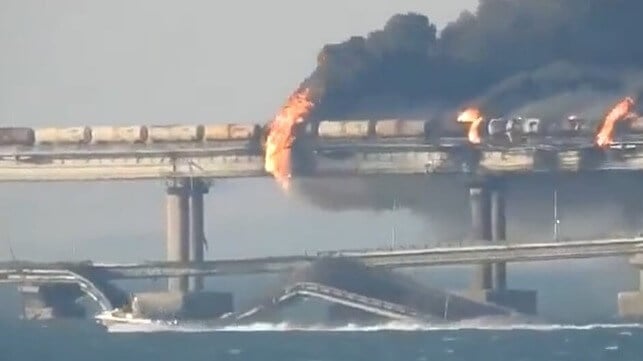
The long-running and carefully-designed Ukrainian campaign to weaken Russia’s occupation of Crimea appears to be building and may be reaching a culmination point.
Over many months, Ukraine has worn down the Russian base, fuel and logistic infrastructure in Crimea, which still remains an important support area for Russian front line operations in south-western Ukraine. Ukraine started this campaign by degrading Russian air defences which had provided a protective umbrella over Crimea.
At the same time, Ukraine continued its attacks on Russian shipping using ports in Crimea. Primarily using remotely-piloted one-way sea drones, the Russian Black Sea Fleet was largely pushed out of Sevastopol to the relative safety of Novorossiysk, and Crimean ports became increasingly dangerous for merchantmen. While not a 100% effective blockade, the Russian naval threat to Odesa has been pushed back, and the Russian military logistic organisation have had to switch to road and rail links.
Then the Ukrainians started on the road and rail links. The Kerch Bridge providing access to Crimea from the east has been weakened by attacks, and can no longer be used by heavy fuel and ammunition trains. The ferries the Russians used instead have progressively been attacked and sunk.
The alternative rail and road routes along the Sea of Azov coast are now within medium-range drone coverage, and are increasingly vulnerable. For truck drivers convoying on these routes, life expectancy is low. There a number of choke points on these routes, for example the few bridges across the North Crimean Canal dividing Crimea from the Ukrainian mainland. When bridges like those at Rozdolne and Vladislavivka are struck are repaired or replaced by pontoon bridges, they have been attacked again.
The impact of this campaign can be seen in the decision by the Russian military administrator for the Crimea to halt the sale of fuel to civilians, and by the large queues of civilian cars waiting to cross the Kerch Bridge – while it still remains open and before it is finally severed, which must be imminent. Crimea has become a military liability for the Russian, a drain on resources. The Ukrainians would probably prefer Crimea to remain a drain on Russian resources, Russia’s very own Stalingrad, knowing that they will delay their departure knowing that President Putin could never survive the humiliation of having to withdraw.
For now, the dominant position the Ukrainians have established over the Crimea has not had a major impact on frontline operations. There have been some Russian withdrawals, for example from the Kinburn Spit which dominates the entrance to the Dnieper River, and such tactical withdrawals will increase as the shortage of fuel, rations and ammunition impacts the Russian units on the Kherson and Zaporizhhzhia front lines in southwest Ukraine.

that matters most
Get the latest maritime news delivered to your inbox daily.
But perhaps more significant than adjustments and withdrawals on the front line will be the collapse of the illusion that Russians are doing well in the war. The Russian population in general, and maybe even Putin himself, have been regimented into believing that the war is far away and being prosecuted successfully. But on top of thousands of casualties, thick black smoke over Moscow, yet another cancelation of the annual St Petersburg Naval Parade, and sometime fairly soon a major disaster on the battlefield will come to a breaking point and then shatter this illusion, fatally undermining the credibility of President Putin’s leadership.
Historically, Russian has demonstrated extraordinary resilience in time of war, but it has also suffered some spectacular defeats. This time though, the parlous state of the Russian campaign to wipe Ukraine from the map of the world appears to be no temporary setback. Ukraine’s position is only getting stronger as it develops its own sovereign capabilities, such as in long range drones and hypersonic missiles. Increasingly, it is able to fight without being restrained by the weak-willed who think it would be nice to compromise and allow Russia to retain some of its illegally-seized conquests.
The opinions expressed herein are the author's and not necessarily those of The Maritime Executive.