


Op-Ed: Elbridge Colby's S. China Sea Reassurance Deepens Manila's Trilemma
Washington’s “model ally” label flatters Manila – but this is not resources and makes a claim to strategic autonomy harder to sustain.
[By Richard Javad Heydarian]
The festering conflict in the Strait of Hormuz coupled with the stubborn military deadlock in Ukraine have reinforced lingering doubts over American commitment to the Indo-Pacific region. An aircraft carrier in Asia is being diverted to the Middle East and military drills with South Korea are being scaled down. An authoritative global survey shows that, for the first time, America is viewed less favourably than China even among key allied nations.
Against this backdrop, Undersecretary of War Elbridge Colby used a visit to Southeast Asia to reassure allies and reassert American leadership. During arguably his most consequential speech as Pentagon’s policy chief, Colby presented a curious mélange of Trumpian chutzpah, superpower triumphalism, and strategic sympathy.
Speaking in Manila, he emphasised shared values with the Association of Southeast Asian Nations (ASEAN) and praised the Philippines as a “model ally”, which is “determined to strengthen its own capabilities to better defend itself and its interests” based on “a clear-headed pragmatism that matches the strategic demands of our time.” He met with the Philippines President Ferdinand Marcos Jr. and Colby also announced joint Filipino–American coast guard patrols in the South China Sea in face of growing Chinese assertiveness in the disputed waters.
The visit was broadly welcomed by the Philippine strategic elite as yet another demonstration of the enduring nature of bilateral cooperation between the century-old allies. The Trump administration’s bearhug of Manila, however, presents a trilemma for Manila. Proximity to an increasingly unpopular American administration undermines the Marcos Jr. administration’s claims to increasing self-reliance (for local audience) and strategic autonomy (to regional neighbors). It also complicates ongoing efforts to de-escalate the rising uptick in tensions in the South China Sea.
Nevertheless, it’s doubtful whether Washington is willing to provide sufficient assistance to a beleaguered Manila in face of an increasingly assertive China.
It’s doubtful whether Washington is willing to provide sufficient assistance to a beleaguered Manila in face of an increasingly assertive China.
Colby has gravitas as a leading strategic thinker in Trumpian circles, with his “Strategy of Denial” framework central to America’s current posture. Similarly to other top Trump 2.0 administration officials, he berated past administrations, both Democratic and Republican, in order to extol the real and imagined virtues of Washington’s “flexible realism”. There was the characteristic litany of jabs at critics, whose ideas Colby dismissed as “cheap talk” and “cloud-castle abstraction” of the “cognoscenti” and “elite commentariat”.
He also defended Washington’s increasingly aggressive foreign policy in the Western Hemisphere as an expression of “the best tradition of the Monroe Doctrine” with echoes of Rooseveltian “speak softly [but] carry a big stick” tradition. Despite channelling the “Make America Great Again” (MAGA) talking points, Colby proactively sought a common ground with Southeast Asia by claiming a shared commitment to “pragmatism” and “dialogue”. An architect of the first Trump administration’s “National Defence Strategy”, which declared a new era of “Great Power Competition”, Colby portrayed the Trump administration’s diplomatic outreach to both Moscow and Beijing as Kissingerian wisdom.
With Washington jettisoning its “democracy promotion” mantra, and now openly questioning the very liberal international order it fostered, the Pentagon’s policy chief spoke of the “spirit of partnership” and “respect” rather than “dependency” and “hectoring” in its dealings with ASEAN. He spoke of “co-investing” in military cooperation to ensure Manila also has “capabilities required to deter aggression”.
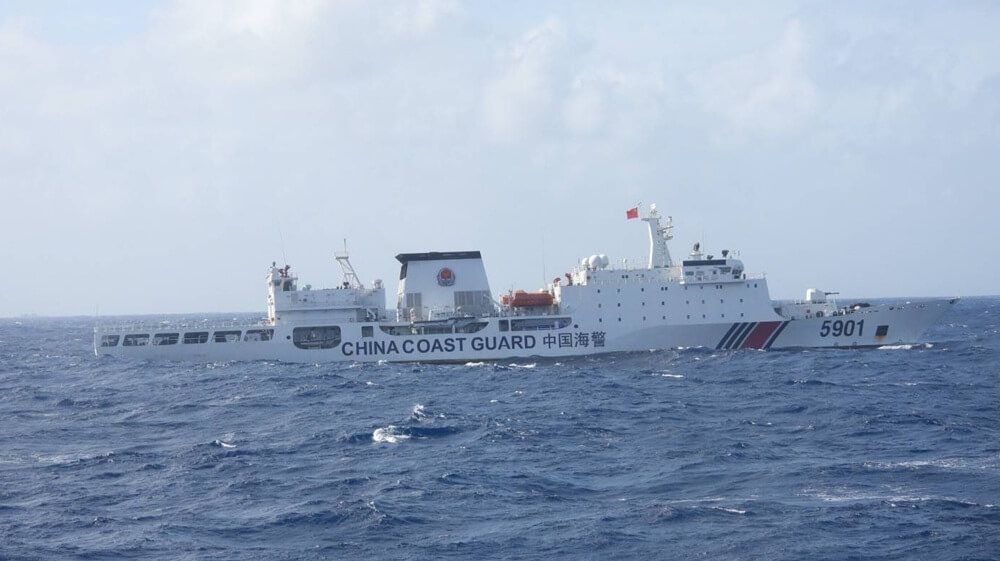
His visit was timely. China has stepped up its harassment of Philippine position in the South China Sea, culminating in the injury of Philippine navy servicemen in the hotly-contested Second Thomas Shoal. Given the permanent presence of Filipino troops in the area, the contested feature effectively falls under the Philippine-US mutual defence treaty. There are growing fears over Chinese construction of military facilities in the Scarborough Shoal, another hotly disputed feature that falls within Manila’s exclusive economic zone.
The Philippine president had earlier criticised Trump’s ill-fated Iran war as deeply injurious to America’s energy-dependent allies. The Philippines has suffered its slowest growth in decades (excluding the pandemic years) due to global energy disruptions wrought by the Strait of Hormuz closure. Despite the lofty rhetoric from Trump officials, however, Washington has yet to provide concrete ways to ameliorate its ally’s troubles. If anything, the Trump administration even slapped yet another round of double-digit tariffs on Philippine exports based on unsubstantiated claims of unfair labour practices. Years-long negotiation over a bilateral free trade agreement have hit the wall.
Nor has America - now confronting rapid exhaustion of its critical assets due to ongoing wars in other theatres - cleared the transfer of high-grade military assets, especially the desperately needed modern fighter jets for the Philippine Airforce. Trump’s unpopularity has even imperilled the Washington-backed “Pax Silica” initiative, which promises massive investments in critical mineral processing and semiconductor production but has faced stiff criticism across Philippines due to concerns about corrosive investments.
Nevertheless, America’s reassuring rhetoric has been sufficient enough to derail ongoing efforts by top Filipino diplomats to de-escalate tensions with Beijing. In particular, it has emboldened China hawks in Manila to advocate for an increasingly strident stance, most notably Philippine Defence Secretary Gilberto Teodoro Jr. who was recently slapped with Chinese sanctions. America’s expanding military footprint in the Philippines, including major drills in and weapons deployment to provinces close to Taiwan, will likely torpedo prospects of a thaw with China for the foreseeable future.
It also corrodes the Marcos Jr administration’s claims to self-reliance and strategic autonomy vis-à-vis its superpower ally. The second Trump administration, therefore, has done just enough to keep Manila on its side, yet has left the outgoing Marcos Jr. administration in an invidious position where it can neither fully deter nor effectively engage an assertive China.

that matters most
Get the latest maritime news delivered to your inbox daily.
Richard Javad Heydarian is a Manila-based columnist, academic, and author.
This article appears courtesy of The Lowy Interpreter and may be found in its original form here.
The opinions expressed herein are the author's and not necessarily those of The Maritime Executive.
