


Op-Ed: Conflict With Iran Opens a Missile-Defense Gap for China
[By David Axe]
The US- and Israeli-led war on Iran has been, with a few key caveats, a quick military success for the United States and its allies. That doesn’t mean it’ll be a strategic success. Indeed, the euphoria in Washington and Jerusalem could quickly turn into despair if the successful air campaign leads to lasting regional chaos or, equally worrying, a protracted ground war.
In any event, the so-far lopsided conflict offers important lessons for the Asia-Pacific. It has revealed just how many munitions it takes to attack and defend during a back-and-forth bombardment. It’s been a reminder of the enduring effectiveness of high-tech air power, especially manned air power. And it has underscored the importance of decentralized command and control.
Munitions stocks
In less than a week of fighting between 28 February and 5 March, US and allied forces expended probably thousands of offensive precision munitions, including cruise and ballistic missiles and guided bombs, striking many hundreds of targets across Iran.
Offensive weaponry isn’t really the problem, however. US forces have stockpiled thousands of Tomahawk and Jassm strike missiles and hundreds of thousands of satellite-guided JDAM bombs and their variants. The production lines for these munitions are hot, additional orders are coming, and inventories should shrink only temporarily.
But offensive weaponry isn’t the problem. By provoking Iran into counterattacking with one-way Shahed attack drones and a variety of short- and medium-range ballistic missiles, the US and its allies set themselves up for long-term failure—especially when it comes to missile defence.
Swatting down the majority of the roughly 800 ballistic missiles Iran has fired at bases and cities across the region, US and allied forces have expended perhaps 2,000 very expensive missile interceptors that US industry builds at rates far too low to immediately replenish inventories.
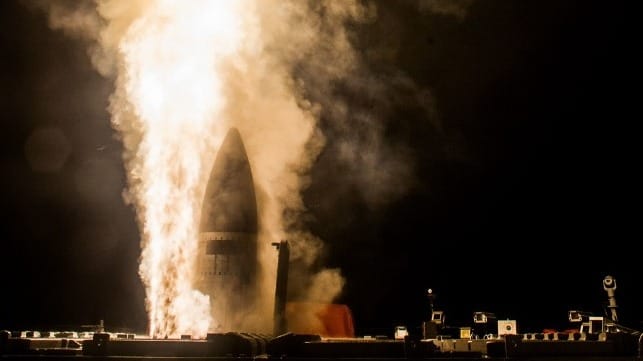
The best land-based Thaad and sea-based SM-3 interceptors, which can strike the biggest and fastest non-nuclear ballistic missiles hundreds of kilometres away, both cost around US$10 million (A$14 million) and up per round and are in particularly short supply. The US may have run down its stock of each type by a quarter or a third in just a few days of intensive use.
Thaad-maker Lockheed Martin and SM-3-maker Raytheon are both spending billions to expand their production lines, potentially quadrupling output of the Thaad interceptor from 100 to 400 rounds per year and doubling SM-3 output from its modest rate of a couple of dozen each year. But the ramp-up could take years. In the meantime, reserves are low.
For China, a much bigger missile power than Iran ever was, that’s an opportunity. Thaad and SM-3 interceptors are the best, and in some cases only, defences against the best Chinese ballistic missiles. Before 28 February, US forces had too few of their best interceptors to defeat a determined Chinese attack. Now they have even fewer. And it will be years before there’s any prospect of that meaningfully changing, given that a Thaad missile ordered today will be delivered around 2030.
If Chinese leaders plan to make good on decades of threats and finally invade Taiwan, there’s a window between now and three or four years from now when the long-term missile gap—between China’s offensive missiles and the US’s defensive ones—will yawn most. That may be the best time for Beijing to strike.
There’s no easy solution to this problem. In the later days of the current war on Iran, US and Israeli forces have relentlessly hunted Iranian missile launchers, clearly intending to blunt Iran’s most potent striking force and alleviate the stress on their own interceptor inventories.
Hitting the enemy weapon before it’s launched is an operational answer to an industrial question: how to maximise supplies of hard-to-replace interceptors. But that approach may not work in a war with China, where the sheer density and sophistication of Chinese air defences could prevent intensive launcher-hunting.
No, the US and its allies need interceptors if they hope to win a major war in the Pacific. Thanks to the war on Iran, they simply won’t have enough interceptors for years to come. Victory in the east is less assured than ever.
Air power works
For all the justified alarm over interceptor stocks, advocates of air power—especially manned air power—should be pleased with the tactical and operational results in Iran. At the cost of just three US Air Force Boeing F-15E fighters—accidentally shot down with no loss of life by a Kuwaiti air force Boeing F/A-18 fighter—US air and naval forces have destroyed nearly the entire Iranian navy, much of the Iranian air force and a substantial portion of Iran’s missile launchers.
They did it by the book, surprising few but shocking many. First, cruise and ballistic missiles struck Iranian air defences and headquarters, punching holes in Iranian air space and sowing confusion among surviving leaders. Amid intensive aerial jamming that scrambled Iranian radars, manned bombers including Northrop Grumman B-2 stealth bombers followed, firing additional cruise missiles and dropping precision bombs to deepen the damage.
A few days in, Iran’s defences were so frayed that it was fairly safe for non-stealthy manned aircraft to fly deep into Iran to drop precision bombs. Slow and highly vulnerable General Atomic MQ-9 drones ranged across Iran, practically daring the increasingly battered Iranians to shoot back as the drones fired short-range Hellfire missiles at Iranian missile launchers.
It’s been a textbook precision air campaign. As long as the US and its allies keep the war short, keep it in the air and find some exit strategy that doesn’t prolong regional chaos or mire them in a ground campaign, they can justifiably declare a sort of victory.
For now, that is. A clean exit may leave a hardline regime in place in Iran. That regime may be more incentivised than ever to pursue nuclear weapons as a deterrent. The true long-term price of short-term victory in Iran would, in that case, be its fleetingness. It’s not hard to imagine the US and friends fighting this same war again in a few years’ time, and potentially with the same unsatisfying outcomes.
Mission command is the best command
The Iranian regime may survive. Its nuclear ambitions may persist. But, yes, it is losing this war in the sense that the US and allies have freedom of action and the Iranians aren’t even safe in deep underground bunkers.
But they’ve done at least one thing right on the battlefield. As war loomed, Iranian commanders delegated authority to low-ranking officers to fight independently. There’s a term for that kind of distributed command structure: mission command. It’s central to the way Western armies fight. And it clearly has adherents in Iran.
The idea is that, amid the widespread communications breakdowns that tend to result from sustained bombardment, small units on the ground can still fight back as long as they understand the overall objectives. In Iran’s case, the objective couldn’t be clearer: survive and resist.
Mission command is why Iranian missiles and drones continued to rain down on US bases and the cities of regional allies even as the death toll among Iran’s leaders and top commanders steadily rose. Mission command is why the air space over Iran won’t be totally safe until the last soldier with a shoulder-fired missile is eliminated—that is, never.
Mission command is why, if the White House unwisely deploys ground troops, what began as a quick victory of sorts in the air may turn into a grinding land war—the kind that arguably destroyed whatever remained of a US political consensus over the long years of the Iraq and Afghanistan wars.
The Iranians are losing—for now. But if they get to fight US soldiers and marines on their own terrain, they’ll no longer be losing. As four US presidents learned the hard way starting in 2001, enemy ground forces, who quickly become insurgents once they cast off their uniforms, can win by mostly waiting.
That’s a lesson no government anywhere should forget, whether in the Middle East, Europe or the Asia-Pacific. High-tech air campaigns are deceptively easy as long as the enemy is outmatched and the munitions are plentiful. Grinding ground campaigns are deceptively hard, no matter how outmatched your enemies appear to be and how many pricey munitions you hurl at them.

that matters most
Get the latest maritime news delivered to your inbox daily.
David Axe is a journalist and filmmaker in South Carolina, United States.
This article appears courtesy of The Strategist and may be found in its original form here.
The opinions expressed herein are the author's and not necessarily those of The Maritime Executive.
