


Charting the Future
ClassNK is shaping the future not only for itself but for an entire industry.
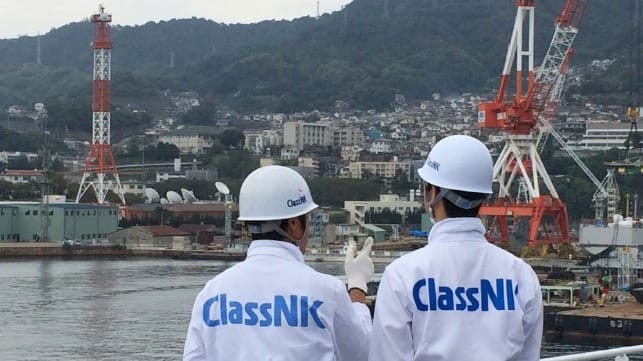
(Article originally published in Mar/Apr 2026 edition.)
"What comes next?" That's the big question ClassNK President & CEO Hayato Suga keeps asking, and it's something that every class society is facing as the pace of technological change accelerates and the role of classification evolves.
His answer is straightforward: "We must go beyond being an accredited certification body and evolve into an organization that shapes the future."
That's a tall order, but Suga is confident.
Drawing on his 40 years of ClassNK experience, he says the shipping industry needs additional support from classification societies at a time when boundaries between industries are becoming increasingly blurred as a result of environmental challenges and digital transformation. That means focusing on expanding services related to digitalization and decarbonization.
"We are in the midst of a major change," Suga states. "We must evolve and move forward. The continuous emergence of new technologies demands that classification societies engage in thinking about and shaping what is coming next."
NIPPON KAIJI KYOKAI (CLASSNK)
Founded in 1899 as Teikoku Kaiji Kyokai in Tokyo, ClassNK was originally established to promote the regulation and development of the fast-growing shipping and shipbuilding industries in Japan.
By 1915, the structure necessary for ship classification operations was ready. In 1919, Teikoku Kaiji Kyokai gained international recognition by forming a group of four with the three major classification societies at the time – LR, ABS and RINA. The first ship to receive a class certificate from Teikoku Kaiji Kyokai was the *Kwanan Maru* in 1920.
Teikoku Kaiji Kyokai was relaunched under its current name, Nippon Kaiji Kyokai in 1946 in the aftermath of World War II. In 1968, Class NK became one of the seven founding members of IACS, the International Association of Classification Societies, established to represent the major national class societies and promote international initiatives and cooperation on ship safety. It's held the chairmanship of IACS on five different occasions.
Now in its 127th year, the society has grown rapidly and earned a global reputation, known especially for its expertise in GHG reduction technologies through alternative fuels and energy-saving devices as well as logistics service certification and a host of other services.
Most important, says Suga, is the trust and credibility it has earned over the years from its clients, many of whom have been on board for decades.
LEADING THE WAY
Since taking the helm a year ago, Suga has instituted a number of personnel system reforms designed to empower employees at all levels of the organization.
"Our greatest asset is our human resources," he says, "and I believe that their real capacity is much larger than what we see now. So change begins with them. We want to foster a culture where everyone takes initiative, and we value employees who think and act proactively and do more than just follow instructions properly."
Culture change is one part of Suga's strategy. Another has to do with assisting companies as they deal with a fast-changing environment. "It's our responsibility to work with customers to provide certification and related services in a timely manner that meets diverse and fast-evolving needs," he notes.
One of those fast-evolving needs is guidance on the energy transition, and ClassNK is leading the way. Last year it added ClassNK Fleet Cost Simulation to its alternative fuels lineup to help clients calculate the added regulatory costs of measures like FuelEU Maritime and the EU ETS.
The company is a leader in the technology of ammonia, and its "Guidelines for Ammonia-Fueled Ships" is another pioneering work. Demonstrating its scope of alternative fuel services, last October it added Japan's first hydrogen-fueled tugboat, *TEN-OH*, to its register.
The company is also a leader in guidance for wind-assisted propulsion systems, publishing the second edition of its landmark "Guidelines for Wind-Assisted Propulsion Systems for Ships." The Guidelines cover survey requirements, design considerations, class notation and risk-assessment protocols for rigid sails, rotor sails, kites and turbo sails.
"We're committed to helping shipping overcome its uncertainties on energy transition by providing accurate information, reliable technical assessments and certification," Suga explains. "During the fuel transition period, we expect multiple solutions to coexist in parallel."
In the short term, this means biofuels and LNG will likely play a role, followed by a shift toward greener options including blue fuels.
"As the range of possible fuels will depend on future technological developments and investment trends," Suga adds, "it's difficult at this stage to narrow the options down to a single solution. It's therefore highly likely that multiple fuels will continue to coexist depending on vessel type and operational needs."
Going beyond maritime, ClassNK this year became Asia's first provider of Sustainable Aviation Fuel certification. This is in support of the International Civil Aviation Organization's 2027 reporting requirements, which will include carbon offsets for the first time.
Ship retrofitting is another key focus, where the main challenge lies in modifying legacy systems while ensuring technical integrity and safety – right up ClassNK's alley and an area in which it excels. And even as it is expert at extending ships' lives through retrofitting, it is equally expert at ensuring their environmental compliance as they approach the end of their useful lives.
Long before the Hong Kong Convention on recycling came into force last year and even prior to its adoption in 2009, ClassNK was proactively involved in supporting its implementation. To date, it has certified over 70 recycling yards and issued approvals for the Inventory of Hazardous Materials (IHM) for more than 5,000 vessels. In addition, its PrimeShip-GREEN/SRM ship recycling software is the de facto industry standard.
GETTING TO THE "TOP"
Suga says his goal is to become a class society that he can proudly call the "top."

that matters most
Get the latest maritime news delivered to your inbox daily.
"This does not mean that sales or market share are the top, but that I want to be recognized by the industry and customers as the top. It's about being recognized as the most trusted. To achieve this, it's essential to respond quickly to industry challenges and provide the best services aligned with the needs of our customers."
By charting the future and focusing on what comes next, Suga and ClassNK are setting a standard for the rest of the industry to follow. They're also well on their way to the top.
The opinions expressed herein are the author's and not necessarily those of The Maritime Executive.
