
Op-Ed: Royal Navy Operational Readiness Has Been Lost
The Royal Navy is facing multiple operational readiness issues, which are impacting capability across what remains of a fleet much reduced in size. The issues are likely to be enduring, notwithstanding the imminent issue of a much delayed Defence Investment Plan, which when it is published later this month will allocate long-term funding to the procurement program.
The problems are not confined to one class of ship.
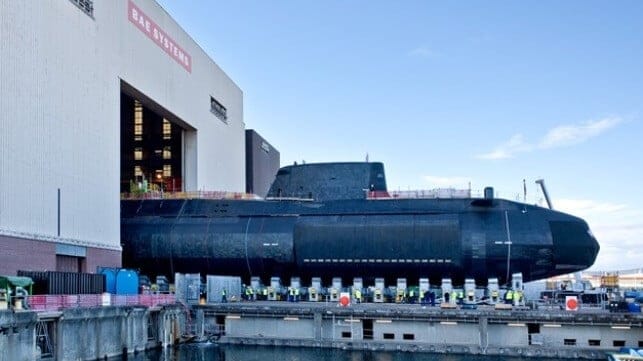
None of the Royal Navy’s Astute Class nuclear attack submarines are available for deployment. HMS Anson (S124), which left Faslane on January 10 for an extended duration deployment to HMAS Stirling in Western Australia, was seen docking back in Gibraltar on May 14, and is awaiting maintenance after its deployment. Of seven Astute Class submarines to be built, five are commissioned, with the sixth HMS Agamemnon (S124) on sea trials prior to handover. The last boat HMS Achilles (S125) is not due to be commissioned until 2029.
This presents major operational difficulties, as a nuclear attack submarine is normally needed to support the nuclear deterrent ballistic missile submarines as they deploy and recover to Faslane. The service is just about managing to maintain the continuous nuclear deterrent at sea, but the aging Vanguard Class submarines are also suffering major maintenance issues and cruises are having to be extended to ensure that there is always one boat at sea. The Royal Navy is keeping its fingers crossed and hoping that at least one Astute-class submarine is operational by the time of the next ballistic missile submarine rotation.
The availability of the six Daring-class Type 45 guided missile destroyers, the primary air defense capability in the fleet, is also in crisis. After a struggle, HMS Dragon (D35) finally set off for the Eastern Mediterranean weeks after it was needed to supplement the defenses of the British bases in Cyprus, and is now operationally deployed as part of the French Charles de Gaulle carrier strike group in the Arabian Sea. HMS Duncan (D37) is also operational, part of the HMS Prince of Wales (R09) carrier strike group. But the other ships of the class were not available, still queuing to undergo the long running Power Improvement Project to rectify the mechanical design fault in the hot climate conditions encountered in the Gulf; HMS Daring (D32) is now crewed but has still not returned to the fleet after a refit which has stretched to an incredible 3,300 days. Weaknesses in Daring Class availability still need to be overcome, particularly if there is a long gap before the successor Type 88 destroyers, still not programmed, come into service.
Of the two aircraft carriers, HMS Prince of Wales (R09) has recovered from a minor breakdown and is back at sea on exercise in the High North. The potential of the two carriers is restricted however by the paucity of the Royal Navy’s F-35B fleet, meaning that the carriers only deploy with about the same number of F-35Bs which are routinely deployed on the much smaller Italian carrier ITS Cavour (CVH 550).
The frigate fleet, made up of Type 23 frigates mostly 30 years old, is down to four ships, with HMS Kent (F78) undergoing refit and the remainder kept operational only with great difficulty. Numbers are likely to sink even further before the first Type 31 HMS Venturer (F12) enters service in 2027, followed by the first Type 26 HMS Glasgow (F88) in 2028.
To keep numbers up, Hunt Class minesweepers HMS Middleton (M34) and HMS Chiddingfold (M37), plus Sandown Class minesweeper HMS Bangor (M109), all of which have been withdrawn from Bahrain and were heading for retirement, will be retained for service with the Portsmouth-based 2nd Mine Countermeasures Squadron.
The two Landing Platform Dock ships to support amphibious operations, HMS Albion (L14) and HMS Bulwark (L15), have been mothballed prior to a potential sale to Brazil, despite their relative youth. The limited amphibious capability which the Royal Fleet Auxiliary can provide instead has been hobbled by a long-running labor dispute which is still affecting both recruitment and manpower availability. A bright note for the future is that Navantia’s construction of three Fleet Solid Support ships for the RFA is underway, not only delivering missing capability but reviving ship-building skills at Harland & Wolf in Belfast.
Even with a planned reduction in the size of the Royal Navy fleet, there are common problems which affect the availability of ships across all classes. These are apparent to a far greater degree than in other European navies, where for example the well-managed Italian Navy is on a lower budget but deployed globally in strength and with high levels of fleet readiness.
With the defense budget reduced over many years, service chiefs have placed emphasis on maintaining front-line capability, and neglected budgetary investment in second order capabilities such as training, maintenance facilities and manning, capabilities which have turned out not to be second order priorities but essential elements of operational readiness.
Service commanders, in post for relatively short periods, have tended to put a gloss on short-comings during their tenure rather than speak out or resign, leaving successors with a growing set of problems.

that matters most
Get the latest maritime news delivered to your inbox daily.
Politicians consistently have thought money could be saved in the short term by elongating procurement programs, leaving office and far from accountability when the medium to long term consequences of additional maintenance issues then begin to surface.
Although there is general acknowledgement that threat levels have risen substantially, this has not translated into recognition of the need to increase investment in defence. The Defence Investment Plan to be published this month will be a step in the right direction, but not nearly enough to overcome years of neglect any time soon. Critical to the Navy regaining its previously formidable capability is whether or not sufficient specialized skills and experience can be retained for long enough to still be passed on to the next generation of sailors – which can only be done if there are ships to sail in.
The opinions expressed herein are the author's and not necessarily those of The Maritime Executive.
