
Floating Data Centers: Uptime is the Product
The challenge isn’t putting a data center on water. It’s delivering hyperscale-level availability in a maritime environment.
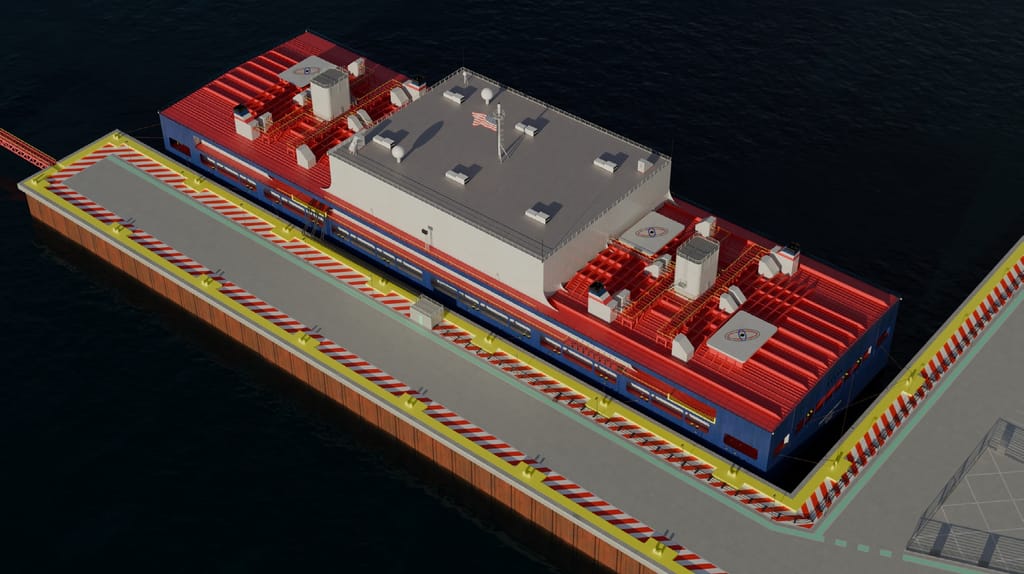
Frank Genco, ABS Vice President of Strategic Account Program writes that with the right partners, data center operators will find transitioning their land-based infrastructure to a marine environment delivers safer, more secure and sustainable performance.
Every industrial revolution comes with its own infrastructure, which must scale rapidly in order to fuel the innovation and associated disruption that comes in its wake. Data centers are the factories of the AI revolution, and their rapid growth — in scale, output and resource-demand — is already outpacing capacity in some areas, particularly when it comes to grid connections, water resources and the tolerance of local communities. By siting data centers offshore, however, many of those constraints can be resolved, enabling timely development of hyper-scale computing to meet accelerating adoption of AI.
Floating platforms are not novel
The challenge is not putting a data center on water. ABS-class assets ranging from regasification units and deep-sea FPSOs to autonomous spaceport drone ships have been operating in demanding marine environments for decades. The industry has a long record of doing this reliably.
The challenge is delivering hyperscale-level availability in a maritime environment. Data centers specialize in training AI models or undertaking inference workloads related to real-time search engines and chatbots. Both require higher power densities than legacy computing infrastructure. Training models is a particularly intensive exercise, with power draws surging or declining by 30-60% within milliseconds. This places a huge strain on GPUs and power supply systems as well as requiring advanced liquid-cooling systems to sustain compute-intensive jobs. Here, being offshore is an advantage, with the use of seawater for cooling expected to make a major dent in power demand.
Uptime is already a mature discipline offshore
Every minute of downtime is lost computing capacity. In training models, this can see workloads set back by hours, days or weeks. In inference centers, which are revenue-linked, outages can have a direct commercial impact. The industry standard uptime guarantee is 99.999% — the “five nines” — but data from some AI clusters suggests higher failure rates due to the scale and complexity of these training runs. One study reported that one in five surveyed data center operators reported outage costs exceeding $1 million, and one in ten said their last outage had serious or severe impacts.
Striving for a “five nines” uptime guarantee, however, is not unique to data centers. High uptime thresholds are set for all offshore assets, from oil and gas production to offshore wind. Downtime on an FPSO can run into millions of dollars per day as a result of lost production and recovery costs. As a result, offshore operators invest heavily in technology, redundancy and training to optimize operations and minimize downtime, and bring in technical authority, like ABS, to help ensure safe and reliable operations day-in and day-out, not just for years, but for decades.
Predicting faults, pre-empting failure
Achieving "five nines" availability is not simply a matter of designing in redundancy. It depends on understanding how equipment degrades over time, especially in a maritime environment, identifying early indicators of failure and intervening before performance is affected. This is an area where offshore industries have developed mature methodologies over decades of operating complex assets in remote, harsh environments.
Digital twins, for example, provide operators with a dynamic representation of the asset, allowing performance to be monitored against expected operating conditions and enabling maintenance scenarios to be tested before work is undertaken. Condition monitoring systems continuously assess the health of equipment, electrical systems and critical infrastructure, while predictive maintenance uses operational data and analytics to identify emerging faults long before they become failures. Rather than reacting to breakdowns, operators can work proactively, planning interventions around operational requirements, reducing disruption and improving asset availability.
ABS has spent years developing and applying these approaches across some of the world’s most demanding offshore assets. Its condition-based classification framework, already used on FPSOs and other complex floating production units, integrates real-time data, digital twin modeling and predictive analytics to shift inspect and maintenance from fixed schedules to asset-driven decision-making. This translates directly to floating data centers, where the same logic applies: the earlier a fault is identified, the lower the cost of intervention.
These same principles also apply to power distribution systems, cooling infrastructure, electrical equipment and marine systems. As AI workloads create highly dynamic power demands, combining operational technology data with predictive analytics will become increasingly important in maintaining stable, reliable operations.
Minimizing repair time
When failures do occur, the differential between high performance and poor performance is not the number of failures, but by how quickly they recover from them.
Offshore maintenance planning begins long before equipment fails. Critical spare parts are strategically stocked, and logistics routes are planned to minimize costly mobilization times. Crew competency is equally important as personnel must have the technical skills and decision-making capability to diagnose faults and restore operations safely and efficiently – often now backed through real-time remote diagnostic tools that connect to shore-based experts.
For floating data centers, this philosophy becomes even more important. Every hour spent waiting for replacement equipment or specialist engineers represents lost compute capacity. Starting with “maintenance by design” principles so that computing racks and associated systems are easy to access will be as important as the resilience of the underlying technology itself.
ABS has been working with floating data center developers from the concept stage, applying the same principles as a classification input, not an afterthought. The goal is to have accessibility, spare parts strategy and fault recovery baked into the design before the first line is drawn.
Optimizing assets for the long term
Floating data centers are unlikely to be short-life demonstration projects. Like other offshore infrastructure, they will be expected to deliver reliable performance over operational lifetimes measured in decades while adapting to changing technologies and customer requirements.
The offshore sector has developed systematic approaches to managing long-term asset performance through reliability-centered maintenance, lifecycle asset management and risk-based inspection, methodologies that ABS helped develop and has applied across floating production assets for decades. These approaches prioritize maintenance based on operational criticality rather than fixed schedules, allowing resources to be focused where they deliver the greatest improvement in reliability. Performance benchmarking across fleets also enables operators to identify recurring issues, compare operational efficiency and continuously improve maintenance strategies.
For floating data centers, these disciplines offer a framework for managing not only the platform itself but also the rapid refresh cycles of computing hardware. While GPUs and servers may be replaced every few years, the supporting marine infrastructure, power systems and cooling architecture must continue to operate reliably for decades. Managing these different asset life cycles together will be key to successful operations.
What changes when the offshore "factory" is computing instead of hydrocarbons?
The engineering principles behind reliable offshore operations remain remarkably consistent, regardless of what the asset produces. Redundancy, maintainability, resilience and disciplined operational management transfer directly from offshore energy into floating data centers. The difference lies in the payload.
Instead of processing hydrocarbons, the facility is processing information. The critical systems shift from separators and compressors to high-density power distribution, cooling systems, fiber connectivity and AI compute clusters. Failure modes also evolve. Thermal management becomes mission-critical. Millisecond fluctuations in electrical supply that might be insignificant elsewhere can interrupt AI workloads, causing expensive modelling losses and delay. This intersection of proven offshore experience with emerging computing technologies creates a unique operational environment – one that will pull together multidisciplinary teams from very different industries. Finding a common language and developing shared knowhow will be key.
Why classification and assurance matter
For many data center developers, investors and hyperscale customers, offshore operations are unfamiliar territory. Confidence will not come from demonstrating that floating data centers can be built but from demonstrating that they can consistently achieve the levels of reliability and availability expected by digital infrastructure customers.
Independent classification and technical assurance have long played a central role in building confidence. ABS, as a classification society, provides independent verification that complex offshore assets have been designed, constructed and operated to meet defined performance and safety standards throughout their service lives.
Over generations, the marine and offshore sectors have pushed boundaries, from bigger structures to deeper wells and remoter waters, by evolving and embedding technologies, processes and methodologies that have helped enable safer and more reliable operation in some of the harshest environments on the planet. ABS has been part of that journey for the offshore energy sector since the beginning, helping operators optimize asset integrity, reliability engineering, maintenance strategies and inspection regimes across some of the world's most complex offshore assets. Those same disciplines now provide the technical rigor to support a new generation of offshore digital infrastructure.

that matters most
Get the latest maritime news delivered to your inbox daily.
 Frank Genco is ABS Vice President of Strategic Account Programs.
The opinions expressed herein are the author's and not necessarily those of The Maritime Executive.
