

WHOI Research Vessel Neil Armstrong Makes Rare Great Lakes Voyage
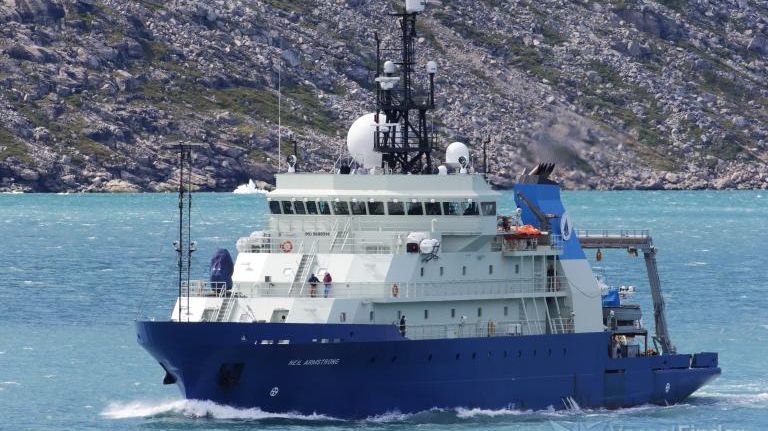
The oceanographic research vessel Neil Armstrong has set sail on an unusual science mission that will take it through the Great Lakes for the first time. Accustomed to operating in the open ocean, the vessel is undertaking a challenging journey through rivers, locks, and inland waterways.
The Woods Hole Oceanographic Institution (WHOI) announced that Neil Armstrong is on its way to support the Experimental Neutrino Detector (END), a physics experiment that will try to detect neutrinos in Lake Superior. The vessel departed its home port of Woods Hole, Massachusetts, on October 28 for a 2,500-nautical-mile transit to Duluth, Minnesota, at the western tip of Lake Superior. It is expected to arrive around November 9.
According to WHOI, bringing a large oceangoing research ship from the Atlantic Coast to Lake Superior has required careful planning, since each river, lock, and connecting waterway along the route has its own rules and navigational hazards.
WHOI is relying on the experience of its marine operations team to get the ship and crew safely to Lake Superior. “Research vessels like the Armstrong are accustomed to operating in demanding conditions, but this trip has a unique set of challenges,” said Kent Sheasley, Neil Armstrong’s master and one of the two captains sharing command of the voyage. Those challenges include the change in buoyancy as the ship passes from salt water into fresh water, tight maneuvering in narrow rivers and locks, wave conditions on the lakes, and Midwestern weather, Sheasley said. The crew is also consulting local pilots who know the Great Lakes routes well.
Neutrinos are subatomic particles that pass through ordinary matter almost without interacting, which makes them extremely hard to detect. Physicists study them for clues to fundamental questions about the universe, including why it contains far more matter than antimatter. The study is led by the University of Minnesota Duluth (UMD) with support from federal agencies.
Neil Armstrong, which can carry 24 scientists and a crew of 20, is expected to deploy five underwater detector arrays and their fiber-optic cables in Lake Superior. After arriving in Duluth, the crew will take the equipment to a site several miles off Two Harbors, Minnesota, set each detector frame down on the lakebed, and lay fiber-optic cable from the detectors to shore. With their equipment mounted, the frames stand about 30 feet tall and weigh roughly 8,000 pounds apiece.
WHOI’s Mooring Operations and Engineering Group built the frames. John Kemp, the group’s operations leader, said getting them from Woods Hole to Lake Superior is only part of the job; each frame then has to be lowered carefully to the lakebed and set in exactly the right position.

that matters most
Get the latest maritime news delivered to your inbox daily.
“This is not a typical journey for Neil Armstrong, but it reflects the versatility of the vessel and crew, and the expertise of the project team,” said Rob Munier, WHOI vice president for Marine Facilities and Operations.
Operated by WHOI as part of the University-National Oceanographic Laboratory System (UNOLS) network, Neil Armstrong is owned by the U.S. Navy’s Office of Naval Research. The vessel was delivered in 2015.