
US Plan Advances for 50-Ship Nuclear-Powered Merchant Fleet
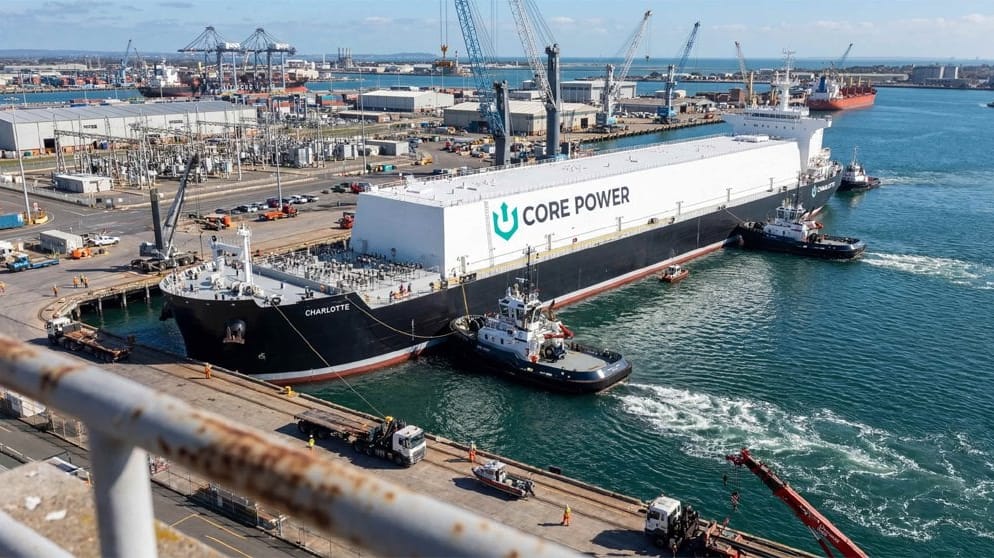
British-based nuclear energy company Core Power is pitching another proposal in the United States, seeking to commercialize nuclear energy propulsion plants for ships.
In February this year, Core Power was seeking a tie-up with the US Department of War to take advantage of simpler regulations governing the operation of nuclear power plants on board ships docking at defense-owned ports. Because the Pentagon has extensive experience of using small nuclear reactors afloat, with well-established protocols, use of this regulatory environment would allow much faster deployment of maritime nuclear energy applications than if deployments had to use the regulatory scheme applicable to civil nuclear energy.
Core Power sought to deploy a nuclear power station on board a vessel stationed in a military port, to bring a major power source close to where energy-hungry data centers might need it. To cover the costs of linking into a grid, the vessel would need to be committed to a particular port for a substantial period, but like an LNG FSPO it could be moved at the end of a contract period to a new task elsewhere. Core Power envisioned using either the Westinghouse 550MW A4W reactor, as used on the Nimitz Class aircraft carriers, or the Rolls Royce PWR2 nuclear submarine reactor, which is also the basis of Rolls Royce’s SMR design for small nuclear generation plants which has been adopted in the UK. In the end, however, Core Power has opted for a nuclear reactor produced by BWX Technologies for this application. In May 2025, the White House issued an Executive Order mandating the development of an advanced nuclear reactor at a military base by no later than September 30, 2028.
Core Power’s latest project is wrapped up in a seven-year agreement signed with the US Maritime Administration last week to build a fleet of 50 nuclear-powered merchant vessels. The fleet would be a mix of LNG tankers and container ships. At a unit cost of $700 million per ship, rather than $250 million for the equivalent tonnage of a conventionally powered ship, the vessels would be expensive – but would enjoy lower fuel costs, higher sea-time and cruising speeds, offering therefore higher utilization and cost efficiency, as well as a Net Zero-compliant complete reduction in sulfur fuel emissions. Core Power estimates that conventional merchant vessel tonnage would need to be 66 percent higher to haul the same volume of goods as could be carried on a nuclear-powered fleet.
US Secretary for Transportation Sean Duffy has shared his enthusiasm for the project, posting online about the ambition to build a nuclear-powered merchant fleet about the ambition to build a nuclear-powered merchant fleet, pitching such vessels as having:


that matters most
Get the latest maritime news delivered to your inbox daily.
Secretary Duffy regards the program as a response to Chinese competition. At the Marintec China conference in Shanghai in June, Chinese state-owned Jiangnan Shipyard, based in Shanghai, announced that it is to build a 25,000 TEU nuclear-powered containership.
Hulls for the US ships would be built in Japan and Korea, with the nuclear power plants fitted out in a yard to be developed in the United States. The yard could potentially be in Corpus Christi (TX), where Core Power has signed a preliminary agreement. The project is aiming for first ship delivery in 2033.
