
US Navy Expands Shipbuilding Options With Awards to Three "New" Yards
Service selects two well-established commercial shipbuilders and one new startup for "prototype" landing craft
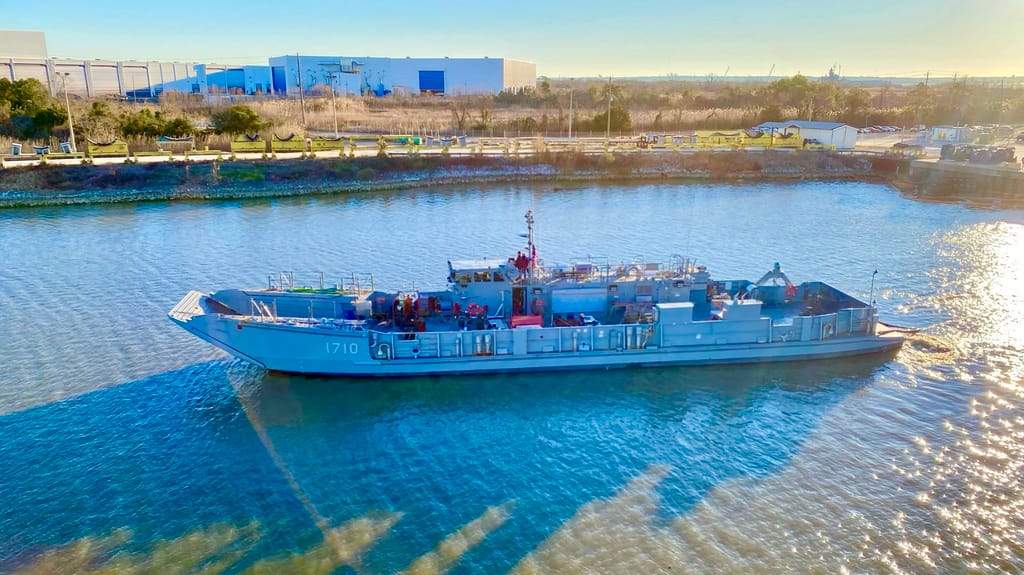
The U.S. Navy has awarded contracts for a total of seven Landing Craft Utility (LCU) hulls to a trio of yards on the Gulf Coast, all of them outside of the small circle of traditional defense shipbuilders.
In an announcement Tuesday, the Navy said that it would be spending $280 million to build seven "prototype" hulls for the LCU-1700 program at Master Boat Builders, Conrad Shipyard and Saronic's future Brownsville "Port Alpha" shipyard. The first two firms are well-established commercial shipbuilders known for their workboats. The latter has a focus on autonomous vessels, not series-production landing craft, and the order will be its first at its new mega-facility in Texas.
"Understanding the urgency of the moment, Saronic is helping address the critical backlog facing America’s shipyards with one of Port Alpha’s first builds. We are tackling the quick production of a vital manned vessel the Navy needs today as we ramp to meet the needs of an autonomous maritime future," said Saronic Co-Founder and CEO Dino Mavrookas.
LCU 1700 has been in the works for a long time, and the predecessor LCU 1610 class hulls have now been in service for more than 50 years. It is an upgraded design with more range, more payload capacity, and better berthing arrangements for the small crew.
The original LCU 1700 design-build contract was signed in 2018 with Swiftships, a Gulf Coast boatbuilder with a history dating back to the Second World War. The agreement envisioned a series of up to 32 hulls, but the Navy ended the contract in 2024. Swiftships filed for bankrupcy earlier this year.
In a separate framework agreement signed in 2023, the Navy awarded Austal USA an order for up to 12 hulls. After exercising options, Austal now has five firm orders, and the first in class - LCU 1710 - began sea trials in February and delivered last month.
By picking Master Boat Builders, Conrad and Saronic for the next tranche of "prototype" LCUs, the Navy's acquisition leaders are getting taking pressure off of larger contractors. Austal has submarine modules, Coast Guard cutters and naval auxiliaries to construct, Fincantieri Marinette has the larger Landing Ship Medium contract, and Bath and Ingalls Shipbuilding are fully booked with contracts to build surface combatants.
By contrast, Master Boat Builders has never held a prime contract with the Navy before. Though it has been contributing modules for Austal's T-ATS fleet tug program and has experience as a Navy subcontractor - plus decades of commercial experience - this will be its first time setting out on its own with defense work. It holds an order for a firm three LCU 1700 hulls, plus an option for a fourth.
“This award represents a major milestone for Master Boat and reflects the dedication of the skilled workforce that has built our reputation over the last 45 years,” said Garrett Rice, President of Master Boat Builders. “We are honored by the Navy’s confidence in our team and proud to expand our role in supporting America’s maritime mission.
The Navy is managing this acquisition in-house using an Other Transaction Authority (OTA) contract, outside of the usual bidding process.

that matters most
Get the latest maritime news delivered to your inbox daily.
“By selecting three distinct shipyards, the Navy is expanding its shipbuilding industrial base capacity and building a resilient 'second source' of supply for landing craft,” said top Navy procurement official William F. Mahan, a former defense executive with years of experience with rapid prototyping and OTA contracts. “Other Transaction prototype authority allows the Navy to move at the speed of relevance.”???
Deliveries for the newly-ordered hulls should begin in 2028-29 at an average price of about $40 million each.
