
U.S. Navy Picks Damen's LST-100 Design for Marine Corps' Landing Ships
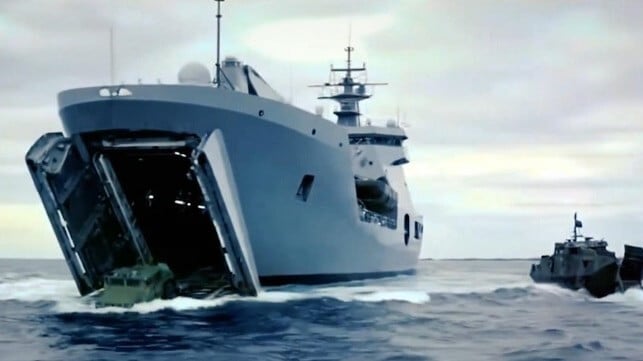
The U.S. Navy has picked Damen's LST-100 design as its final selection for the Landing Ship Medium (LSM) program, emphasizing produceability and affordability rather than exquisite capability for the high-end fight.
According to Navy Secretary John Phelan, the selection is an "operationally-driven, fiscally-disciplined choice" that will deliver oceangoing, beach-capable cargo vessels to the Navy and Marine Corps on a "responsible timeline." A present this capability is only found in the U.S. Army's watercraft community, which operates a small fleet of 1,800-dwt landing craft.
The new LSM selection resolves a long Navy-Marine Corps debate over whether to buy a few highly survivable and very expensive hulls - the Navy's preference - or a large number of less expensive ships, as the Marine Corps demanded. The Navy initially swung towards buying a costlier high-spec design, then canceled the tender and looked for low-cost alternatives. "The conceptual design [for the high-end LSM] produced bids that were simply unaffordable," said CNO Adm. Daryl Caudle in a video announcement.
After this change of direction, the service's first affordable pick was a variant of the U.S. Army's Besson-class landing ship, to be built by Bollinger. The Navy announced plans to work with Bollinger for a single lead-ship Besson-class hull in April, but also said that it was buying the technical data package for Damen's LST-100, suggesting that it was still looking at options.
"We identified proven, in-service designs . . . and then scrutinized them for produceability, performance and tradeoffs," said Adm. Caudle. Based on this review, the Navy and Marine Corps jointly settled on LST-100 for the rest of the program of record, which (in the Marine Corps' vision) will extend to a minimum of 35 hulls in total.
The LST-100 is a popular landing ship design of comparable size to the Besson-class, but it is slightly faster and equipped with an enclosed foredeck and an aft helideck. "The LST 100's cargo capacity, helicopter capacity, berthing and crane make it an excellent choice," said Marine Corps Commandant Gen. Eric M. Smith. It is currently in use by the Nigerian Navy and was recently ordered by the Australian Army.
The LSM selection is the second announced step of Phelan's "Golden Fleet" plan to retool U.S. Navy vessel acquisitions. The first step was the cancellation of the Constellation-class frigate program, which started as an off-the-shelf hull form and ended as a heavily-customized, troubled design. Success of the LSM program will likely hinge on whether the Navy can adapt the LST-100 to meet its unique needs, produce a functional design, then avoid making design changes during construction - all issues that created multi-year delays and extra costs for the Constellation-class.
Secretary Phelan sent a strong message that he intended to strictly prohibit design changes mid-stream. "We are going to take our warfighters’ requirements, translate them into stable, producible designs, and stick with them once they’re set. If anyone wants to tinker with them, I’ve reserved Fridays at 5 PM in my office for change order decisions—no drift, no delay," he said in a social media message Friday.
Dutch conglomerate Damen will be providing the design, but the name of the U.S. shipbuilder has not been announced. One candidate could stand apart: Austal holds the Australian award for the Australian Army's LST-100 variant, so it has in-house experience with the vessel.

that matters most
Get the latest maritime news delivered to your inbox daily.
The Navy says that it wants to use Damen's off-the-shelf design without substantial modifications and begin delivering hulls in 2029. In announcing the decision, Phelan said that the contract would proceed under a vessel construction manager (VCM) model, like TOTE Services' commercially-managed procurement arrangement for the NMSV.