
Op-Ed: Gulf States Face a Strategic Choice After Iranian Attacks
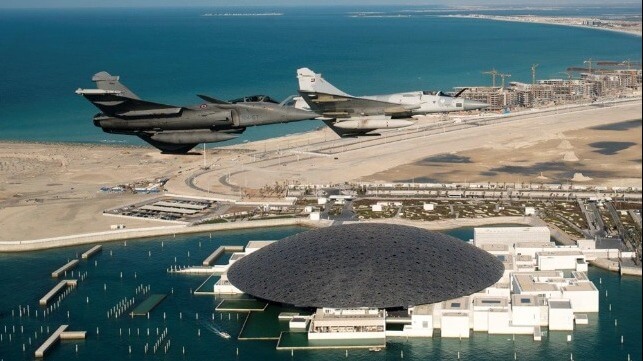
Early on March 1, barely 24 hours after the launch of Operation Epic Fury, the impact of the war on trade in the Gulf region has been immediate. In a very fast moving situation, most air services have been suspended and traffic flows through the Straits of Hormuz have slowed to a trickle.
Such a scenario has long been predicted – and feared. Most immediately, the Gulf States are almost entirely dependent on imported foodstuffs and basic necessities, largely carried by ship. GCC States have plenty of reserves in the bank, but long-term they are also dependent for their financial well-being on the flow outwards of oil and gas exports. Awareness of this risk and vulnerability has shaped the attitude of GCC states towards Iran.
Although culturally and ethnically juxtaposed, and probably as divided by the nuances rather than the commonality of religious belief, Iran and GCC can probably be described as natural enemies – something which both parties have fought to overcome in recent years. Rather than face up to the manifold threats imposed on the region by Iran, GCC countries have tried hard to make friends with Iran in recent years. Hence frequent high-level bilateral visits, the visit of Iranian warships to Emirati ports, and in the weeks leading up to Operation Epic Fury, categorical assurances that the United States would not be allowed to use either GCC airbases or territorial waters to launch an attack on Iran - all to no avail.
Social media has shown Iranian drones hitting civilian targets in Dubai, including the world’s tallest building - the Burg Khalifa and the Burg al Arab hotel - plus other civilian targets in other GCC member states. The impact is not only on the carriage of foodstuffs and basic necessities, but also on the security of the whole economic model – based as it is on free movement trade flows.
The GCC States have a choice. They can either ignore the Iranian attacks – which may become impossible if they persist - and press for a halt to the war. But if they had insufficient political clout to prevent the war starting in the first place, then they are unlikely to be able to halt it at this stage, in the face of American and Israeli determination to intervene in Iran.
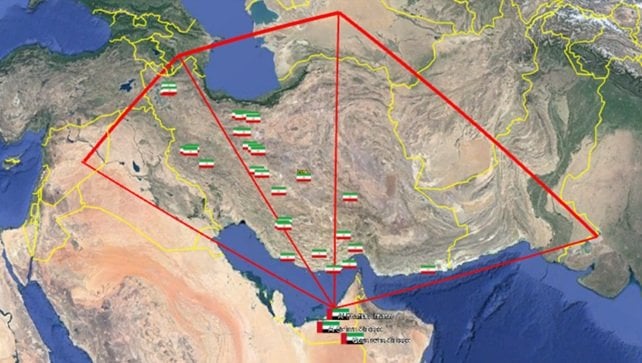
1,000 nautical mile combat range radius (unrefueled) of the Dassault Rafale F4 aircraft ordered from France by the United Arab Emirates; and known Iranian nuclear, drone or missile-associated targets (Google Earth/CJRC)
The GCC states could just wait it out, with ever-increasing damage to their economic model as the war drags on. But such a stance – in effect turning a blind eye to Iran’s attacks - is not likely to inspire confidence in the GCC economic model in the future, particularly if the current regime in Iran survives into a post-war phase.Alternatively, the Gulf States could enter the conflict. Both Saudi Arabia and the United Arab Emirates have large, well-equipped and well-practiced air forces, and could add substantial strike capability to Israeli and US efforts, bringing a decisive end to the war closer.
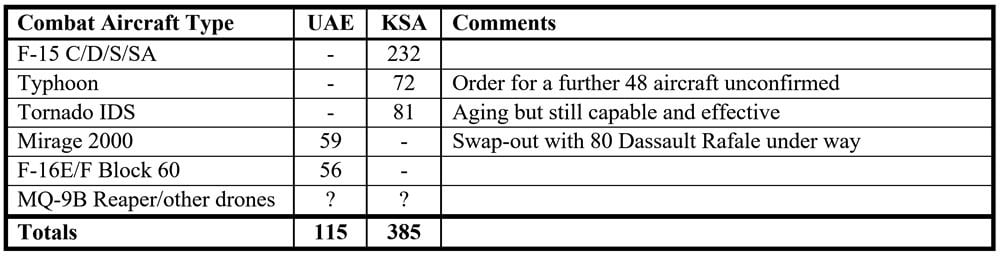
KSA and UAE fighter aircraft fleets (World Air Forces Directory 2022)

that matters most
Get the latest maritime news delivered to your inbox daily.
Qatar, Kuwait and Bahrain also have well-equipped air forces, and all GCC countries have modern navies. Use of Emirati and Saudi airbases would also significantly increase Israeli and US sortie rates.But for an Emirati and Saudi intervention to be executed without post-war implications, it would need to be clear that any Emirati and Saudi intervention is based on protecting their own interests and striking at the current IRGC-based regime in Tehran – as opposed to an attack on the Iranian people.
These are difficult and complex geopolitical decisions, and will shape how the maritime community is to be impacted long-term by the crisis. But in the end, people in the Gulf must be fed, and freedom of navigation for merchant ships will be needed.
The opinions expressed herein are the author's and not necessarily those of The Maritime Executive.