
Some Black Sea Tankers Are Hugging the Turkish Coast for Protection
For Ukrainian maritime intelligence officers looking to do the Russians damage, the passage of shadow fleet tankers through the Black Sea to the crude loading terminals near Novorossiysk presents a target selection challenge, and a process where mistakes can be made.
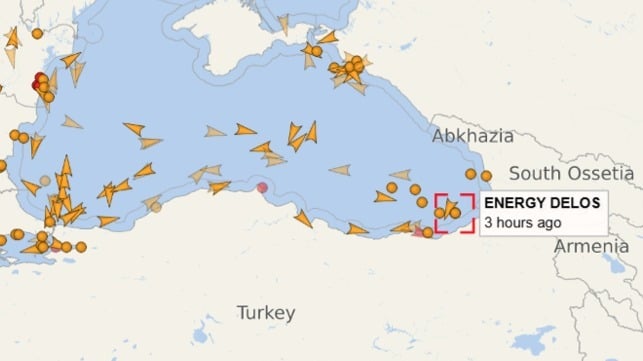
A review of AIS tracking data covering the Black Sea in recent days illustrates the nature of the problem.
There is a steady flow of legitimate tanker traffic heading for the three Caspian Pipeline Consortium (CPC) loading berths at the Novorossiysk-2 Marine Terminal. Of the oil loaded from the CPC Novorossiysk berths, historically about 85% is Kazakh crude from the Tengiz, Kashagan and Karachaganak fields, and this flow represents about 80% of Kazakh oil exports. Some of the balance of Kazakh production is piped through the CPC’s eastern gateway at Alashankou directly to China.
There is heavy Western investment in both the CPC and the technically complex Kazakh oilfields, involving Chevron, ExxonMobil, Royal Dutch Shell and BP, with all parties needing to make returns on sunk capital costs invested in the extraction infrastructure. In total, CPC throughput amounts to about 1% of global annual crude production.
But about 15% of the oil flowing through the CPC, both eastwards via Alashankou and through Novorossiysk, is Russian oil from the Omsk and Kazan oilfields in the Urals. Moreover, as a part-owner of the CPC, Russia is also earning transit revenues from the Kazakh oil flowing through the CPC. On this basis, the Ukrainians have attacked the CPC facilities at Novorossiysk, encouraging Kazakhstan to seek alternative export routes not crossing Russian territory.
Kazakh President Tokayev has set in train projects to lessen this dependency on Russia by expanding trade on the cross-Caspian Kazakhstan-Baku route, a policy objective synchronized with Azerbaijan. Built by a joint venture between Emirati and Kazakh parastatals, two shallow draft tankers designed for Caspian operations, the Liwa (IMO 9802762) and the Taraz (IMO 9802774), are already shuttling between Aktau and Baku, whence Kazakh oil can be piped to Ceyhan on the Mediterranean.
In picking tanker targets, the Ukrainians have been risk-conservative, successfully discriminating between Kazakh-carrying innocents and shadow fleet tankers carrying Russian oil from Novorossiysk. Shadow fleet designation is an important tool in identifying which tankers are carrying Russian oil. In the last few days, the Russian-flagged and sanctioned tanker Strateg (IMO 9589750), leaving the Black Sea by hugging the protection of the Turkish coastline, would have been a legitimate target - though the Ukrainians are not attacking laden tankers, for environmental reasons.

that matters most
Get the latest maritime news delivered to your inbox daily.
Over the weekend this route was also being used by the UK-flagged Energy Delos (IMO 9994565) and the Liberian-flagged Delta Commander (IMO 9418157), also hugging the Turkish coast even though both were traveling with AIS systems on and clearly loading Kazakh crude from the CPC terminal at Novorossiysk. Sister ship Delta Harmony (IMO 9408463) which was also not sanctioned at the time, was hit when waiting to load off Novorossiysk and damaged in a Ukrainian drone attack on January 13, so the caution of Delta Tankers’ Greek owners is understandable.
The targeting process is clearly complex, as not all traffic between Russia and the Bosporus takes a southerly course and seeks to enjoy Turkish protection; from patterns recently seen, most Black Sea traffic, cargo and tanker, switches off AIS systems and takes the risk of using the direct route, even traffic originating from ports in occupied eastern Ukraine. Last week, ISW reported Russian-flagged bulk carrier Fedor (IMO 9431977) transiting the Kerch Strait en route to Lebanon and the sanctioned general cargo ship Severniy Proect (IMO 9202053) making for Latakia from Sevastopol. Both vessels were taking direct routes across the Black Sea to the Bosporus.