

Hybrid-Electric Expedition Cruise Ship Built in Chile Set for Delivery
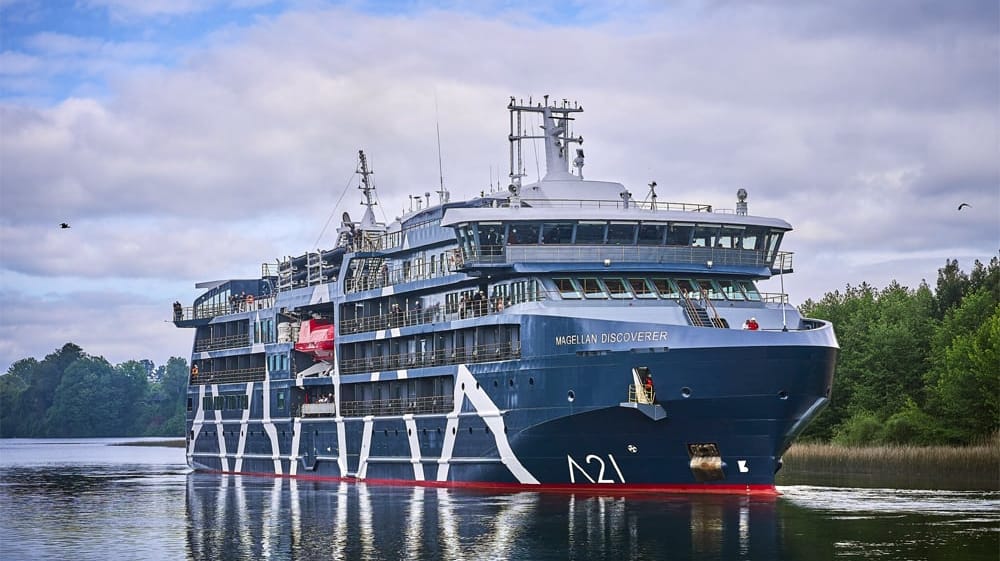
Chilean shipbuilder ASENAV (Astilleros y Servicios Navales S.A.), the biggest shipyard in Chile, highlighted the departure of the innovative new exploration cruise ship Magellan Discoverer from its shipyard this week. The cruise ship, which took about 33 months to build and involved more than 500 employees, contractors, and suppliers, departed ASENAV’s shipyard in Corral for its final trials before delivery and entry into service in December.
The 5,258 gross ton cruise ship is being hailed as the first hybrid-electric expedition cruise ship ever built in the Americas. Designed and built by ASENAV, the ship was created for long-range polar expeditions, and according to its builders and owners, Antarcita21, it will set a new standard for responsible Antarctic explorations. Antarcita21 says, “Every system on board has been engineered to reduce environmental impact while delivering an exceptional expedition experience.”
The hybrid-electric propulsion system is driven by ABB’s Onboard DC Grid, a modular platform that integrates generator power with Corvus Energy Battery Storage System to enable flexible energy management. Power and propulsion come from two MAN main engines and gensets, totaling 4,800 ekW of power for two ABB Azipod units. The marine lithium battery bank was developed by Corvus Energy. It will give the ship a speed in open waters of 14 knots.
ASENAV highlights that the systems optimize energy efficiency while reducing CO2 emissions and underwater noise. The ship was designed to operate in one of the most extreme environments on the planet. The hybrid systems give the vessel the ability to sail for up to 60 days without refueling.
It is also equipped with a heat recovery system that will allow the heat generated in the exhaust gas to be recovered and used for water heating, while the elevator technology captures and converts energy generated during braking into electricity to recharge the batteries. The Vessel Performance Management System employs approximately 100 sensors and will analyze performance, including energy consumption, generator performance, and navigation speed.
“This vessel marks a leap forward in sustainable engineering, positioning ASENAV as a leading shipyard in the local maritime industry and placing Chile at the forefront of global innovation and design for vessels of this type,” said Fernando Rodríguez, General Manager of ASENAV.
Magellan Discoverer is 94 meters (308 feet) in length with accommodations for up to 96 passengers, although it is limited to 88 passengers for the fly-cruise operations in Antarctica. The ship will have 67 staff and crewmembers. It has a reinforced hull and robust bow, giving it the ability to break through ice barriers up to 80 centimeters (2.6 feet) thick. It received a Polar Class PC6 rating and an IMO Tier III certification.
Aboard, the passengers will experience a boutique, yacht-like style experience. The ship has a large lounge and dining room as well as an observation deck, library, and prep area for expeditions.
“This new ship not only represents a technological leap in sustainability, but also a reflection of national talent and what we are capable of achieving when we strive for excellence. We are proud to collaborate with ASENAV on this project that unites cutting-edge engineering with a responsible vision of tourism in the most remote territory on the planet,” said Jaime Vásquez, president of Antarctica21.
The order for the ship was placed in 2023, expanding on ASENAV’s prior newbuild for Antarctica21, Magellan Explorer, delivered in 2019. The ship reportedly cost approximately $90 million to build, with steel cutting beginning in February 2024, and the hull was launched in October 2025. Earlier this year, the ship was moved along the Calle Calle River from the yard in Valdivia to Corral in preparation for trials.

that matters most
Get the latest maritime news delivered to your inbox daily.
Magellan Discoverer departed on October 26 for her final sea trials, where her operational performance, maneuverability, and systems functionality are being evaluated under real-world conditions. She is scheduled to depart for Punta Arenas, Chile, before her entry into service on December 15. She will spend the first few months operating in the Antarctic as part of Antarctica21’s fly-cruise program, where passengers fly to King George Island to join the ship, avoiding the difficult crossing of the Drake Passage.
The cruise line says her unique design will improve overall efficiency and operational flexibility, while minimizing the impact on wildlife and the environment.