
DNV Study Suggests Possibility of Eliminating Efficiency Loss From Fouling
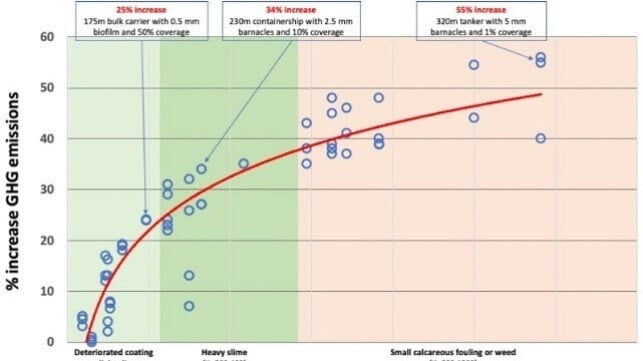
When evaluating the antifouling properties of a hull coating - and the corresponding fuel savings that an operator can expect to achieve over time - shipowners look at how much the vessel gets slowed down by fouling over time. A poorly-chosen coating will show a large slowdown and falling fuel economy between five-year dockings; a properly-chosen coating will still show some slowing over the years, but not much. It now appears possible that the baseline for this measurement could be reset to zero: coating maker Jotun has published results that suggest that with a proprietary hull-cleaning robot, a ship can operate all the time with a continuously clean hull - for all intents and purposes, just as efficient after five years as the day it came out of the drydock.
The study, conducted by DNV, followed 12 vessels that have used Jotun's hull-cleaning robot for more than three years (on average). A check of the ship's performance data found no measurable speed loss over time, compared to an initial one-year reference period. Physical inspections were also conducted to check for visible fouling on the underside.
"The analysis confirmed that the hulls remained clean throughout the review period and that no measurable loss of speed occurred. This provides Jotun with third-party verification that the solution performed as intended under real operating conditions," explained Olav Rognebakke, Head of Section Hydrodynamics and Stability at DNV.

that matters most
Get the latest maritime news delivered to your inbox daily.
The idea is to use a cleaning-compatible coating, then clean so often that early-stage fouling is removed before it can stick to the hull and grow into something large enough to induce drag. Jotun says that by evaluating the speed loss data, DNV has shown that this level of cleanliness is operationally meaningful for the shipowner.
"Credible speed loss data matters. Without it, operators face operational and regulatory risk, and fleet decarbonisation plans can be built on the wrong assumptions. Independent verification, like through DNV, is how we turn claims into documented performance," said Morten Sten Johansen, Global Category Director for Hull Performance at Jotun.