
Chinese Shipbuilders Move Closer to International Cruise Ship Market
China’s shipbuilders continue to target breaking into the international cruise ship construction market. While, to date, for the international market they have built only smaller passenger ships, mostly for the expedition segment, with the delivery of the country’s second large domestic cruise ship and more orders pending, the Chinese shipbuilders continue to position themselves to challenge the international market.
Chinese shipbuilders highlight that they have developed expertise in the cruise ship segment. They are getting more orders, including larger ships and an entry into the luxury segment, but are yet to break into the top ranks. Among the orders is the first new cruise ship for Sea Dream Cruises as well as a memorandum of understanding from a somewhat mysterious firm, NOR (Norseman) Cruises, based in Norway, which reportedly optioned up to five ships with CSSC.
The cruise industry has a large order book nearing $100 billion in value and stretched out to 2039, but it is concentrated at a handful of yards. Italy’s Fincantieri holds the largest book with a total of 38 cruise ships, including the first 200,000-plus gross ton ships for both Carnival Cruise Line and Norwegian Cruise Line. Meyer Turku in Finland is currently occupied with four more Icon class ships for Royal Caribbean International, while Meyer in Papenburg, Germany, is building two 180,000-gross ton ships for Carnival Cruise Line and has five current orders for Disney Cruise Line ships. In France, Chantiers de l’Atlantique is building for MSC Cruises, Royal Caribbean, and Celebrity Cruises. Collectively, they account for 85 percent of the orderbook, and all the cruise ships on order over 25,600 gross tons.
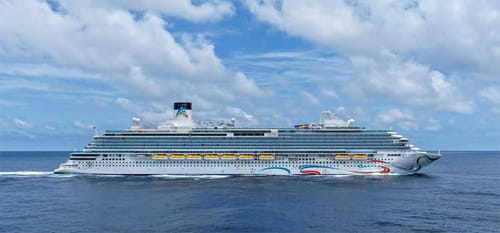
Adora Flora City, which entered service on November 22, is seen as a proof point for China developing its cruise ship construction capabilities (Pudong, China)
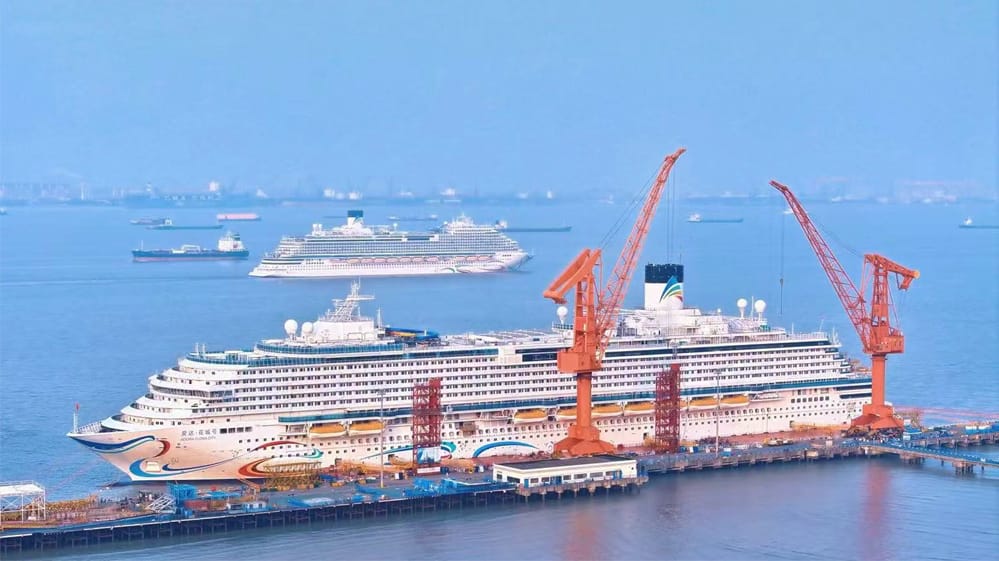
Shanghai Waigaoqiao Shipbuilding Company, a division of China State Shipbuilding Corporation (CSSC), completed the Adora Flora City (141,000 gross tons) for delivery on November 6. This ship, which entered service on November 22, is seen as a proof point for the Chinese industry, which now highlights that it has built cruise ships that, with the hotel components, are the most complex newbuilds.
Construction of China’s first cruise ship was completed in 2024 with Adora Magic City (136,200 gross tons). It was, however, built based on a design from Fincantieri and Carnival Corporation, and the shipyard was partnered with Fincantieri as a consultant. Moving to the second ship, the shipyard refined the design with the shipowner, lengthening what became Adora Flora City by 17.5 meters (57 feet) from 324 to 341 meters. The design increased the passenger capacity but also refined the main lobby and other public spaces, including the shopping arcade.
CSSC highlighted the delivery of the new ship as a “crucial step” in its efforts to develop the segment. It emphasized the localization of the bulk of the materials and the development of several key engineering packages. It said China continues to improve its capabilities across the entire chain of R&D, construction, and operation.
It asserts that the teams have mastered core technologies. It reported quick improvements in the construction process, highlighting that the second cruise ship required nearly four million fewer manhours. Total construction time was reduced by eight months between the two ships, and domestic content of interior outfitting materials was increased to 80 percent.
Adora Cruises, which operates the two ships plus one acquired from Costa Cruises, announced in March 2026 that it had entered into an agreement with CSSC for two newly designed cruise ships using an entirely Chinese-developed design and an option for a third. The first of the ships is expected to be completed by 2030.
CSSC looks to make the jump into the international market with a start-up calling itself Nor (Norseman) Cruises. They reported a memorandum of understanding signed in September that calls for the construction of two ships plus an option for three more. CSSC reported the ship will be 84,000 tons. They declined an interview, but are reported to be working on financing.
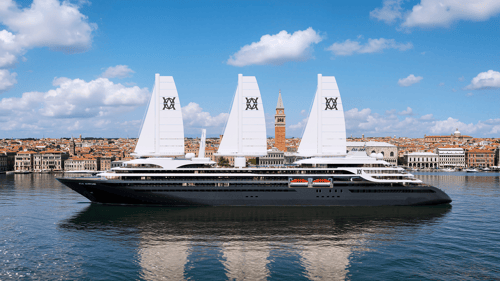
China's largest international cruise ship is the order for hybrid expedition ships to be built for Atlas Ocean (Atlas Ocean)
China Merchants Cruise Shipbuilding (CMCS) secured an order from SeaDream Yacht Club for a single 16,500-gross ton luxury cruise ship. The ship, to be known as Sea Dream III, will be 151 meters (495 feet) in length with accommodations for about 230 passengers. Reports are that the ship, scheduled for delivery in 2029, will incorporate a hybrid-electric propulsion system supported by a large battery pack.
It follows an order CMCS secured in late 2025 with Atlas Ocean for a 24,000 gross ton luxury expedition cruise ship, Atlas Adventure, along with an option to build up to three sister ships. The design features Wärtsilä dual-fuel engines, electric-hybrid propulsion with a large, 9-megawatt marine battery, and three masts for sail-assisted propulsion.
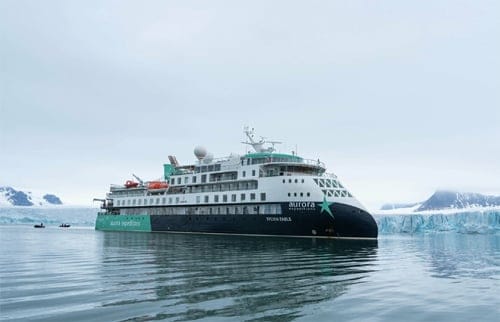
China Merchants has so far built smaller expedition cruise ships for the international market (Ulstein Group)
To date, CMCS has built seven 8,000-gross-ton expedition cruise ships accommodating approximately 180 passengers. They were an advanced design developed by Norway’s Ulstein Group, including its revolutionary X-BOW design.
that matters most
Get the latest maritime news delivered to your inbox daily.
Next for CMCS is a residential cruise ship concept known as Ulyssia. The design for the 323-meter (1,060-foot) ship, which will feature space for 122 residences and 22 guest suites, is being developed by Deltamarin. Ulyssia Residences promises a ship outfitted with all the high-end amenities, including two helicopters, two personal submersibles, and a marina, with residents also having access to a spa, sports facilities, and seven restaurants and bars. They report the ship will enter service in 2031.
With these contracts, China continues to build its cruise ship orderbook and advance toward the global market. The challenge remains to develop business with the major cruise industry players, which, however, are deeply entrenched with the European shipyards.