


Chevron Pulls Out From Financing Study for Guyana’s Deepwater Port
Chevron has reportedly opted out in funding preliminary studies for Guyana’s planned Berbice deepwater port. Hess Corporation - acquired by Chevron last year - supported pre-planning studies for the port, but Chevron is said to have reconsidered.
The American engineering firm Bechtel has been leading the initial design plans. Bechtel in 2023 completed the pre-front-end engineering design, but the feasibility study is yet to be completed. Commenting on the issue last week, Bechtel’s Guyana Engineering Director Harry Pastuszek said that Hess financed the preliminary engineering and design for the project. For the remaining parts of the feasibility study, Chevron declined to move ahead with financing.
Through the Hess acquisition, Chevron secured a 30% stake in the Stabroek Block, Guyana’s prized offshore oil and gas resource. ExxonMobil, the block’s operator, is the majority shareholder with a 45% stake while China National Offshore Oil Corporation (CNOOC) holds 25%.
With the ongoing Stabroek production ramp up through 2030, it is expected that a deep-water facility such as Berbice port would accommodate strengthened offshore energy logistics. The port project is estimated to cost between $1 billion and $2 billion, and would feature an industrial hub including data centers, a fertilizer plant and a refinery.
Berbice’s development has been in the pipeline for over a decade now. Back in 2016, Inter-American Development Bank (IDB) presented a report on the potential economic prospects of an improved port. The report highlighted regional benefits of the project, specifically linking Northern Brazil to the Atlantic Coast. Berbice port could therefore become a transshipment hub for northern Brazil.
The ongoing feasibility study is intended to update the findings made by the IDB report. Already, several development partners have shown interest in the port project but further progress can only be made after the feasibility study is completed. The Export-Import Bank of the United States (EXIM) has pledged to finance phase three engineering design study. This followed a meeting held last month in New York between Guyana’s President Mohammed Irfaan Ali and Exim’s Chairman John Jovanovic.
In addition, President Ali recently told local media that Qatar has also expressed interest in participating in the development of the proposed port. If the port project is finalized, it will be another major economic milestone for Guyana. In the last year, the country has become one of the fastest-growing economies in the world, projected to reach GDP growth of 22.3 percent this year, according to International Monetary Fund (IMF) estimates.

that matters most
Get the latest maritime news delivered to your inbox daily.
The economic boom has also seen expansion in Guyana’s maritime capacity. Unfortunately, the country’s major ports lack deep water access to accommodate larger vessels. For instance, the main port of Georgetown - on the eastern banks of the Demerara River before it enters the Atlantic Channel - has a shallow channel. The maximum allowable draft is about 9.7 meters. Development of a deep-water port would create greater opportunities for Guyana.
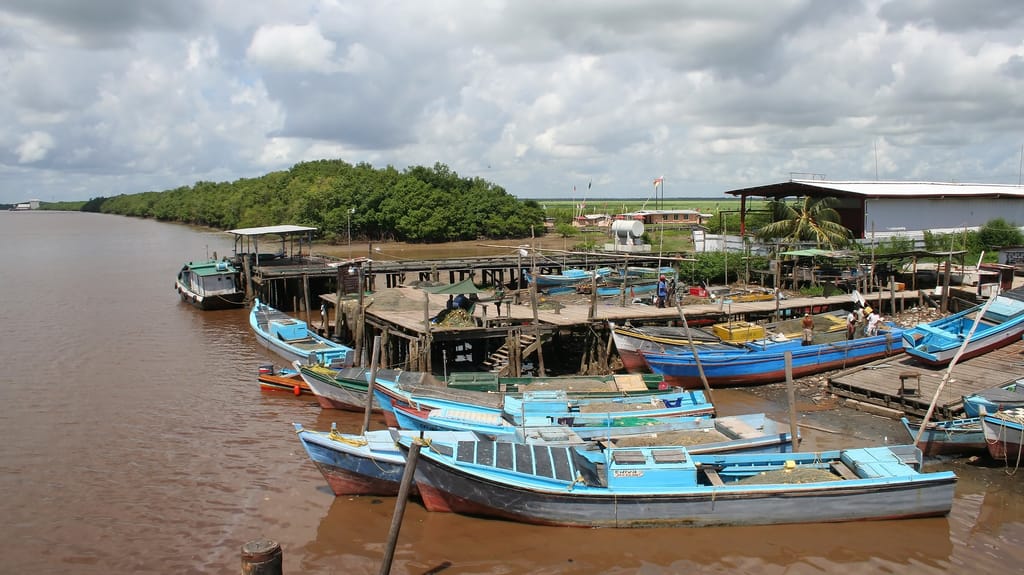
Top image: A fishing pier on the Berbice River, 2007 (Ian Mackenzie / CC BY)
