
Brazil Looks to Grow Cruise Business with Regional Partnerships
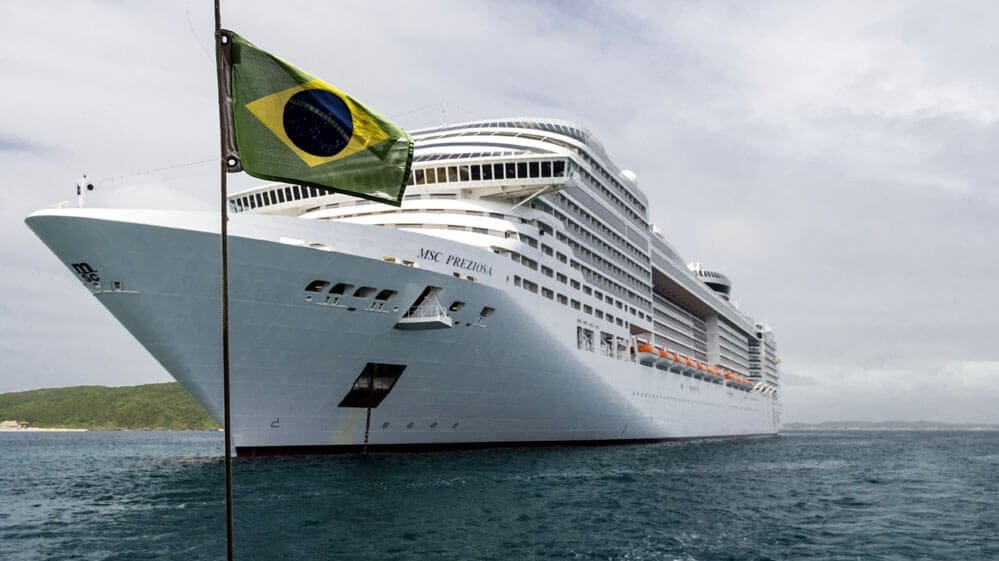
Brazil, like many seasonal markets in cruising, is looking for new ways to grow its market. The leaders of the regional tourism organizations recently met to discuss the steps that they could take to grow cruising in South America.
While it has a long heritage in cruising, Brazil’s market has been challenged by its seasonality. Lines including Costa Cruises have positioned ships in the market, but recently the market has been shrinking as lines have not repositioned as many ships to Brazil. Some of the smaller lines that worked with regional partners have gone out of business.
“We need to expand regionalization, strengthening circulation between South American countries, and, at the same time, expand the internationalization of our destination, with a wider distribution of routes to attract visitors from other parts of the world,” Gustavo Feliciano, Minister of Tourism for Brazil, said during the recent XI Regional Meeting of Cruises and Nautical-River Tourism conference in Uruguay.
While Brazil has consistently been the tenth largest cruise source market, according to data from CLIA (Cruise Lines International Association), its growth has lagged the larger industry. In 2025, Brazil’s market grew with just about a one percent increase in the number of passengers. While it topped 783,000 passengers, its growth was behind similar-sized markets such as Spain and far behind the largest markets, which include the United States, Germany, the UK, Australia, and Canada. South America as a whole reached 1.22 million passengers, a 4.4 percent increase in 2025 over 2024, according to CLIA.
The two largest participants in the market continue to be Costa Cruises and MSC Cruises, which each reposition ships annually from Europe. For 2026-2027, MSC will be the largest with five ships (Divina, Musica, Seaview, Splendida, and Virtuosa) while Costa will have two ships (Diadema and Serena) homeported in Brazil for the winter. Spanish companies such as Quail Cruises, which went bankrupt in 2011, and Pullmantur, which went bankrupt in 2020, had developed the market but could not compete with the majors.
Hopes are high going into the 2026-2027 season as Brazil expects to gain one additional cruise ship. In the 2025 season, there were seven cruise ships homeporting in Brazil. This year, there will be eight cruise ships. A startup Spanish company named Corazul is due to launch in Brazil, working with a local partner.
Feliciano reports that Corazul is considering extending the season this year, which would add as many as 30,000 berths to the market. Traditionally, Brazilian cruises operate from November to March, but Corazul may send its ship, the chartered Piano Land, which it plans to rename Buenavista, in as early as the end of October and run until April 2027. Corazul, however, canceled its launch season in Europe and has yet to take delivery of the Chinese-owned cruise ship.
Among the other steps Brazil is taking to support the development of the cruise industry is the opening of additional ports. This year, they highlighted that seven ports will be available to cruise ships for embarkation and disembarkation.
During the conference, the tourism leaders from the countries also spoke of the opportunities to expand cruising through a regional approach. They discussed expanding joint promotion of the region at international industry events.
Uruguay’s Minister of Tourism, Pablo Menoni, also emphasized the opportunities through a joint strategy among South American countries. He pointed to the diversity of ports and the opportunities to extend cruises to reach the ports of Chile.

that matters most
Get the latest maritime news delivered to your inbox daily.
They also discussed the opportunities to drive public policies that would improve the sector’s competitiveness and address issues such as port costs.
Through a regional approach, the ministers hope to drive the growth of cruising and international tourism.
