


Rolls-Royce Expands mtu Propulsion Portfolio for Yachts
Rolls-Royce introduces new mtu propulsion systems for yachts, enhancing efficiency and reducing emissions.
[By Rolls-Royce]
Rolls-Royce is further expanding its portfolio for yachts and introducing two systems based on the mtu engine Series 2000: standardised variable-speed gensets and a new SCR exhaust after-treatment system. The propulsion system is so compact that it enables the single-deck engine room concept, which is highly advantageous for yachts. With these new solutions, Rolls-Royce is strengthening its holistic ‘From Bridge to Propeller’ approach, in which propulsion, energy management and automation work in tandem.
“Our aim is to offer shipyards and owners a comprehensive and future-proof range of solutions for yachts. This is not just about individual components, but about the optimal interaction of the systems on board to deliver greater performance, efficiency and lower emissions,” said Dr Lukas Köhler, Senior Vice President Global Marine & Mining at Rolls-Royce Power Systems.
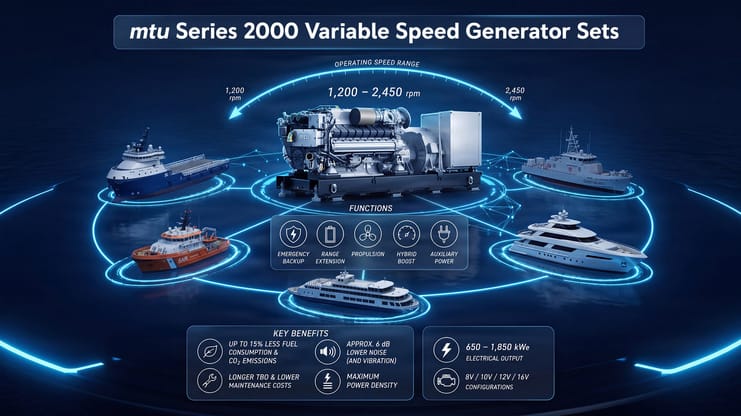
A key component of this expanded range is the standardised variable-speed gensets based on the mtu Series 2000. They adjust their engine speed to the actual power demand, thereby reducing fuel consumption and CO? emissions during operation by up to 15 per cent. At the same time, they operate around 6 dB more quietly, which significantly improves comfort on board.
With electrical outputs ranging from 650 to 1,850 kWe, the gensets cover a broad power range. Their high-power density and compact design allow for flexible integration even where installation space is limited. They are also suitable for battery-assisted marine applications and can be used, for example, as range extenders.
The product is based on Rolls-Royce’s decades of experience with diesel-electric propulsion systems. Numerous large vessels already have variable-speed mtu gensets based on the Series 4000 on board, and many yachts benefit from diesel-electric propulsion systems based on the Series 2000.
The new SCR exhaust gas after-treatment system also expands the range of applications for the mtu Series 2000 in emission-regulated sea areas. The system, which is being certified in collaboration with exhaust gas after-treatment specialist Eminox, meets the requirements of IMO Tier III and reduces nitrogen oxide emissions by 75 per cent compared with the IMO II limits. Depending on the load profile, the solution is designed for a service life of up to 16,000 operating hours, requires no compressed air for dosing and can be flexibly integrated into a variety of vessel designs.
With ‘From Bridge to Propeller’, Rolls-Royce aims to view the yacht as a complete system: from the controls on the bridge to the propulsion in the water. To this end, the company combines its expertise in propulsion systems, energy management and automation to create integrated solutions that improve efficiency, safety and cost-effectiveness.
For shipyards, this approach offers an additional advantage: they receive a coordinated solution from a single source. This reduces the effort involved in design and integration, whilst minimising interface risks. The interlinking of mtu propulsion systems, mtu NautIQ Bridge and automation technologies creates a unified digital environment. It helps shipyards and owners to manage energy flows, reduce emissions and increase operational uptime – a step towards a more modern and comfortable yachting experience.
The products and services herein described in this press release are not endorsed by The Maritime Executive.
