


Wallenius Wilhelmsen Takes Delivery of Large Methanol-Fueled Car Carrier
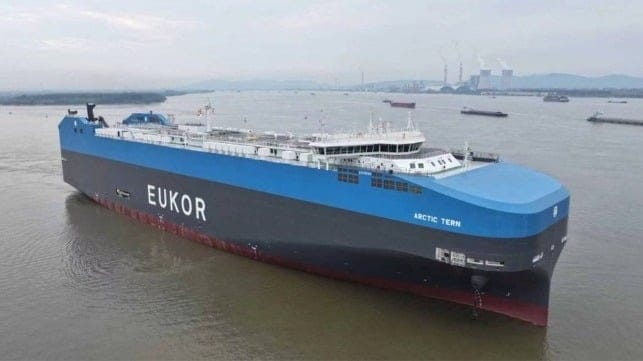
Calling it a defining moment for Wallenius Wilhelmsen and the car carrier industry, the company has taken delivery of the first of its new Shaper Class vessels. Named Arctic Tern (15,750 dwt), the vessel is dual-fuel designed to operate on methanol and is part of the company’s transition toward offering a net-zero end-to-end service.
Built at China Merchants Jinlin Shipyard (Nanjing), the vessel is the first of six 9,300 CET car carriers that Wallenius Wilhelmsen first ordered in late 2023. The order has been revised several times and currently includes the six 9,300 CEU vessels as well as eight that were expanded to a design capacity of 11,700 CEU. Deltamarin has reported that some of the vessels will be further upgraded to a capacity of 12,100 CEU.
The company is also anticipating a future transition to other alternative fuels. Several of the class are being built ammonia-ready and able to be converted as soon as ammonia becomes available in a safe and secure way.
According to the company, with a greater cargo transport capacity, improved fuel efficiency, and flexibility, the Shaper Class strengthens its ability to meet evolving customer needs while supporting low-emission shipping. The vessel will be operated by EUKOT Car Carriers, a jointly owned shipping line between Wallenius Wilhelmsen (80 percent) and Hyundai Motor Group (20 percent).
Arctic Term will be deployed sailing from Asia to Europe. The company reports it is expected to complete its first methanol bunkering shortly after delivery.
Xavier Leroj, COO Shipping Services at Wallenius Wilhelmsen, highlights that the new vessels are “a critical building block in our ambition to offer net-zero end-to-end services as early as 2027.”

that matters most
Get the latest maritime news delivered to your inbox daily.
In addition to its dual-fuel capability, Arctic Tern incorporates technologies designed to improve operational performance, efficiency, and onboard experience. Wallenius Wilhelmsen reported that the design would also provide for shore power capability to enable zero emissions at berth. The hull design was optimized for efficiency and included efficiency and saving devices, such as an Air Lubrication System (ALS) of the hull, a battery solution for reduced energy consumption during maneuvering, and power generation optimization and solar panels.
