


USV Rescues Two U.S. Army Helicopter Pilots Who Were Shot Down by Iran
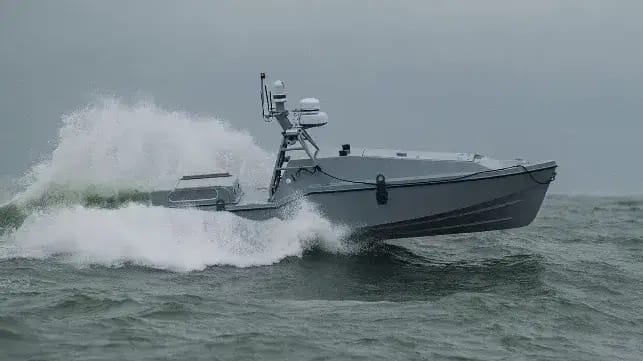
A U.S. Army helicopter was shot down by Iranian forces in the Strait of Hormuz on Tuesday morning, prompting a high-stakes rescue mission - executed by a drone boat. It is the first known instance of an unmanned vessel completing a rescue at sea.
At about 0130 local time (1730 EST), a U.S. Army Apache attack helicopter went down off the coast of Oman, reportedly as a result of Iranian action. U.S. Naval Forces Central Command launched a rescue operation, alongside the 82nd Airborne, the U.S. Air Force and - notably - U.S. 5th Fleet Task Force 59.
The rescue was completed within about two hours using a Saronic Corsair 24-foot unmanned patrol boat. The two airmen were safely rescued and relocated to another area at sea, then hoisted off of the drone by helicopter, according to the Washington Post's Dan Lamothe. They are reportedly in stable condition.
A U.S. official told Axios that the helicopter was struck by an Iranian drone, but that it was unclear if it was an intentional attack. Iran has denied deliberately targeting the helicopter; however, its officials warned that foreign assets operating on its side of the strait run elevated risks. "Foreign forces in proximity to our territory are at constant risk on account of their own human errors, plain accidents, or potentially being caught in crossfire. To reduce risk, best solution is for them to leave," said Foreign Minister Seyed Abbas Araghchi in a statement.
The shootdown is inconveniently timed for diplomacy: on Monday, just hours prior to the incident, President Donald Trump had predicted that an initial ceasefire agreement with Iran would be completed within 2-3 days. On Tuesday, Trump said that the encounter would require a U.S. response and initiated counterstrikes.
Since the start of the current ceasefire, the U.S. military has been relatively restrained in its responses despite frequent Iranian attacks on shipping and on neighboring states. Recent U.S. counterstrikes have been limited to specific Iranian military sites and units involved in attacks, avoiding escalation and allowing the White House to preserve the continuation of peace talks. When Iranian forces launched missiles and drones at U.S. destroyers in the Strait of Hormuz in early May, Trump described the (unsuccessful) strikes as "just a love tap" and said that the ceasefire was still in effect. Likewise, Trump downplayed Tuesday's incident in comments to the Wall Street Journal, saying that it "wasn't a big deal."
Later in the day, he told ABC that "it's very important to respond" and "the response should be very strong, very powerful." Three waves of U.S. airstrikes on targets along Iran's Strait of Hormuz coastline followed shortly after. The precision strikes hit "Iranian air defense, ground control stations, and surveillance radar sites," Central Command said, and were calibrated for a "proportional response" to the helicopter shootdown.

that matters most
Get the latest maritime news delivered to your inbox daily.
The involvement of Task Force 59 in the rescue is noteworthy: it was the Navy's first experimental unit for forward-deploying unmanned vessels at scale, and by virtue of its equipment inventory and its location near contested waters, it has become the service's most visible practitioner in the use of USVs.
The rescue is also a demonstration of capability for the growing community of unmanned surface vessel manufacturers in the U.S., who have suggested for years that their systems would be ideal for dangerous missions like this one. As advertised by Saronic and many of its competitors, there is now a proven SAR use case for USVs: the mission got done quickly and successfully, while minimizing the number of U.S. servicemembers within range of Iranian fire.
